I knew that Sappho poem sounded familiar, and I've finally tracked it down. It's from a collection of "Translations in Translation", poems that have been translated from their original language, and then again into another. It's quite instructive to note what is lost two steps out. In this case, the Greek was translated by the great 17th century Spanish poet, Javier Fernando del Camarón y Gamba, whose work then was translated into English by Thomas Bunt, a less-than-successful milliner.
Of Mr. Bunt's translation, one coeval commentator said, "This unlick'd Bear may speak the Spanish (I cannot know), but that he knows not Numbers, nor Taste, nor Poesy, any man may judge."
Youths pursue the clear, melodious Lyre,
Chase the sweet gifts of purple MUSES' Choir,
But my once soft body OLD AGE has racked;
And now I braid white hair that once was black.
My breath is lead, my knees now cannot bear
To dance over the earth like skipping deer.
Who would so age? Who may unaging rest?
Often I curse at this, man's Fate unblest.
Once rosy-armèd DAWN, struck down by Love,
To the World's End TITHONUS carried off.
Then lovely, young, he aged but never died,
The creaking Husband of an ageless Bride.
Thursday, June 30, 2005
Wednesday, June 29, 2005
Tuesday, June 28, 2005
From Future Pundit comes this map of potential wind power. Distressingly little of the country is suitable for this type of power generation.
Moreover, you really want to find a place where, to start with, no one lives, no one cares about the view, and no birds sing. Whether it is necessary for the sedge to have withered, I leave to committee. But wind turbines tend to chew up birds and spit them out, much in the manner of the comical antics of Warner Bros.' Tasmanian devil.
I am all for "alternative" energy sources, by which I mean "not coal". I believe in man's influence on global warming. I like things that are free--wind, sun, water. But, leaving aside the fact that they aren't really free, they don't scale. It is difficult to tell the wind that, come five o'clock, we need a quick boost in power production. Add to that the ugliness of a turbine field, and the potential loss of, say, a California condor, and I find myself thinking nuclear thoughts. As I have mentioned earlier.
Moreover, you really want to find a place where, to start with, no one lives, no one cares about the view, and no birds sing. Whether it is necessary for the sedge to have withered, I leave to committee. But wind turbines tend to chew up birds and spit them out, much in the manner of the comical antics of Warner Bros.' Tasmanian devil.
I am all for "alternative" energy sources, by which I mean "not coal". I believe in man's influence on global warming. I like things that are free--wind, sun, water. But, leaving aside the fact that they aren't really free, they don't scale. It is difficult to tell the wind that, come five o'clock, we need a quick boost in power production. Add to that the ugliness of a turbine field, and the potential loss of, say, a California condor, and I find myself thinking nuclear thoughts. As I have mentioned earlier.

Sunday, June 26, 2005
In which I play the haruspex. Well, no. But I did have chicken last night, and I do wish to make a prediction:
On or around the Fourth of July, someone will use the American custom of fireworks to make a clumsy rhetorical point regarding the war in Iraq. I make no claims regarding their political affiliation, but somehow I feel certain that this shall come to pass.
On or around the Fourth of July, someone will use the American custom of fireworks to make a clumsy rhetorical point regarding the war in Iraq. I make no claims regarding their political affiliation, but somehow I feel certain that this shall come to pass.
Saturday, June 25, 2005
I promise my Internet searches are wholly innocent. Found searching for more about Sappho, the Icelandic Phallological Museum.
Via MonkeyFilter.
How perfectly the yin and yang of my posts balance.
Phallology is an ancient science which, until recent years, has received very little attention in Iceland, except as a borderline field of study in other academic disciplines such as history, art, psychology, literature and other artistic fields like music and ballet.Quite.
Now, thanks to The Icelandic Phallological Museum, it is finally possible for individuals to undertake serious study into the field of phallology in an organized, scientific fashion.
The Icelandic Phallological Museum contains a collection of over one hundred penises and penile parts belonging to almost all the land and sea mammals that can be found in Iceland.
Visitors to the museum will encounter thirty specimens belonging to twelve different kinds of whale, one specimen taken from a rogue polar bear, eighteen specimens belonging to seven different kinds of seal and walrus, and fifty one specimens originating from sixteen different kinds of land mammal: all in all, a total of one hundred specimens belonging to thirty six different kinds of mammal.
It should be noted that the museum has also been fortunate enough to receive a legally-certified gift token for a future specimen belonging to Homo Sapiens.
Via MonkeyFilter.
How perfectly the yin and yang of my posts balance.
Xenophon is a lying dog. From the Times Literary Supplement, a review of a new collection of essays on Xenophon's Anabasis.
It goes without saying, of course, that the Xenophon of contemporary academic taste is far removed from the bluff figure – a scout-master manqué – whom Victorian schoolmasters found so inspiring. A writer once admired for his plain and manly style is now seen as someone altogether tricksier, “evasive, apologetic, and a master of leaving unwelcome things out” – while the Anabasis itself, as befits the testament of such an unreliable narrator, is reconfigured as something almost approaching a postmodernist text. George Cawkwell, in the opening essay of the collection, repeats his argument that Xenophon’s memoir had a ghostly twin, penned by his comrade on the expedition, the shadowy Sophaenetus; and even though P. J. Stylianou, in the succeeding essay, applies Occam’s razor with great ruthlessness to this theory, we are still left with a sense of the Anabasis as haunted by silenced voices, by depths barely hinted at. Even its most celebrated phrase, once routinely interpreted as a cry of ecstasy and release, can now be represented as something altogether bleaker and more delusory. “The protracted activity of ‘going home’”, John Ma argues in the book’s concluding essay, “solves nothing; resolution and return are constantly deferred.”I could not disagree more, which means I shall have to acquire this book as soon as possible.
New Sappho (sort of). The first four lines, as translated by Martin West:
"[You for] the fragrant-bosomed Muses' lovely gifts,
[Be zealous], girls, [and the] clear melodious lyre:
[But my once tender] body old age now
[Has seized]; my hair's turned [white] instead of dark."
But why, why mayn't I have the Greek online?
Via, of all things, Fark.
UPDATE: Aha!
Cheers to Glaukôpidos.
"[You for] the fragrant-bosomed Muses' lovely gifts,
[Be zealous], girls, [and the] clear melodious lyre:
[But my once tender] body old age now
[Has seized]; my hair's turned [white] instead of dark."
But why, why mayn't I have the Greek online?
Via, of all things, Fark.
UPDATE: Aha!
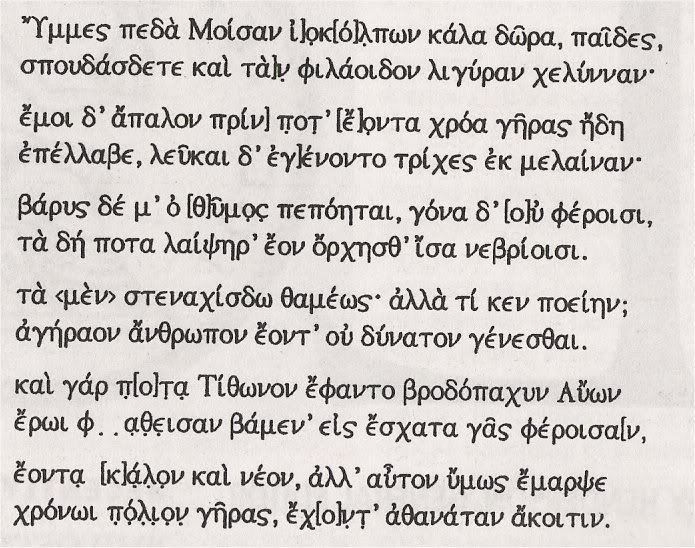
Cheers to Glaukôpidos.
Xenophon's Symposium
"But it seems to me that the works of gentlemen [of good and noble men]--and not only their serious dealings, but even the playful ones--are worthy of discourse. I wish to explain an experience which supports this.
"At the time of the horse-races of the greater Pan-Athenian games, Kallias, the son of Hipponicos, and lover, as it happened, of the boy Autolycos, who was the winner of the pankration [catch-as-catch-can], brought the boy to the spectacle. When the horse-races ended, he continues along with Autolycos and his father towards the house near the Peiraian harbor, and Nikaratos accompanies them.
"He sees a group, namely, Sokrates and Kritobolos and Hermogenes and Antisthenes and Charmides, and arranges for someone to show Autolycos and the others the way, himself turning about to Sokrates and his party, and says, 'A noble meeting! For I intend to hold a banquet for Autolycos and his father. I believe much more magnificence will be brought to my arrangement by men whose souls are cleansed than by generals or horsemen or office-seekers.'
"And Sokrates says, 'You always laugh at us, since you have sacrificed a good deal of silver to Protagoras for wisdom--yes, and Gorgias and Prodikos, and many others--and think poorly of us homegrown philosophers.'
"And Kallias: 'Indeed, formerly, I fancied, I hid from you just how much wisdom I had to tell; now, however, if you go with me I shall eagerly display to you all my worth.'"
The opening is pure Xenophon. For him, being a gentleman [kalos kagathos] is the end to which all men aspire. Therefore, any and all doings of gentlemen are worthy to be discussed and imitated. The extreme end of this is Xenophon's own On Household Management, where a thinly disguised author holds forth on the beauty of pots and pans carefully arranged. Contrast Socrates, with his interest not just in gentlemen, but in all men. Shoemakers, prostitutes, sophists, slaves: all, for Socrates, are people to talk with, even (and perhaps especially) on the most elevated subjects.
Xenophon is at heart an elitist, believing that some men (and he includes Socrates) are better than others, both by nature and by law. Thus, the "works of gentlemen", here "kalos kagathos andron". The "andron" is unsurprising. Xenophon, like any number of Greek philosophers, had a dim view of women, and his wife must either have been completely cowed by her heroic husband, or else viewed him as a colossal bore. Probably both.
But the "playful" side of things is one that Plato seems to have forgotten in his dialogues. There's a good deal of sniggering over sex, and punning, but the scene of Socrates and others relaxed on their couches, with any attempt at serious discussion--note how Socrates promptly brings up wisdom, and Kallias derails him just as quickly--being half-hearted at best, is absent from Plato. There's an ease of manner to Xenophon's characters, a sense of being gentlemen among gentlemen, with none of the ferocity of Plato's inquiries. While Xenophon's Socrates lacks the mystic qualities of Plato's (and in Plato's accounts one is almost ready to believe that Socrates himself was a daimon), he has a grounded quality that I find immeasurably attractive.
Kierkegaard, in The Concept of Irony, makes an excellent point in comparing Xenophon and Plato. "When Alcibiades tells us in the [Plato's] Symposium that he has never seen Socrates drunk, he is also suggesting that this was an impossibility for Socrates, as we do in fact in the [Plato's] Symposium see him drink everybody else under the table. Xenophon, of course, would have explained this by saying that he never transgressed the quantum satis of an experientially tried and tested rule." Plato compares Socrates to Silenus; it would not have occured to Xenophon to compare him to anything at all.
Kierkegaard has a lot of (accurate) abuse for Xenophon in The Concept of Irony, mostly because Xenophon lacked an appreciation for Socrates' ironical statements. There's no middle ground for Xenophon, no double meanings or insoluble grey areas. His every thought is relentless vivisected, labeled, and stored away against its need, just like his pots and pans, and generally quite as commonplace. Xenophon lacks irony, and, sadly, lacks poetry, too1.
What Xenophon does offer is a view of Socrates unobscured by Platonic alterations. His Socrates is earthy, pleasant, amusing, and clever. Xenophon saw Socrates not as a near-divine teacher, but as a friend.
Xenophon's invocation of empirical proof is also typical of him. For him the final determination is whether a thing works in real--i.e. either public or private--life. He demands evidence where Plato demands thought.
His characters are sketched precisely, and their personalities are clear the moment that the open their mouths. At this, he equals or surpasses Plato, although, to be fair, Plato is trying to accomplish something rather different. Xenophon wants to show how it was; Plato wants to show how it ought to be.
In short, I read Xenophon for clarity, not depth. More later, whether you like it or not.
1 Which is at least part of the reason I chose to translate him. My Greek is lousy, and it's nice to have someone who uses straightforward constructions and, for some reason, refuses all offers of synonyms. I heartily recommend him to anyone wishing to regain lost Greek proficiency. He might have been written for just that purpose. I like Xenophon, but don't value him nearly as highly as Thomas Jefferson did. Jefferson felt that Xenophon's was the only genuine account of Socrates. Jefferson was a great politician, but an abysmal philosopher.
"But it seems to me that the works of gentlemen [of good and noble men]--and not only their serious dealings, but even the playful ones--are worthy of discourse. I wish to explain an experience which supports this.
"At the time of the horse-races of the greater Pan-Athenian games, Kallias, the son of Hipponicos, and lover, as it happened, of the boy Autolycos, who was the winner of the pankration [catch-as-catch-can], brought the boy to the spectacle. When the horse-races ended, he continues along with Autolycos and his father towards the house near the Peiraian harbor, and Nikaratos accompanies them.
"He sees a group, namely, Sokrates and Kritobolos and Hermogenes and Antisthenes and Charmides, and arranges for someone to show Autolycos and the others the way, himself turning about to Sokrates and his party, and says, 'A noble meeting! For I intend to hold a banquet for Autolycos and his father. I believe much more magnificence will be brought to my arrangement by men whose souls are cleansed than by generals or horsemen or office-seekers.'
"And Sokrates says, 'You always laugh at us, since you have sacrificed a good deal of silver to Protagoras for wisdom--yes, and Gorgias and Prodikos, and many others--and think poorly of us homegrown philosophers.'
"And Kallias: 'Indeed, formerly, I fancied, I hid from you just how much wisdom I had to tell; now, however, if you go with me I shall eagerly display to you all my worth.'"
The opening is pure Xenophon. For him, being a gentleman [kalos kagathos] is the end to which all men aspire. Therefore, any and all doings of gentlemen are worthy to be discussed and imitated. The extreme end of this is Xenophon's own On Household Management, where a thinly disguised author holds forth on the beauty of pots and pans carefully arranged. Contrast Socrates, with his interest not just in gentlemen, but in all men. Shoemakers, prostitutes, sophists, slaves: all, for Socrates, are people to talk with, even (and perhaps especially) on the most elevated subjects.
Xenophon is at heart an elitist, believing that some men (and he includes Socrates) are better than others, both by nature and by law. Thus, the "works of gentlemen", here "kalos kagathos andron". The "andron" is unsurprising. Xenophon, like any number of Greek philosophers, had a dim view of women, and his wife must either have been completely cowed by her heroic husband, or else viewed him as a colossal bore. Probably both.
But the "playful" side of things is one that Plato seems to have forgotten in his dialogues. There's a good deal of sniggering over sex, and punning, but the scene of Socrates and others relaxed on their couches, with any attempt at serious discussion--note how Socrates promptly brings up wisdom, and Kallias derails him just as quickly--being half-hearted at best, is absent from Plato. There's an ease of manner to Xenophon's characters, a sense of being gentlemen among gentlemen, with none of the ferocity of Plato's inquiries. While Xenophon's Socrates lacks the mystic qualities of Plato's (and in Plato's accounts one is almost ready to believe that Socrates himself was a daimon), he has a grounded quality that I find immeasurably attractive.
Kierkegaard, in The Concept of Irony, makes an excellent point in comparing Xenophon and Plato. "When Alcibiades tells us in the [Plato's] Symposium that he has never seen Socrates drunk, he is also suggesting that this was an impossibility for Socrates, as we do in fact in the [Plato's] Symposium see him drink everybody else under the table. Xenophon, of course, would have explained this by saying that he never transgressed the quantum satis of an experientially tried and tested rule." Plato compares Socrates to Silenus; it would not have occured to Xenophon to compare him to anything at all.
Kierkegaard has a lot of (accurate) abuse for Xenophon in The Concept of Irony, mostly because Xenophon lacked an appreciation for Socrates' ironical statements. There's no middle ground for Xenophon, no double meanings or insoluble grey areas. His every thought is relentless vivisected, labeled, and stored away against its need, just like his pots and pans, and generally quite as commonplace. Xenophon lacks irony, and, sadly, lacks poetry, too1.
What Xenophon does offer is a view of Socrates unobscured by Platonic alterations. His Socrates is earthy, pleasant, amusing, and clever. Xenophon saw Socrates not as a near-divine teacher, but as a friend.
Xenophon's invocation of empirical proof is also typical of him. For him the final determination is whether a thing works in real--i.e. either public or private--life. He demands evidence where Plato demands thought.
His characters are sketched precisely, and their personalities are clear the moment that the open their mouths. At this, he equals or surpasses Plato, although, to be fair, Plato is trying to accomplish something rather different. Xenophon wants to show how it was; Plato wants to show how it ought to be.
In short, I read Xenophon for clarity, not depth. More later, whether you like it or not.
1 Which is at least part of the reason I chose to translate him. My Greek is lousy, and it's nice to have someone who uses straightforward constructions and, for some reason, refuses all offers of synonyms. I heartily recommend him to anyone wishing to regain lost Greek proficiency. He might have been written for just that purpose. I like Xenophon, but don't value him nearly as highly as Thomas Jefferson did. Jefferson felt that Xenophon's was the only genuine account of Socrates. Jefferson was a great politician, but an abysmal philosopher.
Friday, June 24, 2005
Still worse, it is backwards to adopt a searching standard of constitutional review for nontraditional property interests, such as welfare benefits, see, e.g., Goldberg, supra, while deferring to the legislature’s determination as to what constitutes a public use when it exercises the power of eminent domain, and thereby invades individuals’ traditional rights in real property. The Court has elsewhere recognized “the overriding respect for the sanctity of the home that has been embedded in our traditions since the origins of the Republic,” Payton, supra, at 601, when the issue is only whether the government may search a home. Yet today the Court tells us that we are not to “second-guess the City’s considered judgments,” ante, at 18, when the issue is, instead, whether the government may take the infinitely more intrusive step of tearing down petitioners’ homes. Something has gone seriously awry with this Court’s interpretation of the Constitution. Though citizens are safe from the government in their homes, the homes themselves are not. Once one accepts, as the Court at least nominally does, ante, at 6, that the Public Use Clause is a limit on the eminent domain power of the Federal Government and the States, there is no justification for the almost complete deference it grants to legislatures as to what satisfies it.I leave it to those more qualified than I to comment on the legal fallout of Kelo v. New London (the link is to Justice Thomas' dissent). I will simply gnash my teeth.
UPDATE: An excellent point:
The worth of a thing can only be established by the price for which two parties are willing to transact in that thing at a particular time. If one of the parties is being forced to enter the transaction, then by definition the price he is being paid is less than it is worth to him. Namely, he’s getting ripped off. The whole lynchpin of eminent domain is that certain circumstances warrant ripping people off in that manner in the interest of serving a sufficiently important goal. Society does what it can to compensate the ripped-off individuals, but they are not being paid what their land is actually worth.
Sullen silence was taken for rapt attention, and gave him greater room to talk; sharp answers were received as smart sallies of girlish vivacity, that only required an indulgent rebuke; and flat contradictions were but as oil to the flames, calling forth new strains of argument to support his dogmas, and bringing down upon me endless floods of reasoning to overwhelm me with conviction.Anne, dearest, you know how fond I am of you, and if I had a giant robot army you might have half, but, for Heaven's sake, joy, why such metaphors?
Hem, hem. Given the rather artificial nature of clan tartans, but still following in such traditions as may be gleaned, it seems to me that attendants, should they wear kilts, ought to be dressed in the tartan of he whom they are attending.
Pictorial evidence also comes to its aid, for the first person to be painted wearing a recognizable modern kilt, not a belted plaid, appears in a portrait of Alexander MacDonell of Glengarry, the son of the chief who was Rawlinson’s friend. It is interesting to note that, in that portrait, the kilt is worn not by the chief but by his servant- thus emphasizing, once again, its ‘servile’ status.They are, after all, acting as members of the household, however temporarily.
Ankh ankh, en mitak/ Yewk er heh en heh! I should be remiss not to mention a third distinct pleasure from opera: bits of it are hilarious. To paraphrase Oscar Wilde, one must have a heart of stone to listen to the Funeral of Amenhotep III without giggling. And I say this as someone who liked Akhnaten.
And not just the unintentional bits! Ariadne Auf Naxos made me snort milk out my nose the first time I heard it. (Although I have a revised version of the actual opera section. See, the original Ariadne gets so upset that she storms off in a huff, leaving only the Composer to fill the role (so the character is now a woman dressed as a boy dressed as a woman). Ariadne and the comedy are still performed simultaneously, but Zerbinetta keeps getting the Composer/Ariadne all hot and bothered, culminating in an aria in which he (the Composer) sings of love and death, but she (Zerbinetta) keeps adding words to make it absolutely filthy. Bacchus descends but is abducted by Harlequin et al. He keeps rushing onto stage trying to sing with Ariadne and getting pulled off just before they can reach musical consummation. In the end Zerbinetta has her way with the Composer on stage, thus representing the reconciliation of the tragic and comedic impulses in mankind. Harlequin et al., Bacchus, and the Music Teacher come out to form a human curtain in front of the two, and sing of this happy day, rising in volume as necessary when Zerbinetta and the Composer start making too much of a ruckus. What? I have low tastes.)
And not just the unintentional bits! Ariadne Auf Naxos made me snort milk out my nose the first time I heard it. (Although I have a revised version of the actual opera section. See, the original Ariadne gets so upset that she storms off in a huff, leaving only the Composer to fill the role (so the character is now a woman dressed as a boy dressed as a woman). Ariadne and the comedy are still performed simultaneously, but Zerbinetta keeps getting the Composer/Ariadne all hot and bothered, culminating in an aria in which he (the Composer) sings of love and death, but she (Zerbinetta) keeps adding words to make it absolutely filthy. Bacchus descends but is abducted by Harlequin et al. He keeps rushing onto stage trying to sing with Ariadne and getting pulled off just before they can reach musical consummation. In the end Zerbinetta has her way with the Composer on stage, thus representing the reconciliation of the tragic and comedic impulses in mankind. Harlequin et al., Bacchus, and the Music Teacher come out to form a human curtain in front of the two, and sing of this happy day, rising in volume as necessary when Zerbinetta and the Composer start making too much of a ruckus. What? I have low tastes.)
Omniscience, Opera, and Where's My Cake? I've been listening to L'Orfeo of late, which is the sort of thing I do so that I can act like a pompous ass, chattering about toccati and so forth at cocktail parties. Which I don't attend, but the principle still applies. Generally when I confess an interest in opera I get one of two responses:
"So, do you really like that sort of stuff?" or
"Kill the wabbit! Kill the wabbit!"
Which is all well and good so far as it goes. Yes, I really do; no, I'm not terribly musical (which is why I find many other 'classical' works dull). Well, yes, it does take a little effort to "get into it", like any other area of study worth of the name (previous discussion), but I'm living proof that, firstly, it doesn't take much to start, and, secondly, that once one is hooked investigation becomes a pleasure rather than a necessity.
L'Orfeo certainly rewards both passing acquaintance and (presumably) in-depth analysis. In addition to the obvious pleasure of astonishingly beautiful music, there's the pleasure of hindsight. Even I can hear the seeds of great opera to come. Now one hears a convention which Mozart will transcend, now, the conflict between drama and music that Wagner will either heal or irreversibly escalate, depending on who one talks to. I can pretend, from my privileged position four centuries after, to an omniscience which is refused me in daily life. That pleasure of looking back and seeing the evolution of music laid out before me, of, thanks to the wonders of time, being able to follow the great composers in their thoughts, should not be underrated.
L'Orfeo also rewards a fresh listener. It is a shocking work, a new thing in music (or nearly so), a piece without a category. It is impossible for me to understand, listening to it, why the first audience did not burn down their city. To something so unprecedented I cannot imagine any response except fire, and lots of it.
I don't mean in a destructive sense, but just that L'Orfeo can be so overwhelming that any response can seem inadequate. In The Descent, by Jeff Long, there's ascene where Satan kills a fellow by sticking his hand in the fellow's chest cavity and pinching closed a vein. The dying fellow reflects that it doesn't hurt: it's such an alien sensation that he has no response to it. L'Orfeo is like that. It astonishes. Which is no small pleasure.
The terrible thing is that this pleasure is incompatible with the pretense of omniscience I mentioned. If I listen to it as something unprecedented, I'm not allowed my omniscience view. If I'm omniscience, necessarily I am seldom surprised. I can either interact with it immediately, or through the lens of time. Of course, in any one listening I have both pleasures, though at different points in the opera. But what I really want is the joy of discovery along with the pleasure of foreknowledge.
"So, do you really like that sort of stuff?" or
"Kill the wabbit! Kill the wabbit!"
Which is all well and good so far as it goes. Yes, I really do; no, I'm not terribly musical (which is why I find many other 'classical' works dull). Well, yes, it does take a little effort to "get into it", like any other area of study worth of the name (previous discussion), but I'm living proof that, firstly, it doesn't take much to start, and, secondly, that once one is hooked investigation becomes a pleasure rather than a necessity.
L'Orfeo certainly rewards both passing acquaintance and (presumably) in-depth analysis. In addition to the obvious pleasure of astonishingly beautiful music, there's the pleasure of hindsight. Even I can hear the seeds of great opera to come. Now one hears a convention which Mozart will transcend, now, the conflict between drama and music that Wagner will either heal or irreversibly escalate, depending on who one talks to. I can pretend, from my privileged position four centuries after, to an omniscience which is refused me in daily life. That pleasure of looking back and seeing the evolution of music laid out before me, of, thanks to the wonders of time, being able to follow the great composers in their thoughts, should not be underrated.
L'Orfeo also rewards a fresh listener. It is a shocking work, a new thing in music (or nearly so), a piece without a category. It is impossible for me to understand, listening to it, why the first audience did not burn down their city. To something so unprecedented I cannot imagine any response except fire, and lots of it.
I don't mean in a destructive sense, but just that L'Orfeo can be so overwhelming that any response can seem inadequate. In The Descent, by Jeff Long, there's ascene where Satan kills a fellow by sticking his hand in the fellow's chest cavity and pinching closed a vein. The dying fellow reflects that it doesn't hurt: it's such an alien sensation that he has no response to it. L'Orfeo is like that. It astonishes. Which is no small pleasure.
The terrible thing is that this pleasure is incompatible with the pretense of omniscience I mentioned. If I listen to it as something unprecedented, I'm not allowed my omniscience view. If I'm omniscience, necessarily I am seldom surprised. I can either interact with it immediately, or through the lens of time. Of course, in any one listening I have both pleasures, though at different points in the opera. But what I really want is the joy of discovery along with the pleasure of foreknowledge.
Eva Brann's new book.
Open Secrets / Inward Prospects is a book of thoughts of one who thinks about everything. Such a person has a fascinating double life, says Tutor Brann, one implicit like us and the other explicit for people like her. Her life is not apart from ours but layered over it. Philosophy for her is not a profession with its own methods, its own lingo, its own ethics abstracted from ordinary life. The philosopher looks at everything, and especially at everything human, but she sees better than the rest of us living with the same things. Visiting Colonial Williamsburg, for example, she ponders the fact that the guides dressed in period costume must have on modern underwear. Considering archaeological museums, she wonders about the confusion of future archaeologists when they dig in the dust of our civilization: Won't they mix up our pots--the ones we made--with those we dug?Via Arts and Letters Daily.
Thursday, June 23, 2005
Uh-HUH.
NEW YORK (CNN/Money) - Country Music Television has selected its first "vice president" for the Dukes of Hazzard Institute. The first task for the New York-based executive: Upgrade the Institute's new facilities.
In other words, get cable and a new TV set for his apartment.
Yes, Christopher Nelson's new job, which comes with a $100,000 salary and a one-year contract, will be to watch reruns of "The Dukes of Hazzard" weeknights on the Country Music Television cable channel and write blog postings for the network's Web site.
The Cosmos solar sail has come unstuck in space.
With failure of Cosmos 1 virtually certain, the team members that have been staffing Project Operations Pasadena have elected to return to their homes. Thanks to the Internet, if our spacecraft miraculously reappears, each of us will still be able to keep watch over the mission from our individual remote locations. Greg returns to Berkeley, Jim and Brent to Utah, and Paul to his usual life at the Jet Propulsion Lab, just up the valley from Pasadena. Lou will be returning from Moscow in a couple of days. I took off for home a couple of hours ago in order to begin to catch up on sleep.If history is any guide (this is the second one they've lost), Kamchatka is the place to start looking.
I've been neglecting you all most shamefully, right down to the e-mails. I can only hope that you're over at Steve's Blog, learning about moas and Kazakh fashion. I know that latter made me want to take my wife's Godey Paper Dolls, flick paint on them, cut them randomly with pinking shears, and start up a designerie.
Wednesday, June 08, 2005
A Lego Life of Polycarp.
The Quartodecimans explained. (Thus have I always seen their sect spelt.)
Via Eve Tushnet.
The Quartodecimans explained. (Thus have I always seen their sect spelt.)
Via Eve Tushnet.
Richard Strauss, 1864-1949
In November 1933, without any consultation with Strauss, Goebbels appointed him to the post of president of the Reichsmusikkammer, the State Music Bureau. Strauss decided to keep his post but to remain apolitical, a decision which has been criticized as naïve, but perhaps the most sensible one considering the circumstances. Strauss was forced to resign his position in 1935 after refusing to remove from the playbill for Die schweigsame Frau the name of the Jewish librettist, his friend Stefan Zweig.
Friday, June 03, 2005
...of these things, then, as has been said before, it remains for us to determine by what categories and in what order we ought, insofar as it is possible for us to do so, and moreover to the degree to which these things, the present object of our discourse, I mean the previously mentioned ones, allow, as has been said before, to order and categorize these things which were previously mentioned, insofar as they are these things, to the end that we may discourse upon these things not in some arbitrary or unordered way, as though our discourse on these things were a formless mass, as one might, without the discernment necessary to determine how these things might be discussed, whether ordered or unordered or in some third way, in the way given to these things and our discourse by nature or by custom or by some third measure, itself neither the ordering of nature nor that of custom, but either in itself not unordered, though it should seem so to the undiscerning, nor, as has been said before, by nature or custom, but rather that these things which are now the object of previous discourse...
--Aristotle, On Nothing in Particular
--Aristotle, On Nothing in Particular
There is, to the elevated & well-ordered mind, no activity more pleasing, more wholesome, more balancing of the humors, more rarefying of the spirits & more tempering of the soul, than the creation of names for a smock shop.
A Smockwork Orange
Smock Monkey
Lock, Smock, and Barrel
The Smocksmith
Mendacious Smockery
Tick Tock Smocks
If You Can Smock a Leek
Buck Up, Old Smock
Smock and Roll
A Smock of Seagulls
Pippi Longsmocking's
You Mean to Smock Me After
Smockbuster
The Smocktopus
She Groks Smocks
The Smocketeria
Kneesmock Rise
The Love Song of J. Alfred Pru-Smock (I should have been a pair of ragged shears)
Smock and Awe
Teh Smoxx0r
A Smockwork Orange
Smock Monkey
Lock, Smock, and Barrel
The Smocksmith
Mendacious Smockery
Tick Tock Smocks
If You Can Smock a Leek
Buck Up, Old Smock
Smock and Roll
A Smock of Seagulls
Pippi Longsmocking's
You Mean to Smock Me After
Smockbuster
The Smocktopus
She Groks Smocks
The Smocketeria
Kneesmock Rise
The Love Song of J. Alfred Pru-Smock (I should have been a pair of ragged shears)
Smock and Awe
Teh Smoxx0r
Thursday, June 02, 2005
Sunday, May 29, 2005
Yes!
I knew you'd come through, Frenchmen! I knew you (much like us) were better than your media and government.
E.U. aux Enfers!
Hang in there, friends, resist. For my part, I shall eat French cheese, get drunk on French wine, sing the Marsaillaise. Vive Vercingetorix! Vive Ste. Genevieve! Vive St. Gregoire de Tours! Vive Villon! Vive Montaigne! Vive Racine! Vive Rameau! Vive Henri Fabre! Vive la France liberee!
I knew you'd come through, Frenchmen! I knew you (much like us) were better than your media and government.
E.U. aux Enfers!
Hang in there, friends, resist. For my part, I shall eat French cheese, get drunk on French wine, sing the Marsaillaise. Vive Vercingetorix! Vive Ste. Genevieve! Vive St. Gregoire de Tours! Vive Villon! Vive Montaigne! Vive Racine! Vive Rameau! Vive Henri Fabre! Vive la France liberee!
Saturday, May 28, 2005
Also found when I was bouncing about the web, this time for Brontë related material: Wuthering Heights, the role-playing game. I can do no better service to the game than to reproduce the disclaimer:
DisclaimerAn excellent review points out some interesting traits:
In all the rules, the male gender (he, his, etc.) will be used for our examples. This of course implies the game is not suited for the feeble minds of our ladies.
This work deals with such themes as Suicide , Despair , homosexuality & socialism for the sole purpose of entertainment.
No animals, nor children were knowingly hurt during the playtests of the game.
Rage and Despair are pretty labile; they go up or down all the time, depending on events that affect the character. The GM often rolls d10/2 and assigns a loss or gain, and these in themselves may prompt acts. For instance, if you lose 5 or more Despair at once, you suffer from a fit of joy, which of course is usually seized upon by the player as an opportunity to do something the character is going to regret.
The implications are hilarious and lead to great role-playing, both in the sense of histrionics and in the sense of driving plot events. I especially like the following:
1) In order to be sincere, one must roll beneath his Despair. Think about it. This means that in order to LIE, no roll is necessary; i.e., hypocrisy is the default behavior. It also means that the only reason one DOESN'T lie is because he "just doesn't care anymore," momentarily. That is just too funny.
2) Upon losing or gaining a lot of either Rage or Despair, extreme actions are required. Afterwards, you gain (or lose) a bit back. Without going into the math, there's a small chance that the amount gained back actually prompts the extreme effect of the reverse emotion! This is not likely to happen very often, but when it does, you get the most outrageous see-sawing mood swings. It's definitely worth the wait.
3) Suicide isn't ever required through the system, but it seems perfectly reasonable in a grotesque literary fashion, now and then. The "nipping off to kill myself now" announcement isn't to be found in any other RPG I can think of. The really fun part is not being able to figure out what's more depressing, success or failure.
From Present Simple comes the story of a man, his dream, and the skull-drilling that made that dream reality.
Something I meant to mention earlier, but then I vanished:
The 11th Annual Interactive Fiction Contest.
>click link
You click the link. A new page opens.
>read page
I don't understand.
>get page
You cannot get the page.
>look page
The page contains information regarding the 11th Annual Interactive Fiction Contest. Why don't you create your own parser and join in?
The 11th Annual Interactive Fiction Contest.
>click link
You click the link. A new page opens.
>read page
I don't understand.
>get page
You cannot get the page.
>look page
The page contains information regarding the 11th Annual Interactive Fiction Contest. Why don't you create your own parser and join in?
The idea that kitchen knives might be banned as potential weapons was, at one time, parody. Sadly, that farce has begun its slow evolution into policy.
This is not the first vilification of knives. After James Bowie's famous Duel on the Sandbar, his weapon was denounced as far too dangerous. A pistol, it was argued, might miss; a sword could be parried; but there was no defense against Jim Bowie's knife.
I mention all of this as prelude to the 6 1/2 foot folding knife I found trying to learn more about the attempt to ban bowie knives. Really, the absurdity of a ban on kitchen knives is so evident that I can't think of anything political to say.
I do wonder, though, if this future ban will apply to the kirpan which Sikhs wear. If so, I see serious conflict ahead. And I, for one, know enough history to know not to mess with the Sikhs.
This is not the first vilification of knives. After James Bowie's famous Duel on the Sandbar, his weapon was denounced as far too dangerous. A pistol, it was argued, might miss; a sword could be parried; but there was no defense against Jim Bowie's knife.
I mention all of this as prelude to the 6 1/2 foot folding knife I found trying to learn more about the attempt to ban bowie knives. Really, the absurdity of a ban on kitchen knives is so evident that I can't think of anything political to say.
I do wonder, though, if this future ban will apply to the kirpan which Sikhs wear. If so, I see serious conflict ahead. And I, for one, know enough history to know not to mess with the Sikhs.
Of course, proving things has gone out of style. And why not? Who needs to understand something when we can just manipulate it? Why should we look for perfection when good enough is right here? And so easy, too. It's not like the Greeks accomplished anything with their "proofs".
Via, some time ago, Arts and Letters Daily.
Via, some time ago, Arts and Letters Daily.
This week: further Hollow Earth. Next week: Odylic fluid v. Orgone energy!
As was pointed out in the comments by Mr. Hardy, of Laputan Logic fame, the theory that the force of gravity experienced by we terrestrial mites is in fact the centrifugal force of a spinning earth fails to explain why gravity at the poles (or whatever axis one chooses) is not appreciably weaker than elsewhere. I confess that I find this objection to the Hollow Earth theory insurmountable, so long as gravitational pull is so explained.
However, and most unfortunately for everyone who wants to talk about something else, there's another option. Without abandoning the Hollow Earth theory, we can simply adjust every vector in the universe to fit our plan. We can perform an inversion.
The basic geometry follows this plan. Let there be created a circle with center A (Euclid, Book I, Postulate 3, and I'm not citing anymore) Let point B be taken on the circle. Let point C be taken anywhere on line AB. Let line AB be extended to point D, such that AC:AB :: AB:AD. Thus, the rectangle AC, AD is equal to the square on AB.
It is evident that, given point C, point D can always be found, and vice versa. The practical application is that, for any point inside the circle, a corresponding point outside the circle can be found. Moreover, we find that as we approach the center of the circle, the behavior is as if, in our alternate hypothesis, we were moving outwards to any given length. Thus, any attempt to disprove the Hollow Earth theory would by flying to the other side of the Earth would fail. The appearance would be that of nearly limitless space, but the reality (from our Hollow Earth perspective) is that space is smaller near the center of the Hollow Earth.
The further one moves away from the outer edge (the Utter East, so to speak) which seems to us to be the surface of the Earth, the more effort it takes to move the same distance. At the center, assuming that the universe is unbounded, time and space cease entirely. The degree of curvature of the universe might be found by determining the extent to which one slowed at the center of the sphere, and how long it took one to reach the opposite edge of the earth. This is, unfortunately, exactly as impractical as, say, throwing a baseball out into space and waiting for it to hit oneself in the back of the head to find out how large the universe is.
Drilling through is no help. One does not "break through" the Earth's crust. Rather, as point D moves to infinited, the drill would "flip" and begin boring through the other side of the Earth. In this model of the Hollow Earth, rather than a shell of rock with space beyond it, we have the universe within a solid mass of rock which goes to infinity (which, of course, corresponds in the Solid Earth model to the Earth's center).
We can invert every law of nature the same way if we choose. There is, I think, no hope that we can finally lay the Hollow Earth theory to rest without invoking first principles.
I must acknowledge the great debt I owe to Martin Gardner and his book, On the Wild Side, for much of this post.
As was pointed out in the comments by Mr. Hardy, of Laputan Logic fame, the theory that the force of gravity experienced by we terrestrial mites is in fact the centrifugal force of a spinning earth fails to explain why gravity at the poles (or whatever axis one chooses) is not appreciably weaker than elsewhere. I confess that I find this objection to the Hollow Earth theory insurmountable, so long as gravitational pull is so explained.
However, and most unfortunately for everyone who wants to talk about something else, there's another option. Without abandoning the Hollow Earth theory, we can simply adjust every vector in the universe to fit our plan. We can perform an inversion.
The basic geometry follows this plan. Let there be created a circle with center A (Euclid, Book I, Postulate 3, and I'm not citing anymore) Let point B be taken on the circle. Let point C be taken anywhere on line AB. Let line AB be extended to point D, such that AC:AB :: AB:AD. Thus, the rectangle AC, AD is equal to the square on AB.
It is evident that, given point C, point D can always be found, and vice versa. The practical application is that, for any point inside the circle, a corresponding point outside the circle can be found. Moreover, we find that as we approach the center of the circle, the behavior is as if, in our alternate hypothesis, we were moving outwards to any given length. Thus, any attempt to disprove the Hollow Earth theory would by flying to the other side of the Earth would fail. The appearance would be that of nearly limitless space, but the reality (from our Hollow Earth perspective) is that space is smaller near the center of the Hollow Earth.
The further one moves away from the outer edge (the Utter East, so to speak) which seems to us to be the surface of the Earth, the more effort it takes to move the same distance. At the center, assuming that the universe is unbounded, time and space cease entirely. The degree of curvature of the universe might be found by determining the extent to which one slowed at the center of the sphere, and how long it took one to reach the opposite edge of the earth. This is, unfortunately, exactly as impractical as, say, throwing a baseball out into space and waiting for it to hit oneself in the back of the head to find out how large the universe is.
Drilling through is no help. One does not "break through" the Earth's crust. Rather, as point D moves to infinited, the drill would "flip" and begin boring through the other side of the Earth. In this model of the Hollow Earth, rather than a shell of rock with space beyond it, we have the universe within a solid mass of rock which goes to infinity (which, of course, corresponds in the Solid Earth model to the Earth's center).
We can invert every law of nature the same way if we choose. There is, I think, no hope that we can finally lay the Hollow Earth theory to rest without invoking first principles.
I must acknowledge the great debt I owe to Martin Gardner and his book, On the Wild Side, for much of this post.
Thursday, May 26, 2005
'Is it that they think it a duty to be continually talking,' pursued she, 'and so never pause to think, but fill up with aimless trifles and vain repetitions, when subjects of real interest fail to present themselves? - Or do they really take a pleasure in such discourse?'
'Very likely they do,' said I: 'their shallow minds can hold no great ideas, and their light heads are carried away by trivialities that would not move a better furnished skull; - and their only alternative to such discourse is to plunge head and ears into the slough of scandal - which is their chief delight.'
--Anne Brontë, The Tenant of Wildfell Hall
'Very likely they do,' said I: 'their shallow minds can hold no great ideas, and their light heads are carried away by trivialities that would not move a better furnished skull; - and their only alternative to such discourse is to plunge head and ears into the slough of scandal - which is their chief delight.'
--Anne Brontë, The Tenant of Wildfell Hall
De Laribus1
This post is the result of this article (1 mb .pdf, it's the first one), found when I was cruising Hardscrabble Creek. The article, "That's the Title on the Manifesto: Labor and Class Concerns in Harry Potter" is charming, and deserves a look, but I felt that it missed an important point.The slavery of the house-elves is disturbing to the modern reader because we are accustomed, rightly, to view slavery as an unalloyed evil. Thus, presented with the pitiful Dobby wringing his ears and ironing his hands, our sympathies go out to him, and with him his brethren. We find, however, in the Goblet of Fire, and further in the Order of the Phoenix that his fellow house-elves are less enthusiastic than Dobby when presented with the idea of freedom. Dobby is, as Hagrid puts it, a "weirdo". The house-elves of Hogwarts, of whom we see the most, are happy in their servitude, and Hermione's attempts to free them or to help them organise insult them.
There is no Real World counterpart to the house-elves relationship with their masters. They are not paid, nor bought and sold like slaves, nor do they exist as serfs. The house-elves' relationship with their employer is magical, and they are bound to the home, it seems, rather than an individual. Kreacher, for example, haunts the home of the Blacks despite his hatred of Sirius.
J. K. Rowling tells us that the house-elves have their own magic, different from wizards. I suspect that this magic is related to their servitude; indeed, I suspect that the house-elves' powers date back to a ancient, possibly prehistoric pact, something like the "old magic" which protects Harry while he is living with a relative.
(As a side note, I should mention that this sort of "old magic" occupies a different sphere from the rather mechanical school Latin and wand-swishing which the students at Hogwarts are taught. It is the same difference one finds between Xerxes in Roverandom, who is "quite a good magician [of the conjuring magic sort]" (the bracketed section was cut from the final draft), and Psamathos Psamathides, who is entirely other. Given J. K. Rowling's difficulty portraying the numinous, it is unsurprising to find both this hypothesized pact and the "old magic" itself rarely and perfuctorily described.)
To return: the house-elves don't care to advance within or destroy entirely the "class structure" in which they find themselves.
Ms. Wendy Alicia Felicity Green Stengel proposes that "[t]he four castes in Indian culture map neatly onto the classes in Harry Potter", and further that the wizards which we are meant to view sympathetically--Hagrid, Ron, etc.--who are uninterested or opposed to freeing the house-elves, are themselves products of this class structure, which shapes their thinking. She identifies the house-elves with the Sudra, the "Servants and Laborers".
From this interpretation she draws the obvious conclusion. If the class structure is like that of the Indian caste system, and if the wizarding world reinforces it at every turn, there can be no other option but revolution.
The fundamental error is, I believe, neatly capsulated in this paragraph:
And, if one does consider class, race, and caste as equivalent, we can discern how the Weasleys and Hagrid can be sympathetic and yet not be engaged in elf-rights: brethren or no, they simply do not see a common bond of humanity between themselves and the house-elves.This is a curt dismissal of what seems to me an interesting point. The house-elves are not, in fact, human. In her haste to map caste systems and call for revolution, Ms. Stengel seems to have missed or elided this point."The way the[y] were treating her!" said Hermione furiously. "Mr. Diggory, calling her 'elf' all the time... and Mr. Crouch! He knows she didn't do it and he' still going to sack her! He didn't care how frightened she'd been, or how upset she was--it was like she wasn't even human!"Ron, however, is a product of his class, and shares the common class views.
"Well, she's not," said Ron.
Hermione rounded on him.
That doesn't mean she hasn't got feeling, Ron. It's disgusting." (GoF, 139)
In the Real World, slavery is always wrong. In what does this wrongness consist? It is in the violation of the nature of the person who is the slave. We have discovered that no one has a "slavish nature". To be self-determining is a quality which belongs to all people, no matter their economic, social, or class standings. As such, we naturally view all class structures (except possibly aristocracy in its original sense) as social creations and further as wicked. Class is an artificial and indefensible barrier, goes our thought, since we hold that all men are created equal. We see the house-elves, who are rational beings, held in apparent bondage, and are revolted. We desire to free them, just as Hermione does, and when they protest we claim that they must be "uneducated and brainwashed". This conclusion is, so far as I can tell, Ms. Stengel's.
Aristotle's defense of just slavery in the Politics:
It is possible, then, in the manner we are speaking, to start by speculating on the despotic rule and the political rule in animals, for the rule of the soul over the body is despotic, whereas the rule of the intellect over desire is political or royal; and it is eveident from these examples that the rule over the body by the soul is according to nature and is beneficial, and so is the rule over the passionate part of the soul by the intellect and by the part that has reason, but that the rule of both parts alike or by the inferior part is harmful to all. Again, similar remarks hold true among men and the other animals; for tame animals have a better nature than wild animals, and among tame animals the rule by men is better for their safety. Further, of the sexes, the male is by nature superior to the female, and it is for the male to rule and the female to be ruled.The house-elves might well possess this nature. Their happiness in servitude may not be contentment stemming from their "brainwashing", but the happiness that comes from fulfilling one's nature. Hermione plots to free the house-elves; Ms. Stengel calls for a revolution. The house-elves have shown no interest in either.
Among men as a whole, too, the same must be the case. Those differing from others as much as the body does from the soul or brutes do from men (they are so disposed that their best function is the use of their bodies) are by their nature slaves, and it is better for them to be ruled despotically, as indeed it is for the inferiors in the cases already mentioned. For a slave is by nature a man who can belong to another (and for this reason he does belong to another) and who can participate in reason to the extent of apprehending it but not possessing it; for the animals other than men cannot apprehend reason but serve their passions....
It is evident, then, that it is by nature that some men are slaves but others are freemen, and that it is just and to the benefit of the former to serve the latter.
Naturally, even if the house-elves do possess a servile nature, the relationship between servant and master may well go wrong. Dobby is horribly abused in the Malfoys' home. Kreacher is warped by his time spent serving the Blacks. But these examples of the servant/master relationship gone wrong do not prove that such wrongness is inherent in the relationship. When Dumbledore calls the fountain of Magical Brethren a lie, it may be that he is not suggesting revolution but reform: a return from the extreme of a slave/oppressor relationship not into the opposing extreme of ochlocracy, but to the mean of servant/master. If the house-elves do indeed have a servile nature, the revolution would not simply be unwelcome but harmful.
House-elves need not have any earthly relation with the "proletariat" as we understand it. The "caste system" which includes the house-elves may not be a social creation but a metaphysical fact. J. K. Rowling is under no ethical burden to "free" them, and thus far I have seen little evidence that she will.
There are other interpretations. I am fond of a quasi-libertarian one, in which the house-elves are immortal and have pledged their service to various houses, acting as free agents, in exchange for the powers they possess. In this case Dobby's mistreatment is a breach of contract, and calls for reform within the system, rather than a revolution of it. This is just speculation; i.e. I am drinking now.
But really, it seems to me that if I can suspend my disbelief for the system of physical laws governing the world of Harry Potter, I can at least try not to impose our world's philosophical laws on it.
The real question is, is it wrong to create an inherently servile rational species? I suggest this less as a creation myth for house-elves than as a serious ethical dilemma with which we shall have to deal in our lifetimes. I am reminded of the suicidal cow in the Restaurant at the End of the Universe... and I wouldn't eat a house-elf, either.
1 "People called Roman they go the 'ouse?!"
Subscribe to:
Posts (Atom)