Huchen and taimen appetites have also found their way into folklore. Ainu stories from Japan’s northern island of Hokkaido speak of monstrous taimen (known as chirai in Ainu) large and voracious enough to eat deer, bear, and humans whole. In Mongolia, legend tells of an especially harsh winter when starving herdsmen discovered a giant taimen trapped in river ice. Relieved to find food, the herdsmen chopped off pieces of its flesh. They survived the winter, but when the river ice melted in spring, the giant taimen came onto the land, tracked them down, and ate them all.
Showing posts with label Central Asia. Show all posts
Showing posts with label Central Asia. Show all posts
Thursday, April 20, 2023

Tuesday, November 08, 2022
Thursday, August 08, 2019
Teach yourself Sakha. Someone is doing the labor of translating a key Russian test into English. It's remarkable how cognate it is with Turkish for something way out in Siberia.
Tuesday, April 10, 2018
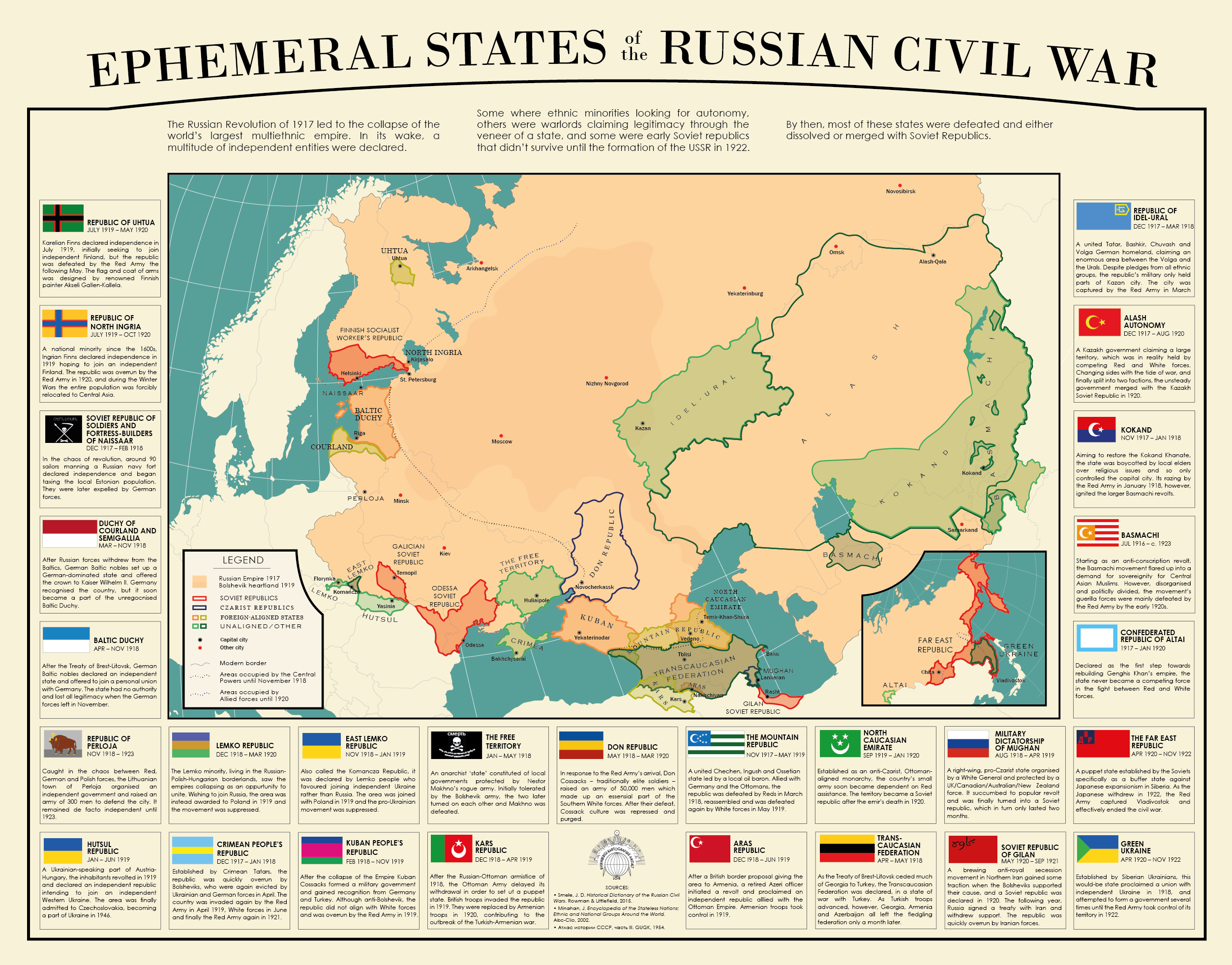
In November 1917, a local oil baron united Chechen, Ingush and Ossetian peoples in a Mountain Republic, allied with Germany. The Republic had the distinction of being defeated by both sides in the Russian civil war – first by the Reds, in March 1918, then by the Whites, in May 1919.Just one of many very obscure and short-lived nations from Russia's civil war. The Republic of Uhtua, the Soviet Republic of Soldiers and Fortress-Builders, Green Ukraine (which was in the Far East), the Confederated Republic of Altai, the list goes on. Some of them had interesting flags too.
Saturday, September 19, 2015
Learn Tuvan with Songs
Great website! It's appealing even if you're not trying to learn Tuvan, but would just like to look at some lyrics and translations to famous throat-singing numbers.
Tuesday, October 07, 2014
Soviet geology: an exotic and romantic business:
Apparently, the composer Giya Kancheli (recommended) came out of such a background.
Large sections of the country were still waiting to be explored and mapped. Foreign travel was still impossible for most Soviets, so idealistic youths were drawn to geology for the thrill of adventure and exploration. Some of them really thought they could find personal freedom, if not by going west, then in the distant corners of the wild east....
They mapped, carried loads of samples, fished and hunted, wrote poetry, drank vodka, and sang songs around the campfire. In fact, many Russian musicians and poets (Nobel laureate Joseph Brodsky included) started out as geologists or worked as technicians in those parties. Few outside of Russia know that it was geologists who started an important movement in modern poetry in St. Petersburg in the 1960s, called the “Geological School.” Furthermore, geologist authors dominated a genre of unofficial, often politically risqué songs (“bard songs”). The songs were about cloud shadows in the tundra, windy mountain passes, shamans and dervishes in time-forgotten villages, apatite [sic..... unless they mean the mineral], camaraderie, lack of cigarettes, and nostalgia for home and love during long field seasons.....
Even until the late 1980s, saying you were a geologist to girls in St. Petersburg was a great pick-up line — often greeted with admiring smiles and questions about exotic places and wild excesses in the field. Yet when I told my father that I was going to become a geologist he said: “Do you want to be one of those inebriated loudmouths with backpacks and guitars who bellow songs on night trains?”
Apparently, the composer Giya Kancheli (recommended) came out of such a background.
Friday, July 04, 2014
Wednesday, October 31, 2012
Steve Bodio's radio interview on An Eternity of Eagles is playing now on our local NPR station, but you can (and should!) listen anytime here. Bateleurs, wolf-hunting Kazakh falconers, wind farm mortality and more!
Sunday, October 21, 2012
Giant elk-shaped geoglyph discovered in the Urals, dating to the 6th-3rd millennium B.C.
Hat tip to Forging the Sampo, who also has some good thoughts and quatations on elk in Finnish folklore and the Kalevala.
Tuesday, September 25, 2012
The phrase "shot with a drone in Pakistan" brought something else to mind, but it's nice to see one of the upsides to drone technology: awesome mountaineering footage. I want one!
Saturday, September 10, 2011
Even more terrible was the Palden Llamo, one of the divine protectors of Buddhism but also a devouring mother who sacrificed her own children. She rode upon a lake of entrails and blood, clutching a cup made from the skull of a child born from incest, her thunderbolt staff ready to smash the unbelievers and her teeth gnawing on a corpse. Her horse's saddle was made from the flayed skin of her own child, who had become an enemy of the faith, and snakes wound through her hair. Like many gods, she bore a crown of five skulls and a necklace of severed heads. Her ostensible purpose was to defend Buddhism against its enemies, and in particular to guard the Dalai Lama, but she must have terrified many true believers as well. The Tibetans considered Queen Victoria to be one of her incarnations.Emphasis mine. Of all the sentences not to have an end-note! From The Bloody White Baron, a biography of the appalling Baron von Ungern-Sternberg: as Steve put it, "one of the most disturbing minor figures of history.... be glad that he is minor."
Thursday, August 25, 2011
Sunday, August 21, 2011
Here is a tidbit from Tony Anderson's (excellent!) Bread and Ashes which will be of interest to fans of Central Asian culture:
*Not too ridiculous a clause, given that this blog does in fact have a few such readers.
The way became very steep and we led the horses, thank God, while Rezo encouraged them with strange Ratchuelian cries of 'Achoo!' and 'Brrr!'....This is of interest because, while the scene is in Ratcha, i.e. the Caucasus of northwest Georgia, anyone who has ridden a horse in Mongolia* will recognize these commands as the Mongol words for "Giddy-up!" and "Whoa!" Perhaps not amazingly surprising, given the central events of Mongol history, but interesting to see it far away and in liguistically very different country.
*Not too ridiculous a clause, given that this blog does in fact have a few such readers.
Sunday, May 08, 2011
The wind hissed as if welcoming usWorst poem ever? Not by a long shot; it's a crowded and competitive field. But Major James Abbot's eulogy to his eponymous town does approach McGonagall territory.
The pine swayed creating a lot of fuss
Wednesday, March 30, 2011
Massive new arch discovered in Afghanistan, one of 14 natural spans in the world over 200 feet. Very cool, even if it does bump Dinosaur National Monument's Outlaw Arch a notch down the list. Complete list of 200'+ arches here.
Friday, February 04, 2011
Kazakh music to brighten up your Friday:
The BBC's Human Planet Explorer site is not recommended if your time is valuable. But it does have Abyssinians fighting off raiding cliff baboons with slings, Shetlanders dressing up as Vikings, among much else.
This, for instance, is bound to go viral. You saw it here first, alas.
Friday, January 28, 2011
Some Himalayan glaciers may be expanding rather than shrinking:
[The] report, published in the journal Nature Geoscience, found the key factor affecting their advance or retreat is the amount of debris – rocks and mud – strewn on their surface, not the general nature of climate change.These observations regarding debris bring to mind the reported construction of artificial glaciers by Balti villagers in times past:
Glaciers surrounded by high mountains and covered with more than two centimetres of debris are protected from melting.
Debris-covered glaciers are common in the rugged central Himalaya, but they are almost absent in subdued landscapes on the Tibetan Plateau, where retreat rates are higher.
In contrast, more than 50 per cent of observed glaciers in the Karakoram region in the northwestern Himalaya are advancing or stable.
The last glacier to be started, we were told, had been made 35 years earlier by the grandfather of the present rajah. It had been built to an ancient formula, with ice blocks coming from male and female glaciers (their difference was not made clear). These blocks were deposited in a high valley and covered with charcoal and thorn bushes, on top of which 50 goatskins of water were placed. The water was to help keep the ice cool and to augment the ice supply when the water froze in winter. After 20 years of gradually adding ice and snow, the glacier became strong enough to support itself and send a constant supply of water in the nonwinter months to the dry fields below.
Tuesday, January 25, 2011
...to slaughter your enemies, see them driven before you, and revel in carbon credits on an epic scale.
I leave attempts to find any actual meaningful content in this article as an exercise to the reader (the study may or may not contain some, but you'd never know it from the Daily Mail).
Monday, September 27, 2010
An interview with master Persian singer Mohammad Reza Shajarian. I've been fond of his recordings for a while, and it sounds like the singer himself is an admirable man:
...in recent years, his songs have taken on new meanings.
"He ends every concert with 'Morghe Sahar — Bird of Dawning', and it really brings the audience to their feet," says Milani.
The song starts with a call for the bird to begin its lament. "And by the end of the song," Milani says, "it is asking the bird to sing, so night of oppression can come to an end, and the day of liberation can begin. And there has developed a kind of metaphoric language. Night is invariably understood to mean despotism; winter is cold days of oppression. And this song uses virtually all of these now well-known metaphoric words to ask for the rise of day of freedom and end to the night of oppression."
"Iranian literature is primarily poetry," explains Milani. "And Shajarian is a master of this literature and knows exactly what lines from which poems could be used at what moment in history. He says if you follow my songs, you can almost write the history of the last 40 years."
Friday, August 27, 2010
Two U.K. climbers make a couple of really remote first ascents in Afghanistan's Wakhan Corridor:
Hat Tip: The Adventure Blog
Alan says: "I was standing on top of a mountain in Afghanistan that probably no Westerner had even seen - maybe no human being has even seen.Alan Halewood has photos on his blog.
Hat Tip: The Adventure Blog
Subscribe to:
Posts (Atom)