Wednesday, December 14, 2005

Over at Querencia I learn from Reid Farmer that the use of the narwhal's horn has finally been discovered.
But a team of scientists from Harvard and the National Institute of Standards and Technology has now made a startling discovery: the tusk, it turns out, forms a sensory organ of exceptional size and sensitivity, making the living appendage one of the planet's most remarkable, and one that in some ways outdoes its own mythology.

The find came when the team turned an electron microscope on the tusk's material and found new subtleties of dental anatomy. The close-ups showed that 10 million nerve endings tunnel from the tusk's core toward its outer surface, communicating with the outside world. The scientists say the nerves can detect subtle changes of temperature, pressure, particle gradients and probably much else, giving the animal unique insights.
No virgins were harmed in the process of this investigation, only some odd theories. My personal favorite was that it produced a piezo-electrical charge (PDF):
I think the tusk is a sensor of some kind. It could be used for detecting sound, temperature or salinity. I also think there may be a voltage potential across the tooth. Most bones and teeth have what is known as a piezo effect: they contain crystals that generate a voltage when a mechanical force is applied to them. So when a twisted crystal like the narwhal's tooth is moving with a tremendous force through water, there's probably some kind of voltage across it.
Below I reproduce, with permission from our lovely foreign correspondent (who will either need a pseudonym or a website of her own someday) a brief portion of a Plant Ecology exam. She liked the haiku-like quality of the problems. I liked the test itself (which I failed). The test is, naturally, posted only for the amusement of readers and not for any underhanded and scurrilous academic evasion. They've all been turned in anyway.
Wilford Weatherly was the third of the Weatherly brothers. He was an evolutionary plant ecologist who constantly wondered why certain plant and environmental characteristics fit together and why some combinations were never observed in nature. He was also an avidly interested in the application of plant ecological principles to societal challenges. Below are a number of his “brain teasers” that you should have no difficulty figuring out. As was typical of Wilford, for each question below, there is a set of characters - some plant and some environmental. What we first need to know is would you expect to find characters together in the same plant or do the plant and environmental characters fit together? Answer with a "yes" or a "no". If not, why not? If so, do they represent a particular adaptive syndrome characteristic of a specific species or group of species from a particular environment? Can you possibly identify the plant? Where is that environment?

...

b. high photosynthetic rate
glacial atmospheric CO2 concentrations
C3 photosynthesis
...

d. Kyoto Protocol
ozone
UV-B
...

f. invasive species
annual life form
associated with greater fire frequencies in invaded regions
...

k. enzymatic oxygenase activity
enzymatic carboxylase activity
PEP carboxylase


l. a species tolerant of moderate, fast-moving fires
non-serotinous cones
tree
...

r. overgrazing in Utah
shrubland emergence
forest fire policies
...

BONUS.

u. high plant biological diversity
endemic species
herbaceous life forms
No, I'm not going to provide the answers.
On the kotatsu, over at No-sword. What I didn't know was that
[s]ince the Great Importation, kotatsu have been too cozy for their own linguistic good -- they're now used as a mocking, disparaging element in words like kotatsu-byouhou ("kotatsu [military] tactics" -- pure theory, never tested in the real world) and kotatsu-benkei (basically the same thing as an uchi-benkei: someone who is meek and submissive while out in the world, but turns into a Benkei-like tough guy at home).
Which makes Descartes' work both literally and metaphorically kotatsu-philosophy:
I was then in Germany, summoned there by the wars which have not yet concluded. As I was returning to the army from the coronation of the emperor, the onset of winter stopped me in quarters where, not finding any conversation to divert me and, by good fortune, not having any cares or passions to trouble me, I spent the entire day closed up alone in a room heated by a stove, where I had all the leisure to talk to myself about my thoughts.
--René Descartes, Discourse on Method

Tuesday, December 13, 2005

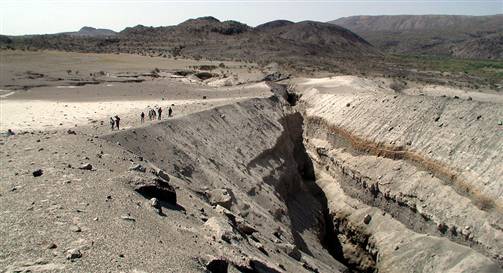
In other, and better, news, mighty deeds are occurring in Ethiopia, tectonically speaking: a 37-mile-long, 13-foot-wide fissure opened rather suddenly in the Afar desert this September. It's very impressive:

Cronaca sees Matt's sparrow (murdered for destroying a Dutch domino project, and later enshrined); and raises him a h0 m0se xua l n3cr0ph1l1ac Dutch mallard (no Google hits, please!).

Allow me to note with dismay the declining standards as to the birds we immortalize in museums. These two are being hailed as "the two most famous tragically dead birds of the 21st century". In the 20th Century, pigeons were rightly decorated as war heroes:

"[Pigeon] Gustav was a real local hero, putting his life on the line to bring back vital information on the success of D-Day."

"On his last mission, "Cher Ami," shot through the breast by enemy fire, managed to return to his loft. A message capsule was found dangling from the ligaments of one of his legs that also had been shattered by enemy fire. The message he carried was from Major Whittlesey's "Lost Battalion" of the 77th Infantry Division that had been isolated from other American forces. Just a few hours after the message was received, 194 survivors of the battalion were safe behind American lines."

I certainly do not, however, belive that the pigeon-guided missile would have been an ethical use of such potentially valiant creatures.
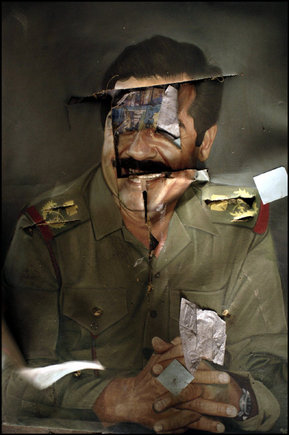
The Critic As Artist:

--Anonymous, Iraq, 2003
Medium: Assault-on-Poster

In this passionate yet subtle subversion of Classic Propagandic Narcissism, the meta-artist has here subverted the very medium of the genre to achieve an effectually differentiated paradigm in opposition to the original work's intent. The overall result is reminiscent of the works of Francis Bacon.

Or perhaps there's a simpler interpretation...

I've mentioned Ascham's The Scholemaster previously, but I had yet to run across Elyot's The Governor, which examines the education of those who are destined to rule. He and Ascham agree on a number of points; this one caught my eye:
But in as moche as he also saithe, that he that is of good astate in his body, ought to knowe the power and effecte of euery exercise: but he nedethe nat to practise any other, but that whiche is moderate & meane betwene euery extremitie: I wil now brefely declare in what exercise nowe in custome amonge vs, maye be mooste founde of that mediocritie: and maye be augmented or mynysshed at the pleasure of hym that dothe exercise, without therby appairinge any part of dilectation or commodite therof. And in myn oppinion none may be compared with shootinge in the longe bowe, and that for sondry vtilities that come therof, wherin it incomparably excelleth all other exercise. For in drawyng of a bowe, easie & congruent to his strength, he that shoteth dothe moderately exercise his armes, and the ouer parte of his body: & if his bowe be bygger, he must adde to more strength: wherin is no lasse valiaunt exercise than in any other werof Galene writeth.
This gentleman is well worth reading, not the least evidence of which is that he gave us the word "maturity".

Monday, December 12, 2005

Three detailed expositions of excellence from the Mesnagier De Paris:

Eel
[L]'anguille qui a menue teste, becque délié, cuir reluisant, ondoiant et estincelant, petis yeulx gros corps et blanc ventre, est la franche. L'autre est à grosse teste, sor ventre, et cuir gros et brun.

The eel which has a little head and a slim beak, shining, wavy, sparkling skin, small eyes, a large body with a white belly is the true eel. The other has a large head, a yellow belly, and thick brown skin.
Cheese
Non mie blanc comme Helaine,
Non mie plourant com Magdalaine,
Non Argus, mais du tout avugle,
Et aussi pesant comme un bugle:
Contre le poulce soit rebelle,
Et qu'il ait tigneuse cotelle.
Sans yeulx, sans plourer, non pas blanc,
Tigneulx, rebelle, bien pesant.

Not near so fair as Helen was,
Nor weeping like the Magdalene,
No Argus, but altogether blind,
And dense and heavy as an ox:
Against your thumb it should rebel,
And it must have a scabrous rind.
Without eyes or tears, and not white,
Scabrous, firm, and good and dense.
Horse
Be aware... that a horse should have sixteen characteristics. Three qualities of a fox: short, straight ears; good hair; and a strong tail full of hair. Four qualities of a hare: a lean head; extreme wariness; light movements; and speed. Four qualities of an ox: a wide, large, and broad chest; a large belly; large eyes that stand far out from the head; and low jointedness. Three qualities of an ass: good feet; a strong backbone; and gentleness. Four qualities of a maiden: a beautiful mane; a beautiful chest; beautiful loins; and large buttocks.
That last I could not find online; it is from Tania Bayard's translation.

I count eighteen characteristics of a horse. It's interesting to compare with Xenophon (the attribution to whom of On Cheeses and Eels is apparently apocryphal):
His neck should not hang downwards from the chest like a boar's, but stand straight up to the crest, like a cock's; but it should be flexible at the bend; and the head should be bony, with a small cheek. Thus the neck will protect the rider, and the eye see what lies before the feet. Besides, a horse of such a mould will have least power of running away, be he never so high-spirited, for horses do not arch the neck and head, but stretch them out when they try to run away.
Would someone please tell me I'm translating "tigneuse" wrong?
Four of eight.

Thursday, December 08, 2005

More Giant Catfish

Carved into the stone of Ankor Wat, this Mekong giant catfish is devouring a dog or a deer. Courtesy of a very good NPR story on the fisheries of Cambodia.

Here's a live one (courtesy of this site, which has other photos of Southeast Asian aquatic megafauna:

Wednesday, December 07, 2005

Glad we got that cleared up
Dispelling years of anecdotes in travelogues, the popular press, and scholarly works, biologists from the University of Bristol argue that it is nearly impossible for elephants to become intoxicated from eating the fruit of the marula tree.
Mendacious. Contumely.

"Full" article.
Famous names
Suddenly there came from the inner room a sound that was not human, a gasp and a loud cry I was sitting watching the tailor. We rushed to the door but it was locked. We called, but there was no answer, only the loud inhuman noises. I was young and strong in those days, so I lifted the door from its socket and we rushed in. The men had come by now, the old steward and another old man, a nephew of the house. There was the Fourth Mistress lying back against the wall on the k'ang. Fortunately she had on a pair of trousers. Otherwise she was bare. Even her feet were not covered. The old steward put his hand on her mouth and said, "What is the matter?" He was an old steward and dared to do so.

She called in a loud voice, "I am Kuan Kung."

"What do you want?" we all called together.

"I want a sword," she called in a loud voice.

"All right, all right," we answered, "we will get it for you." But still she called and cried in that strange voice.

So we asked again what she wanted, and she said, "A cannon."

..."I want a flowered cannon."

...

Still she would not stop calling. And the old steward asked again, "Why do you call so?"

And she answered, "The Third Mistress spends all her time reading the Three Kingdoms [link added], and the heroes say that she is too familiar with them."
--A Daughter of Han: The Autobiography of a Chinese Working Woman, by Ida Pruitt, from the story told her by Ning Lao T'ai-t'ai.

If there were any justice in this postlapsarian world this possession would be my fate, since a) I read too much of the Three Kingdoms, and b) I could use a sword, a flowered cannon, etc.

The Three Kingdoms is, I think I can safely say, the work of historical fiction upon which the most video games have been based. I have forgotten if I encountered one of them before reading the romance, but I know that a number of people have been inspired by, say, Dynasty Warriors, to find out more and read further. I helped a number of them when I was working at Barnes and Noble, and one commonality became quite clear. Everyone develops great likes and dislikes for the characters. There are very few who can remain neutral--which is, of course, the story of the Empire's shivering to pieces, and the formation of Wu, Shu, and Wei.

There's a case to be made for the tradition villain Cao Cao, for example. One person I argued with insisted that he alone has the ruthless character, along with the force of personality and intellectual gifts ("...able enough to rule the world, but wicked enough to disturb it") to successfully reunite the Empire, and that Liu Bei and Sun Quan are wrong to oppose him. I disagree, but it cannot be denied that the virtuous Liu Bei's dithering over correct behavior cost lives and cause misery.

For my part, I have an undying hatred for Liu Bei's great strategist, Zhuge Liang. Blessed with knowledge and powers beyond the mortal sphere, he laughs up his sleeve at everyone around him, moving them about like pieces on a chess board. He and that other smirking Taoist, Pang Tong, live in rustic seclusion, ignoring the suffering of the people, until a suitably fine position can be got. Then they proceed to wreak havoc and Liu Bei's enemies, allowing their master his luxury of correct thinking whilst they themselves scruple nothing in lying, manipulating, and stealing to further their cause. Moral duties they ignore, and the dictates of Heaven are merely legal details to be got around.

It's odd that I hate Zhuge Liang so much, since he resembles another character whom I like: Odysseus. Both are cunning beyond those around them, willing and very able to deceive, and both possess supernatural aid. In particular the end of Zhuge Liang reminds me of the end of Odysseus.
"I am in the habit of praying," replied Kong-ming [Zhuge Liang's 'heroic epithet'], "but I know not the will of God. However, prepare me forty-nine men and let each hace a black flag. Dress them in black and place them outside my tent. Then will I from within my tent invoke the Seven Stars of the North. If my master-lamp remain alight for seven days, then is my life to be prolonged. If the lamp go out, then I am to die. Keep all idlers away from the tent and let a couple of youths bring me what is necessary."
---Romance of the Three Kingdoms, Lo Kuan-chung, trans. C. H. Brewitt-Taylor

Idlers not kept away, he perishes shortly thereafter. This failed propitiation has always reminded me of Odysseus wandering inland with an oar over his shoulder.
Beyond Epirus, among the high hills of the Thesproteans, he sat the oar upright in the stony ground, and turning toward the ram which he now meant to sacrifice to Poseidon, he found Heaven's amiability to remain unpurchased, because the offering of Odysseus, who was a rebel against Heaven's will to destroy him, had been refused, and the ram had vanished
--Something About Eve, James Branch Cabell

Odysseus and Zhuge Liang are both supernaturally clever, but neither can, finally, avoid that fate which is common to all men. In Odysseus I find it tragic, and in Zhuge Liang I find it just, even though Odysseus also through his strategems burned and sacked a great kingdom, and Zhuge Liang also had his moments of human sympathy. The difference, I think, is that Zhuge Liang is, despite these moments, always separate and above events and people. He is untouched by common concerns. He is not simply a great strategist--great strategists are two a penny in the Three Kingdoms--but can control the winds and the weather. How can he have a place in human society? Even Homer's Achilles does not differ in kind from his fellow men. He is strong, but not strong beyond strength. He too has human attachments, and these attachments allow him to understand Priam when that king comes to Achilles' tent.

Zhuge Liang also cheerfully vexes to death my favorite character, Zhou Yu, about whom more later.

Tuesday, December 06, 2005

Late but happy traipses this water scorpion; article found at Cronaca.
In case you are having trouble at the breakfast table. It is not your fault. It is an immutable law of the universe.

Monday, December 05, 2005

Small Poem About the Hounds and the Hares

After the kill, there is the feast.
And toward the end, when the dancing subsides
and the young have sneaked off somewhere,
the hounds, drunk on the blood of the hares,
begin to talk of how soft
were their pelts, how graceful their leaps,
how lovely their scared, gentle eyes.

--Lisel Mueller (1924-)

Steve is off to Turkish Kurdistan, in search of hounds. May he find all the dogs of his desire!

Sunday, December 04, 2005

Here's a collection of medievalist blogging. The highlight is probably the ancient recipe for pork with truffles. The lowlight is almost certainly Rudolf the red-Nosed Reindeer in Latin. Also, don't miss the discussion of treating headaches with electric eels.
Christmas Cheer:

Vandals Burn Swedish Christmas Goat, Again

Article here:

Since 1966, just 10 of the 43-foot-high goats have survived beyond Christmas Day. Most were burned _ sometimes within hours of being built during the first week of December. The 1976 goat was hit by a car

Saturday, December 03, 2005

If you want to feel hungry, take a look at The Cook's Cottage, an Indian food blog, lavishly illustrated. For instance, a pomegranite salad recipe is illustrated with Boticelli, Rosetti, Persian portraiture and photos of the fruits themselves. The author also has detailed step-by-step recipes with photos, plus many wonderful pictures of Indian marketplaces and everyday life.

Wednesday, November 30, 2005

From the beehive state. After reading about my NaNoReMo attempt (successful, thanks to cheap sci-fi), a friend sent me this article:
A Salt Lake City attorney reads it in Japanese and reads nothing else. A BYU student downloaded it onto his MP3 player and listens to it wherever he goes. A Provo couple took their book, blanket and picnic basket to the park and read for 15 hours.

Call them the "Book of Mormon-challenged."

All over Utah, many Latter-day Saints are desperately - some despairingly - racing to meet church President Gordon B. Hinckley's challenge, issued July 25, to read the Book of Mormon by year's end.
Their reading would be more inspiring if it did not so perfectly fit Cabell's quip about it being better for people to read anything rather than not at all. "By similar logic it would be more wholesome to breakfast off laudanum than to omit the meal entirely."

Sunday, November 27, 2005

Proclus has a nice post that readers may well have missed, on historic chile consumption in New Mexico.
Josia Gregg observed on page 154 of Commerce of the Prairies, an account of his travels to New Mexico in the 1830s, that "[c]hile verde (green pepper), not as a mere condiment, but as a salad, served up in different ways, is reckoned by [New Mexicans] one of the greatest luxuries."
Mrs. Peculiar has some nice purple-red pods on to soak. It's good to be home.

Wednesday, November 23, 2005

The BOGOMILS' errors
Let us now recite:
Bulgarian terrors
To all who think right.

They claim that the Devil
Is God's elder son,
And on the same level
With the Three-in-One.

The sacraments mocking,
Creation they hate,
And thus are offending
Our Lord Incarnate.


Slowly, but exceeding coarse, my wheels grind. I would have done the Borborians except everything I learned about them was really, really icky.

Q.
A.

Monday, November 21, 2005

Mr. Lileks is going to receive a thousand e-mails pointing out that Inigo, not Fezzik, said that last line.
For those of you who enjoy such things, Summitpost has an interview with the chief of search and rescue for Mt. Elbrus. He doesn't say anything particularly surprising, but he certainly has that inimitable Russian vim:
"Nobody can tell in which of the dozens of thousands of bottomless glacier crevices [sic] their frozen bodies lie."
That's not how the Park Service usually phrases it. I like the Russian style.

Happy Thanksgiving!

Friday, November 18, 2005

An interview with the man who is not Lemony Snicket.
What to listen for in Philip Glass. I want, for the benefit as such on whom the music may be inflicted, to write a little about how to enjoy the operas of Philip Glass.

Terry Teachout doesn't like him, but Terry Teachout never quoted Buffy, so to hell with him. I will now give you the secret to enjoying Akhnaten.

The prelude is eleven minutes and twenty-four seconds long. You should be able to sink three beers in this time. More alcohol if you're doing shots, but beer is AEgyptian, and you should claim to anyone who questions you that this is a ritual from archaic AEgypt to honor the spirit of Amenhotep III. It is not; the Prelude of Akhnaten serves the same purpose as the knee-plays of Einstein on the Beach: a convenient moment in which to down some pain-killing alcohol.

Now: wait for it. The scribe will begin speaking of the king. Apparently he flies like the zeret bird. No, I don't know what that means, but if you've taken my advice, you don't care. But, get up! Stand up when your archaic AEgyptian scribe is speaking to you! He goes to the sky [the king]. He goes to the sky [ibid.]. On the wind. (De capo).

The funeral of Amenhotep III is beginning. If you do not get up and shake your rump during the funeral of Amenhotep III, you are no true opera-lover. All the goths in the house: ninja dance! Let's see some white man overbite! Throw your hands in the air, like you just don't care.

You call that apathy?

Sing along. Don't worry about not knowing the words: they're mostly in archaic AEgyptian anyway. Contemplate that fact while considering also that this is Mr. Glass' most accessible opera. Keep dancing. You don't want Amenhotep III to go to the sky without a decent send-off, do you? Open are the doors of the horizon! If you really feel bad about knowing the words, they are: Ankh ankh, en mitak/ Yewk er heh en heh/ Aha en heh. Don't you feel stupid for asking? Also, note the absence of violins. Enjoy instead the silliest brass section, ever.

About eight minutes in to the nine minute funeral you will, if you are dancing correctly, start to feel a little winded. Go ahead and sit down. You've got a couple of hours to go. Oh look. Beer! Hurray beer!

And that is how to listen to Philip Glass.
Regarding the venomous and malicious aspects of creation, I just now learned of (which avian I'm sure is old news to most of you) of the pitohui, a venomous bird.
Some Australians have just discovered that venomous lizards are much more common than previously thought: monitors and iguania, which comprise a lot of species. It's really an unnerving thought that komodo dragons are venomous (though I'm well aware that venom would be the least of my worries in an attack). The way they look at you...

Thursday, November 17, 2005

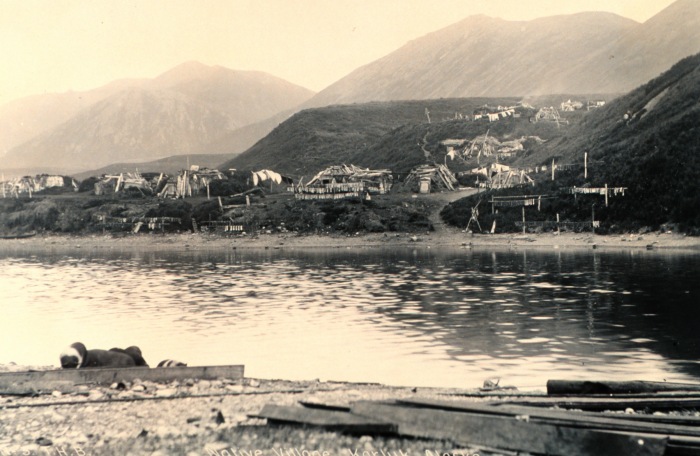
Here's an old picture I found, courtesy of NOAA, of the village of Karluk, on Kodiak Island, in 1938. It makes a nice addition to my previous post on Karluk, which has been updated with other images.

Saturday, November 12, 2005

From Nature Blog comes a BBC story about a recreation of farm life in the 1620s. It included this bit of wisdom:
8. Corsets, not bras. "By that I don't mean Victorian corseting," says Ms Goodman. "Corsets support your back as well as your chest, and don't leave red welts on your skin like bra elastic does. They made it hard to breath walking up hills, but I get short of breath doing that anyway. And most people feel sexy in a corset."
I can only hope that this advice is taken to our nation's bosom.
A quick NaNoReMo update. I'm three books ahead of schedule, thanks to some unexpected time off, but none of them are exactly works of art. For those of you bored enough to keep track, the original list will be updated in near real-time!

Brief reviews of the latest great novels:

A Passage to India: caves are evil.
Their Eyes Were Watching God: Ooh, this was good. How I hate dialect!
The Autobiography of Alice B. Toklas: Gertrude Stein, I like you so much better now. But, dear heart, you might take your own advice. Remarks are not literature. This was actually the one I enjoyed most of the three. Alice is marvelously gossipy, and I loved the way that she was shown only in reaction to those around her. But either be against commas, or use them correctly. Consistency is all I seek.
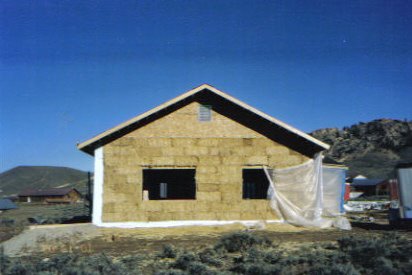
A straw bale house in Gunnison, Colorado that my wife and I visited. You want pictures of joists? Because I've got pictures of joists. I could show you some serious 10x10s, if that's what you're into.

They dye the sky in Gunnison that color, by the way. It's not natural.


I attended a Straw Bale Construction workshop today, although "seminar" would be apter, since to me "workshop" implies activity beyond reading, videos, and discussion. I don't hate these things, but it would have been nice to get my hands dirty. Despite the price tag, the workshop had a goodly number of attendees. Straw bales are cheap. It's just the learning that gets you.

For those of you who have no idea what I'm talking about, straw bale construction uses... straw bales... in construction. They're often used where otherwise sheetrock and insulation would go, but they can be load-bearing, showing surprisingly little compression. If log cabin construction is Tinkertoys, straw bale is Lego. A straw bale wall generally makes excellent insulation, with an R value from 30-50 depending on bale density and alignment. A lot of this insulative value comes from the thickness of the bale: straw bale walls can be around two feet thick. Two feet of fiberglass insulation would be pretty good, too, but straw is cheap. Bales run from two to six bucks here in Oregon, depending on the season and location.

A big draw for would-be bale builders is the environmental aspect. Straw is a waste product that is otherwise burned or buried (there are a few other uses, but I've yet to hear of anything widespread). It's organic--which to me means "carbon based", but apparently has some other meaning, if people can apply it to cheese puffs, bicycles, and water--and sustainable. Sustainability seems to me an insufficient criterion for a lifestyle. I can imagine a number of low-entropy states which are sustainably unpleasant. But it is nice to be using a material that will give us twenty or thirty years of use (or more!), and can then be spread on the garden to compost. So while for me the main attractions are price and ease of assembly, I acknowledge that it's a bonus to hold a hippie-lifestyle high card.

Straw bale is not actually much cheaper than traditional construction. In the long term it will save money of energy, but, apres Keynes, in the long term we're all dead. That it lends itself to small crews and owner-builders, however, potentially saves money on labor costs.

The rules for building with straw are the same as the rules for raising mogwai, except that instead of "don't feed them after midnight" you have "don't set them on fire". So I guess really just, "never get them wet". Oh, and both can be corrected with a sledgehammer if they get out of line.

Excess of moisture is how a straw bale house dies. Above seventy percent relative humidity, mold begin to grow, and the bale begins to suffer. The air which passes relatively freely from outside to inside (another advantage of straw bale construction is the air exchange) starts to smell a little off. The bale loses structural integrity. The walls collapse. Everyone dies. It's actually much worse than the danger of fire. Straw bales, expecially after they've been stuccoed, resist fire rather well. But because of the danger of rotting bales, the lowest course needs to be twelve to fourteen inches off the ground.

This, of course, is why I chose to move to the Pacific Northwest and build one. Sometimes I am rather contrary. But I was pleased to learn that any number of such houses have already been built in and around Portland, and that the humidity remained within safe limits. I don't like being the first penguin to jump off the ice. I like things safe, and established, preferably for at least two millenia. Building with straw fits nicely into that last category.

However, I am still a little suspicious of load-bearing bale walls. It just doesn't seem right to me, and all the successful Nebraskan churches in the world won't change my mind. I prefer a straw bale wrap, where the house is build using post-and-beam construction, and the bales are placed around the walls.

Anyway, my notebook is full of new books to read, magazines to subscribe to, and now-indecipherable notes like "30 lb. tar paper! Stem." One enjoyable thing about this sort of workshop is how easily it gets off topic. The same crowd drawn to straw bale workshops knows a good bit about grey-water systems, bottle walls, cobb construction, composting toilets, living roofs, passive and active solar power, and the multifarious tasks hemp can accomplish. Hearing about all these wonderful techniques, I immediately start building tree-houses, earthships, hobbit holes, and other castles in the sky. I want to use old blue jeans as insulation, and salvaged telephone poles as load-bearing posts. But no matter how much I like the subject, I cannot go eight hours of discussion with strangers without wanting to bite someone. Please note, fellow bale-enthusiasts: there are stupid questions, and today you asked a number of them.

One of my more pleasant summers was spent building an addition to a home. I hope my wife and I can experience that same satisfaction, along with putting a roof over our heads and four walls around us. We haven't studied floors yet.

Thursday, November 10, 2005

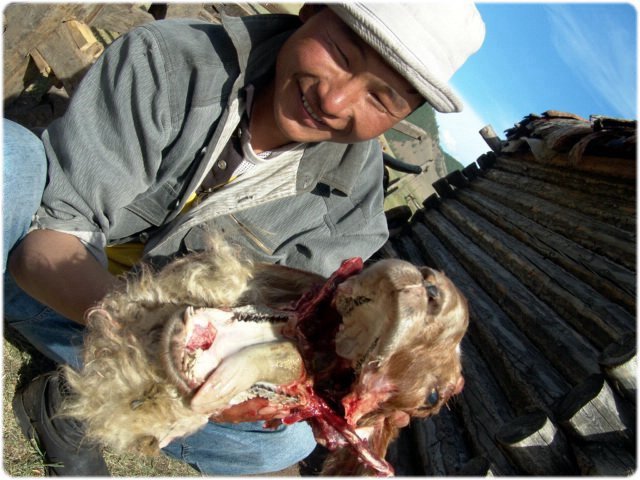
There is some great stuff lately at New Mongols. My definite favourite is La Mongolie culinaire, a well-photographed account of Mongol cooking, which begins (how else?), "Quand on tue le mouton..." It definitely captures, as the French say, the "I don't know what" of the Mongolian dining experience:

"il fait la gueule le mouton"

Brings back some fine memories. These folks saw far more vegetables than I ever did, though. Mouton au riz, ha! And where, oh where are the marmots, who are really much tastier than the sheep?

What to do for entertainment after such repasts? Gamble with the sheeps' bones, of course! Here are some rules to North-Central Asian knucklebone games. Or why not provide some atmosphere by learning to throat-sing?

Also worth a look are Mongoliac and Throat Singing, both blogs by folks on extended stays in Mongolia and Tuva, with many fine photos.

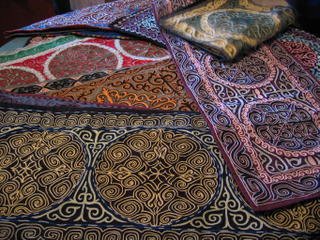
If you like the Kazakh wall hangings, please ask Steve to sell you some.

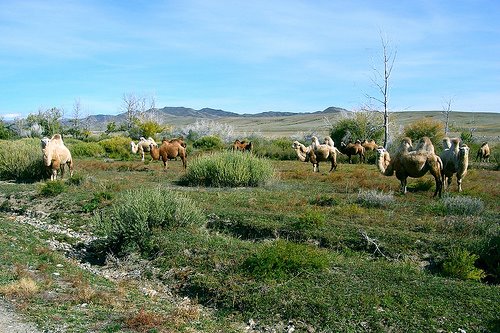
Ah, proper Siberian camels, not those mangy desert jobbies!

Moslems love America!

I do hope the current appeals for friendship with America get a little mainsteam airtime. I fear they won't, as the official media stance seems to be that all Moslems hate us because we oppress them, each and every one. But Iraq's Kurds seem to feel quite differently. It's really appalling that one of the Middle East's bright spots is forced to pay for good press in the States.

Meanwhile, the Azeris would like some of that assistance as well. It will be to our immense shame if we don't come through for them. If Stephen Green is correct that we're really fighting a media war, we cannot afford to pass up this opportunity. The picture says it all.

Wednesday, November 09, 2005

Lies! Filthy Lies!

Steve posted today on the shameless deception which is Save the Falcons. This whole "Arabs are stealing our raptors" delusion has been cropping up periodically for decades now, often doing real damage to the lives and livelihoods of honest American falconers. Perhaps Steve can write on the travesty of Operation Falcon, in which numerous falconers were framed by federal agents. The unnerving thing about this disinformation is that it does show an ability to inspire a very peculiar hysteria in well-meaning people, mostly people who know little about birds and nothing about the Middle-East or falconry. Certainly anyone who as ever witnessed actual falconry, in all its glorious inefficiency, must doubt claims that falcon-hunts could possibly devestate entire Central Asian ecosystems, as Save the Falcons repeatedly asserts. These are not credible people. For instance, here is an article mainly about information technology used one of S.T.F.'s leaders business; it is not a falconry article, nor an environmental article. Note the proud assertions: "He has supplied falcons to the royal families of Saudi Arabia and the United Arab Emirates. Sixty percent of Khalsa's clients live in the Middle East"

Why should this man be trusted to fight falcon smuggling?

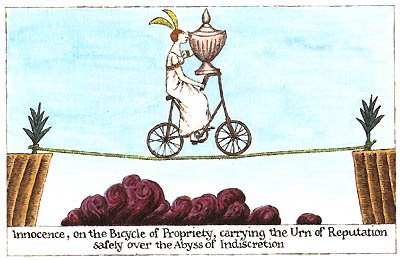
Congratulations to Roseann Hanson, who has just started her new blog, Three Martini Lunch! It's also very good to see her husband, the Alpha Environmentalist posting once again, especially when the posts involve really first-rate piracy (by current standards, anyway). He's been posting a lot on bicycles lately, though, in anticipation of a two-wheeled circumnavigation of the Grand Canyon. Here's something to inspire him for the crossing of Marble Canyon:

For further inspiration, here's an account of the Bundys, inhabitants of the Canyon's Northwestern rim, shootin' rattlesnakes with six shooters and much more. Bundyville is now disappointingly known as Mt. Trumbull.

Sunday, November 06, 2005


Vermin is the Princess of Quite A Lot.

Saturday, November 05, 2005

Goodness, that was ill-natured of me. Here, have a cheerful Harry Potter dance.
NB: Skip this post if you feel like it. It's rambly.

Steve was kind enough to send an email my way in which he praised the St. John's education. He made the excellent point that one can, these days, be an expert in one's field while still having no understanding of the civilization on which that field is predicated. Biologists may not know philosophy; philosophers know just enough biology to get into trouble *coughpetersingercough*; and the great and astounding history of our sciences is related in simplified, poorly written books whilst eminently readable classics like Faraday's Chemical History of a Candle or Euclid's Elements languish.

This post is not, however, Johnny triumphalism. I want instead to explore the weaknesses of the St. John's experience. I am, of course, a bitter, partisan voice often choked with my own bile. But the Great Books program, as fine a paedagogical device as it is, has several immanent flaws.

It breeds generalists without real depth. It breeds elitism without bringing forth the elite. It breeds complacency in the face of real life and death, and an unexamined belief that the contemplative life is not only superior, but that the vita activa is corrupt and corrupting. It's this last quality that I want to examine most closely.

A certain fellow stalks the polis these days, declaring that all action is sinful. A sort of secular Jain, he has no advice to offer, only his criticism of any course taken. In his view, death by inanition is preferable to making an omelet, lest we break eggs.

The life of a spectator is an easy one, which is why so many of us choose it. But as distracting as this attitude is in political life, it is disastrous in the daily grind. And this attitude is fostered by the Great Books program.

Johnnies read a great number of Greek tragedies. We read Job, King Lear, and Anna Karenina. And I will claim right now that none of these works--not one--has ever helped me deal with the tragedies of my own life. Even the Greeks failed to capture the essence of the blind, murderous world we live in. I read Job on my wedding day, to calm myself. "At least I don't have boils," one can almost always say.

Instead of re-forging the bonds of humanity, reading these works let too many of us cast off those bonds, in exchange for pretend pathos, for the glib pleasure of sympathy with characters to whom we need offer neither charity nor concrete assistance. Instead of drawing us together, as I believe the tragedies must have drawn together the audiences before whom they were performed, the necessarily solitary act of reading and contemplating led me, at least, to a solitary existence.

I want to relate the most truly communal experience--not a feeling of friendship with individuals, but of being part of a collegium--I had at St. John's. It was the night before Winter Break began, and the college was showing The Grinch Who Stole Christmas and It's a Wonderful Life. I went there with several friends of mine, and we found seats in the crowded hall.

I am a sucker for movies. I cheer every time the Death Star gets blown up. I tear up when Jim Craig rides down that hill in The Man From Snowy River, and I think Casablanca is the most romatic movie ever made. I make muffled shrieks when the chair is turned around in Psycho. So it needs little thought to conclude that, by the end of It's a Wonderful Life, I was blubbering.

But when the lights came up and I looked around, so was everyone else. The cynical, all-knowing group of college students had been transformed by what is (let us be honest) a sappy, sappy movie. Neither age nor sex was cause for exemption. Sitting next to each other, students hugged and wept.

I contrast this with the idiotic, sybaritic attitudes we most of us affected most of the time, and I conclude that some element of our education was missing. The Greek tragedies never united us in seminar, aghast at our own mortality, the way that movie did. For all the genius poured into the Great Books over millenia, not one of them can teach you how to deal with the death of a loved one. This lack would not make me quite so angry if it had not been so strongly implied that this could be taught.

A certain sort of clever person will learn to use their reading to distance themselves from anything that might affect them. They become adept at drawing parallels between life and reading, that they might reduce everything to a text, and themselves to critics. The critic's point of view, detached and near-omniscient, is a great temptation to those of us particularly susceptible to sloth. It requires no action.

I believe in an immutable, underlying reality. This belief occasionally makes me want to hit people by way of proselytization. It's difficult to refute a yop cha chirugi. I recognize this tactic as self-defeating, but that doesn't remove the temptation. The contemplative life implicitly denies those who act the right to define their own lives, by sitting in judgment on their actions.

It allows one a relaxed, superior attitude. When a friend is suffering, it's too easy for us to distance ourselves, not only emotionally but with regard to our Will, and transform the trouble into an intellectual problem. But for certain problems there is no solution. Death stands grinning at the end of every life, and all the philosophical practice in the world won't accustom you to that fact. It is a part of human nature to fear death, and to suffer as we watch the people we love die. Anyone who says differently is selling something.

I cannot adequately express my love for the people in my life who have died, let alone those who are still alive. I hope that they are gathered in the bosom of our ancestors. But that hope does nothing to alleviate the pain of death. A refusal to confront this pain in all our impotence is at the heart of the desire for a contemplative life. I assign psychological causes rarely, but this one I will stand behind.

So, having wandered far afield, to return: the St. John's education teaches a great deal of history, but does not and cannot make that history live in us. It offers what it claims are insights into the human condition, but what can also become barriers between us and the world. For every ten thousand would-be Socratics, there's not one that would share his cup.

I am cowardly in the face of suffering. It makes me want to turn inwards in fractal self-reflective thoughts. It is this tendency which is fed and nurtured at St. John's, despite the best efforts of tutors and faculty. Excellent in argument, useless in action.

Of course there are exceptions, and you mostly likely are one if you read this blog and are a Johnny (not, of course, due to any innate quality of this blog, but because I know most of you, and you are all wonderful. Hi!). St. John's does leave one in a position to gain real understanding and to make real changes in the world. But one must recognize when the time has come to act, and to act effectively. Too often we act out, trying not to accomplish anything, but to gratify ourselves emotionally.
A very happy birthday to Voracious Reader, and a happy Guy Fawkes Day fiery Bonfire Night to others.