Thanks to Tenser, said the Tensor.
Saturday, September 23, 2006
The dwarf planet formerly referred to as Xena has, thankfully, been officially named Eris. Xena fans need not riot in indignation however: the powers that be came up with a very elegant tip of the hat to the warrior princess. Eris' moon (formerly Gabrielle) has been named after Eris' daughter, Dysnomia. Dysnomia, for our few readers whose Greek has gone to pot, means lawlessness.

Friday, September 22, 2006
Friday, September 15, 2006
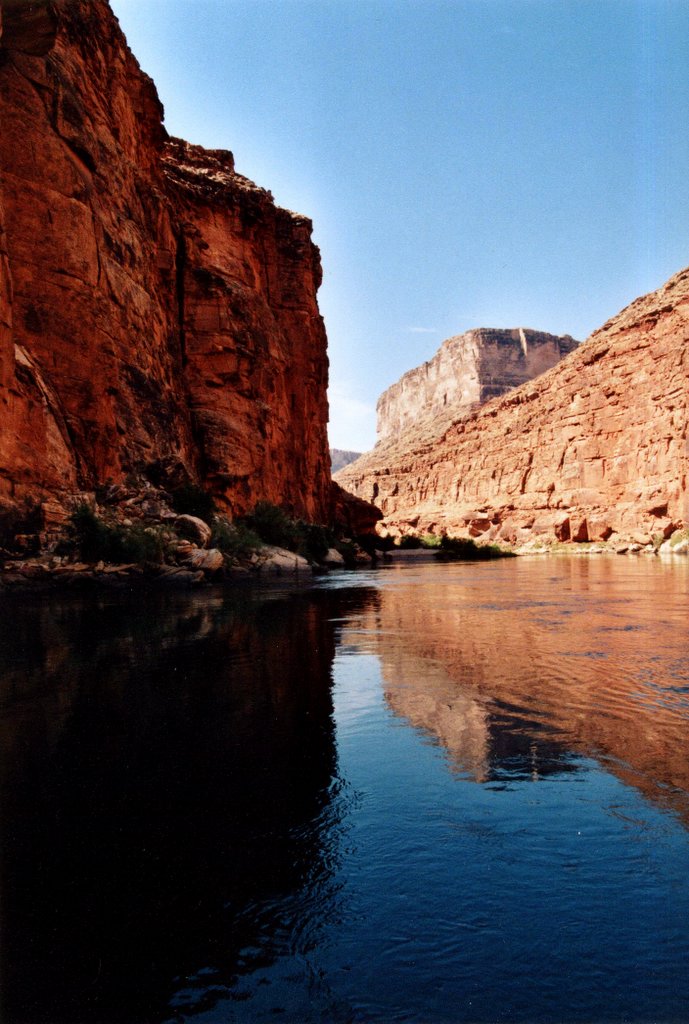
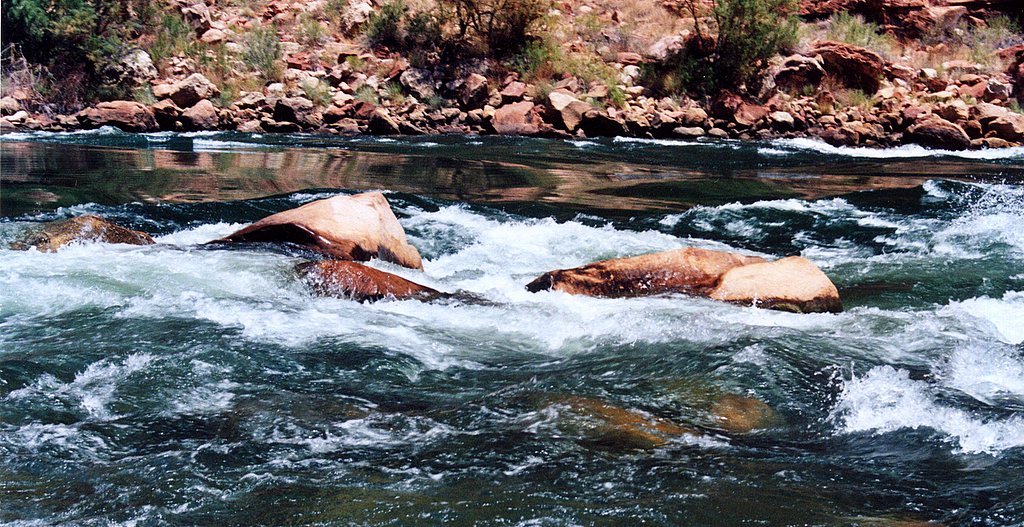
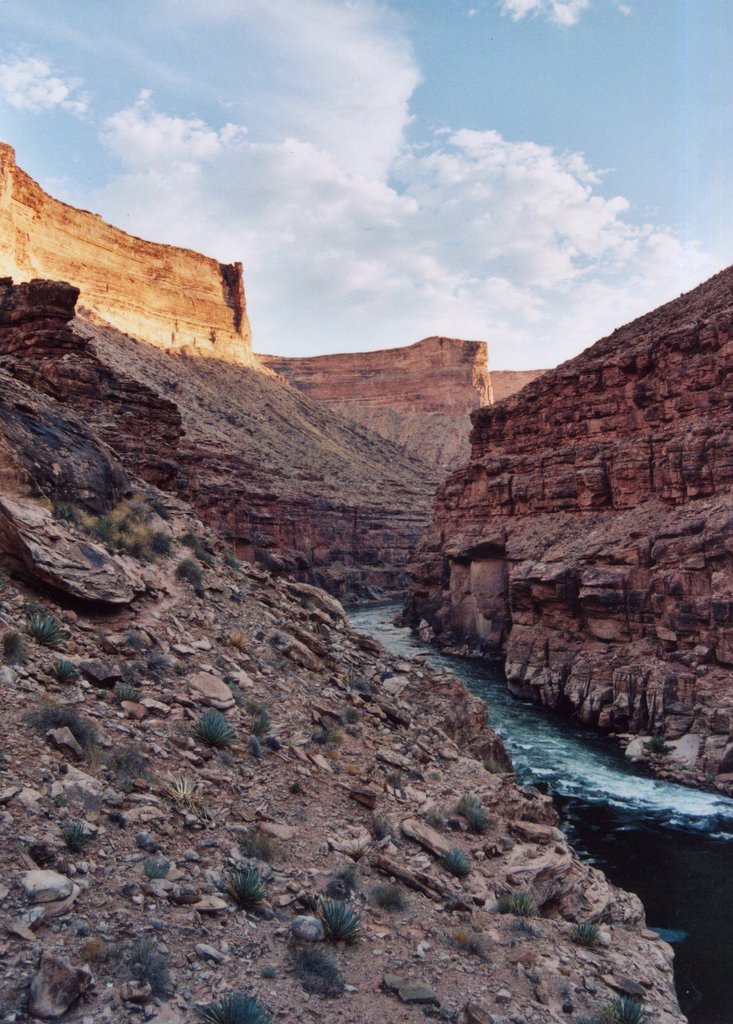
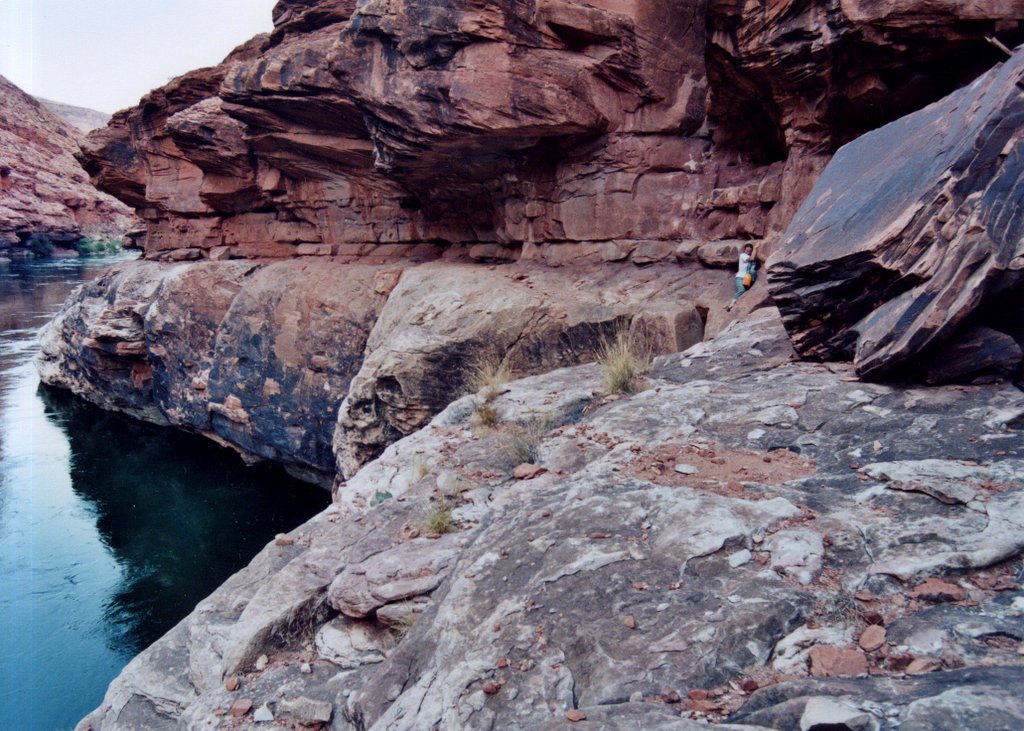
The entrance to North Canyon Rapid. The viewer will observe the emerald clarity of the water, not colorado at all; the water is also quite cold, in the mid-40s. This is the effect of Glen Canyon Dam. Historically, the Colorado ran warm and thick red, coloured by the vast erosional forces of its upstream basin. Glen Canyon Dam was built largely as a silt trap for Lake Mead, and itsreservoir (Lake Powell) is filling with silt far, far faster than was hoped. The clear, green water is beautiful, even I can't deny it. Fortunately, we are frequently allowed to see what the river looked like pre-dam, thanks to the common flash flooding of the numerous side canyons. Pictures to come! 

Steve Irwin
I have read numerous worthy tributes of late to Steve Irwin, The Crocodile Hunter, who was killed suddenly last week by a blow from a stingray. The amount of broadcast television I have viewed in the past several years is very, very close to zero, and I have never dwelt anywhere that was so technologically advanced as to receive the Animal Planet channel. Nonetheless, I did catch a number of Crocodile Hunter episodes over the years, at motels and friends' homes, and I don't hesitate to declare that I liked Mr. Irwin and his approach. His love of animals was straightforward, exuberant, not at all shy, but full of a vigour which too few men dare to reveal in public in our times. His Aussie farm-boy aspect allowed him to get away with much that the world would frown upon in an American. (Contemplate his U.S. foil, the insipid Jeff Corwin, who, though he is undoubtedly a good snake handler, clearly feels some deep discomfort with his calling, causing him to veil his endeavours in constant sarcasm, apologetics and irony.)
Sadly, hard on the heels of Mr. Irwin's death, plenty of folk began to frown. I particularly note the respectful censures of Austin Bay, a blogger whom I enjoy and respect:
In the komodo dragon show I thought Irwin crossed the line from skilled showmanship to inexcuseable thrill-seeking – wagered mortality is tantalizing, but adds a queasy, dark twist to a family program. I told my wife “I wonder if this guy (Irwin) has a death wish?”...Plenty of other folks seem also to be tut-tutting at the late Mr. Irwin for being an irresponsible daredevil. But they are thereby betraying an unfortunate ignorance of what, I maintain, drives such individuals to pursue strange and risky callings.A violent, unnecessary death.
Irwin was idiosyncratic, personable, enthusiastic, informed, and physically courageous. That’s a lot to admire. But what drove him to get too close one too many times?
I have all my life participated in two sports widely considered risky, eccentric and often irresponsible: white water boating and climbing mountains. The media loves to portray these sports as high-G, non-stop screaming thrill rides, and their enthusiasts as underclass adrenaline addicts with nothing to lose. (Almost always, such portrayals look toward the ultimate goal of selling products with little if any bearing on the activities depicted.) Unfortunately, most of the public doesn't question these images. The truth, I maintain, is very often quite different. I am not seeking adrenaline in my climbing and boating, and I only seldom find it. And perhaps surprisingly, this is true even when I am performing at my best (though I make no claims to be anywhere near the top end if these sports). On the contrary, at my best moments I find a calm, a clarity, an easy focus (concentration implies too much effort). I lose the self-examination which is otherwise a mental constant; I focus on my task without focusing on my focus. This is what I seek, and I would never think to apply the word thrill to it. The adrenaline comes only when I slip and start watching myself again. I believe musicians, especially singers, will recognize what I am describing.
Furthermore, the common notion that these activities cannot be intellectual is grossly unfair. Intellect, I grant, is not an absolutely necessary prerequisite, but it does greatly enrich the affair. Mountaineers and boaters commonly make study of geography, geology, biology, meteorology, history, anthropology and even literature. Such knowledge is often practically useful, and may in some circumstances be mixed up with life and death. But it also, especially when combined with experience and increasing local familiarity, reveals a web of interconnection and meaning spread across a landscape whose beauty is eternally frustrating to express to others.
Again, a musical parallel may be helpful. A top-notch violinist playing a top-notch piece is confronted first with the physical, technical challenge of manipulating her fingers and bow through the necessary motions. Secondly, there is the challenge of willpower, of concentrating the mind as necessary without falling into harmful self-observation, which leads either to fear and indecision or pride and grandstanding. Finally, there is the intellectual challenge, much of which occurred outside the actual performance: study of the composer, his style and influences; of the piece, its history and structure; of the instrument, its mannerisms and possibilities. Again, the concert can generally go on with little or none of this intellectual study; but the intellect can greatly enhance the performance's quality and the performer's calling. I submit that the true thrills (as opposed to cheaper, ancillary thrills that may be part of the lifestyle) of mountaineering, boating, hunting and surely many other pastimes that thus blend physical and mental skill, have a closer kinship to the sublimity of classical music than to the gross visceral lurch of simply falling from a height. Mountaineers could save piles of money if roller-coaster rides were an acceptable substitute. When people assert that "adrenaline sports" are not worth the risk, they wrongly assume that an adrenaline rush is their ultimate payoff. The rewards are much higher, and many intelligent, thoughtful people, people with plenty to lose, decide that they are well worth the risk.
Steve Irwin did not wrestle crocs and pester pythons simply to get a twitch of adrenaline every time some reptile snapped its teeth at his privates. Darren Naish aptly describes how his style ran deeper than the TV producers chose to show:
There is... no doubt whatsoever that his knowledge and experience of wildlife was considerable, and he knew the herpetofauna of Australia and other countries down to the subspecies level. He published at least some technical articles and could easily turn his hand to the dissemination of academic information: he wasn't only a populariser. Sure, he was a character, but then that's pretty much the only way of making a name for yourself on TV today it seems.The man loved reptiles and animals generally, loved getting to know them on a level that can only come with actual interaction, not with chaste contemplation from the distance. It's not easy to make a living pursuing an eccentric calling, and an affable wildlife biologist with a telegenic personality can hardly be blamed for accepting his own television show. Again, the TV producers always turn these kind of things into a sideshow, putting high-altitude mountaineering and herp collecting alongside the Jackass movie. Studying scale patterns on snake snouts or gasping for breath while humping gear above basecamp don't seem to sell advertising spots, to the detriment of all of us.
Thursday, September 14, 2006
Wednesday, September 13, 2006
A long-standing question answered:
By a simple Google search of course. Sigh. Anyway, I and many like me have inevitably wondered whether and how Greek is written in cursive. It seems an obvious thing to do, but the textbooks coyly refrain from mentioning the issue. My first Russian textbook presented the cursive script in chapter one, so I've long been aware that even such Easternmost of Westerners are capable of and amenable to cursive writing. At last, a chatroom thread provides some answers:
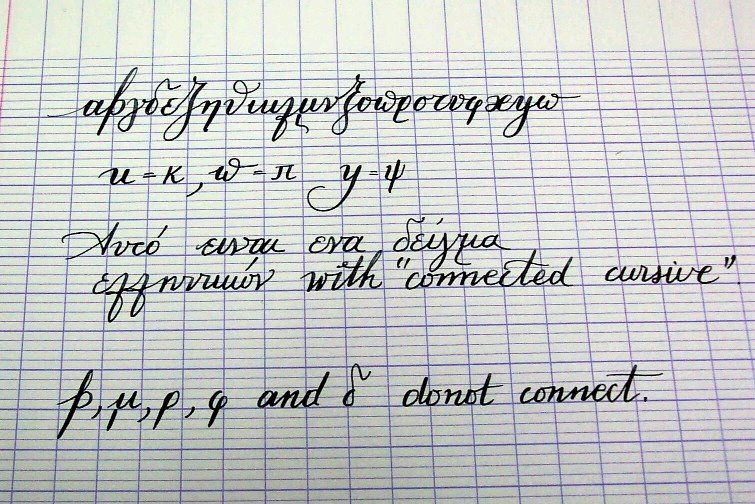
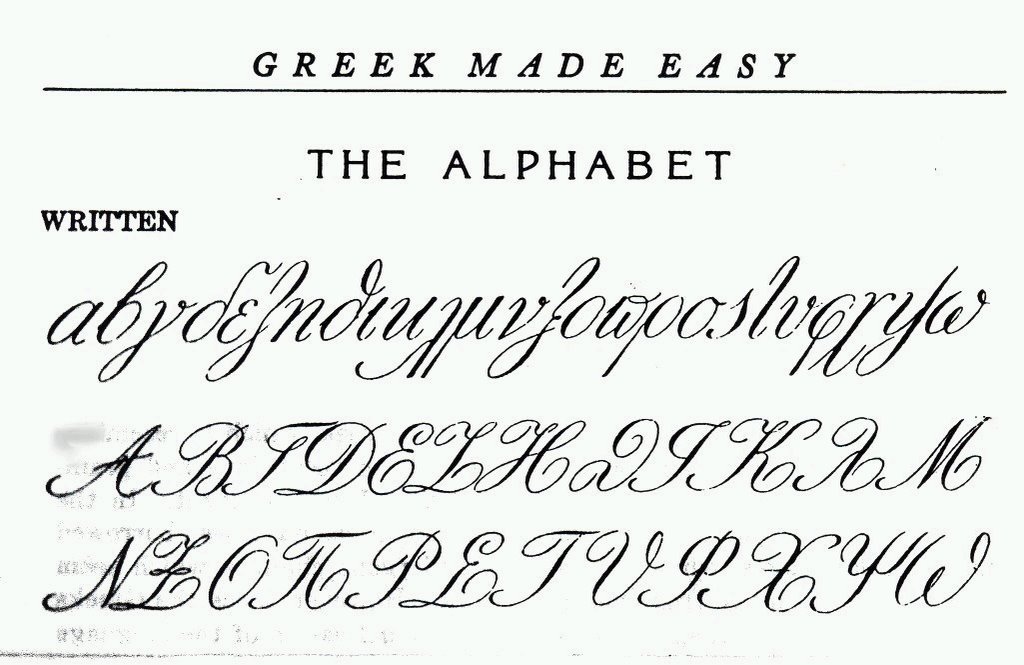
As so many Greek students must have reflected, the whole affair just does not seem suited to cursive: much more awkward than the Russian, and many Russian authors have let us know at great length just how hard it is to outdo a Russian in awkwardness (Peculiar is currently reading Dostoevsky's The Gambler). Look at pi, lambda and kappa: ugh! how on earth does one tell pi from omega in practice? By being a Greek, I suppose. Co-religionists or no, I'd just as soon be a bloodthirsty Turk. I'm rather pleased with psi, though.
Lingua Mongolia is a wonderful online resource for the Mongol language. Though one can certainly think of plenty that might be added, it is straightforward, helpful, and easily the best online tool I've seen for learning to write Mongolian in the Uighur script.
Hat tip: Jabal al-Lughat.
I'm generally not one to participate in Stöckchen, as the Germans know them, from the Internet (how did a rather abstruse notion, whose name was coined by Richard Dawkins, come to mean a silly parlour game spread about online? Memology at work, of course!), but this one, courtesy of Languagehat, was a little too apropos of me and my kith to pass up: Ten books I have bought but haven't read. Narrowing it down to ten is much easier in that most of my books languish in storage; I shall confine myself to those currently on the shelf.
Three Icelandic Outlaw Sagas: The Saga of Gisli/the Saga of Grettir/the Saga of Hord Why, why have I not yet read this?Anyone with ten interesting, unread books on his shelf may consider himself tagged.Rebecca West, The Birds Fall Down It sits right beside the marvellous Black Lamb and Grey Falcon, in which I have made a respectable dent but have yet to finish.
Libby: The Sketches, Letters & Journal of Libby Beaman, Recorded in the Pribilof Islands 1879-1880What is it about women named Libby?
Mormon America: The Power and the Promise Dirty blond, attractive, but with too prominent a forehead, too prominent a chin: the selfsame teeneage girl, genetically speaking, works the counter of every filling station in southern Utah. Proclus and Odious did not believe, until they witnessed. Surreal, somehow endlessly fascinating. My perverse curiosity may one day drive me to see The Book of Mormon Movie.
St. Gregory of Tours, The History of the Franks It was recommended to me on the basis of its having really, remarkably horrible queens. I look forward.
Memoirs of Hector Berlioz : From 1803 to 1865, Comprising His Travels in Germany, Italy, Russia, and England The man was a splendid writer. His Evenings With the Orchestra is one of the most witty, wonderful, bizarre things I've ever read: it contains, among much else, a 19th Century science fiction story about a utopian city founded on musical principles, complete with zeppelin transport; and a lurid romantic tale about an English sailor falling for a Maori cannibal princess. He wrote memoirs because Benvenuto Cellini did.
Jack Turner, Teewinot: Climbing and Contemplating the Teton Range Near and dear to my heart, the author and the subject.
G.K. Chesterton, The Flying Inn I have no idea what to expect.
Jennifer Brennan, Curries & Bugles: A Memoir & Cookbook of the British Raj Not just born in the wrong century, but hungry to boot. Grrrr.
Isaac Dinesen, Anecdotes of Destiny Do you know that other Stöckchen in which you are asked with what person, living or dead, you would chose to take lunch? My answer is easy: Karen Blixen.
(This Stöckchen probably does not apply to Odious, Kate or Steve, all of whom seem successfully to have supplicated occult powers to grant them the ability to consume a book with infernal swiftness.)
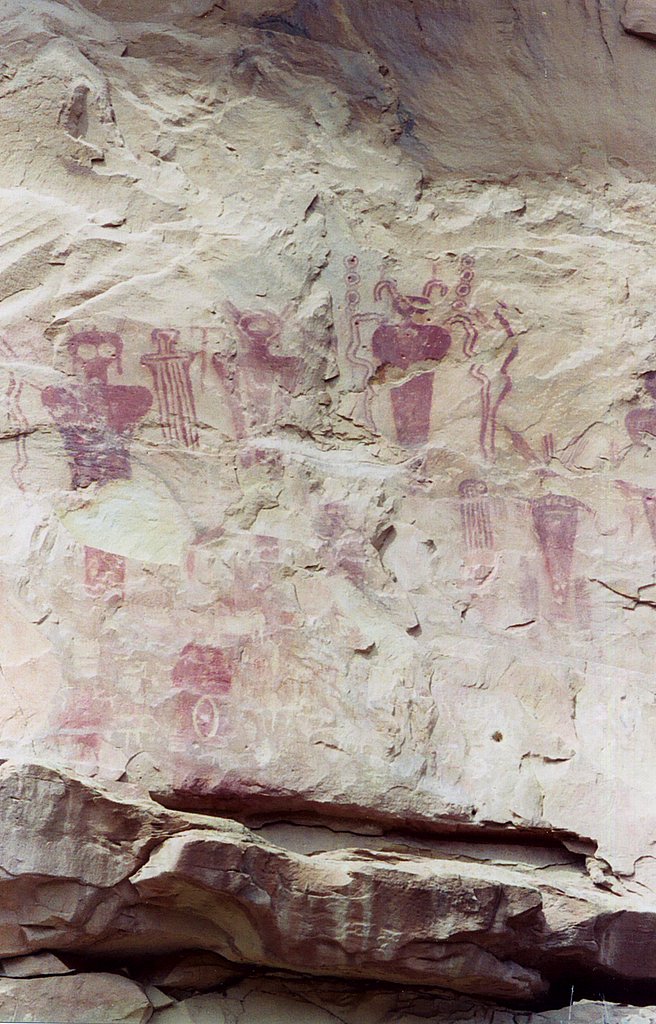
Reid Farmer, one of the co-denizens of the Querencia blog, came through on Monday, and we shared an excellent meal and equally excellent conversation. Per the latter, my favourite rock art panel:
Sunday, September 10, 2006


Thursday, September 07, 2006
From the lovely Shaenon K. Garrity I have learned that...
Daniel Pinkwater's latest book is available online.
Daniel Pinkwater's latest book is available online.
Monday, August 21, 2006
Poor Larissa! She's in great, great need, dire even. If she doesn't soon receive some of the White Russian of human kindness, she may have to return to her old career: posing for the Turkish popular music industry!

At last, an internet! We returned a good week ago, and our welcome home was a bravura display of characteristic New Mexican incompetence. None, not one of the business with whom it is our misfortune to interact was able to grasp that we would be gone for a month. "EEEhhhh," brayed the post office clerk (the classic New Mexican accent is a hybrid of Cheech Marin's with Frances McDormund's in Fargo), "your carrier never got the hold. Your mail's maybe in the box, I guess." Likewise, a volunteer fire department that stopped us on our drive in due to "a motor vehicle accident" (silly me, wondering if perhaps a bullock-cart had collided with a hang-glider): some very un-fire-fighterly legs showed beneath the hems of some none-too-reflective jackets; messages were given to and traffic directing duties exchanged with other teeneage females who happened to drive by; emergency vehicles idled in the road with ther lights off, invisible in the inky downpour*. And, to cap everything, on our first trip into town we were rear-ended by a tourist. A month of whitewater, climbing, wilderness peaks, unsociable megafauna, but we didn't begin fearing for our lives until the Rio Arriba County line.
Ah well, the weather here is splendid, feels more like the Oregon coast than high desert. New Mexicans never take green for granted, and having all our usual dust bowls and withered sedges doused with so lurid a colour is pleasant and surreal. Other consolations for coming home have included the opera, viz. Salome, which provided everything I came to see, great singing from the principles, wonderful orchestral playing and a straightforward, undistracting production. We'll be at Massanet's Cendrillon on Thursday, last of the season for us. I'm a little sorry not to see Ades' The Tempest, but not much.
We also went to a very good film last night, in all likelihood even better than our second choice, which was of course Snakes On A Plane. Crossing the Bridge is a documentary about Istanbul's numerous music scenes: psychedelic rock, arena-Mevlevis, Turkish rap by Ceza. I actually rather liked the latter. Turkish seems to vocalize about twice the number of syllables as English, so the tone-twisting of Turkish rap is quite impressive. Ceza speaks pointedly against the gangsta associations of U.S. rap; for him and for the rest of the often very punkish musicians in the film, the music does not seem to be drug-fueled like its American counterparts. "God punished hip-hop with me!" Hear for yourself (parent page). Ceza's charming, arrestingly sweet-looking sister contributes a rap of her own.
Much else: Siyasiyabend, a very folksy, Dylan-ish singer songwriter, street musician, who is a mean hand with a santoor; a Turkish B-movie star turned saz player and songwriter. Kurdish diva Aynur sings (sample, parent) with some modern influences but excellent technique; I love the way Middle Eastern singers can draw out a perfect high note with no vibrato at all (very difficult) until at last they let the vibrato emerge with perfect control, bringing the note to a climax. Brenna MacCrimmon is another one to look for: a Canadian, while travelling in Romania and Bulgaria she unearthed many ancient vinyl singles of Turkish musicians, and dedicated herself to resurrecting the songs. She reminds me of another bloody good cd, Istanbul 1925, old recordings of Turkish nightclub music. The film also shows a mindblowing Romany session, with clarinet, violin and ud competing at breakneck speed.
One of the most charming and touching performances is given by Müzeyyen Senar, a splendid old battle-axe fronting an old-fashioned Near Eastern big band (think 'Umm Kalthoum, if that means anything to you). With a milky glass of raki** in hand she sings (quoting from memory), "They say the tables are stained with lovers' sin and wine. I've been drinking since I was four minutes old: that is my sin." She swings the glass upside down in careless arcs, smiles, downs it in one gulp.
The Turks are not Arabs!
*Local emergency response: I hate to tell you, but if you're ever in an accident, it is not all right to assume local responders are competent. The closest look I've ever had at a major accident was in western Montana. A woman was lying crumpled more or less in the rear trunk of her small car; a wide splash of blood had flown from her head. A very competent friend of mine stabilized her spine. Just then, the authorities showed up and proceeded to take an agonizing amount of time about things; calling for pieces of equipment, then having found them changing their minds and sending them back; bickering between different agencies. When at long last they were ready to lift her out of the ruined car onto a stretcher, only my friend noticed that the EMTs has inadvertently attached her neck to the car with the cervical collar. It was not until the had lifted her body several inches and wondered why her neck and head weren't following that they heeded my friend's objections. The moral: if you're still conscious, keep an eye out for your own ass!
**Raki: I house-sat a couple times for our friend Phillipe, a Lebanese gentleman who had somehow found his way to Magdalena, New Mexico. He used to go home for Christmas in Beirut; he would, he said, when the family interaction got too stressful, get out of town and go to Baghdad to relax. Once, I was still at the house sweeping the floor when he returned. Opening a bag, he asked in his deep Levantine voice, "Would you like to try some raki? I must apologize, it is my uncle's home-brew, not very strong, perhaps 170-proof." It was. A lot of Arabs aren't like the Arabs either, if you follow me.
Wednesday, August 09, 2006
Wednesday, August 02, 2006
This is exactly how I am right now:
I once bought a HUGE Pixy Stick at an amusement park. It was about as wide as a soda can and maybe two feet tall. I'd only gotten through half of it and I was completely out of my mind. At one point I was on a roller coaster, and in my Pixy Stick-tripped out mind, the ride was rolling way too slowly, and if I hadn't been strapped in I would have gotten out and pushed.So if you haven't heard from me, I still like you, but my life needs a lot of pushing right now.
Monday, July 31, 2006
From our procrastinating correspondent comes (among other things) Early Stuart Libels. Avaunt you giddie-headed Multitude!
Thursday, July 13, 2006
Struwwelpeter: a collection of hideous German children’s rhymes, clearly intended to edify, appall and delight the younglings simultaneously. Edward Gorey fans will be delighted. Bugs Bunny fans may be pleased as well.
Oh yes, almost forgot, Magic Flute review. To put it succinctly, it was bloody good, not afraid to have fun. Natalie Dessay was excellent as Pamina, particularly in the Act II Finale. The real star, however, was the snake at the very beginning, jolly fine snake, Tamino proclaiming helplessness from well inside its jaws. Es lebe die Schlange!
Wednesday, July 12, 2006


Explaining myself:
Blogging has been somwhat sparse lately. Surely our loyal readers are desperate for news of our whereabouts. Well, Odious has been treading the path of virtue, which appears to involve multiple bee-stings. I, on the other hand, have been treading a path of frivolity, which for me runs to high altitudes. My whereabouts:
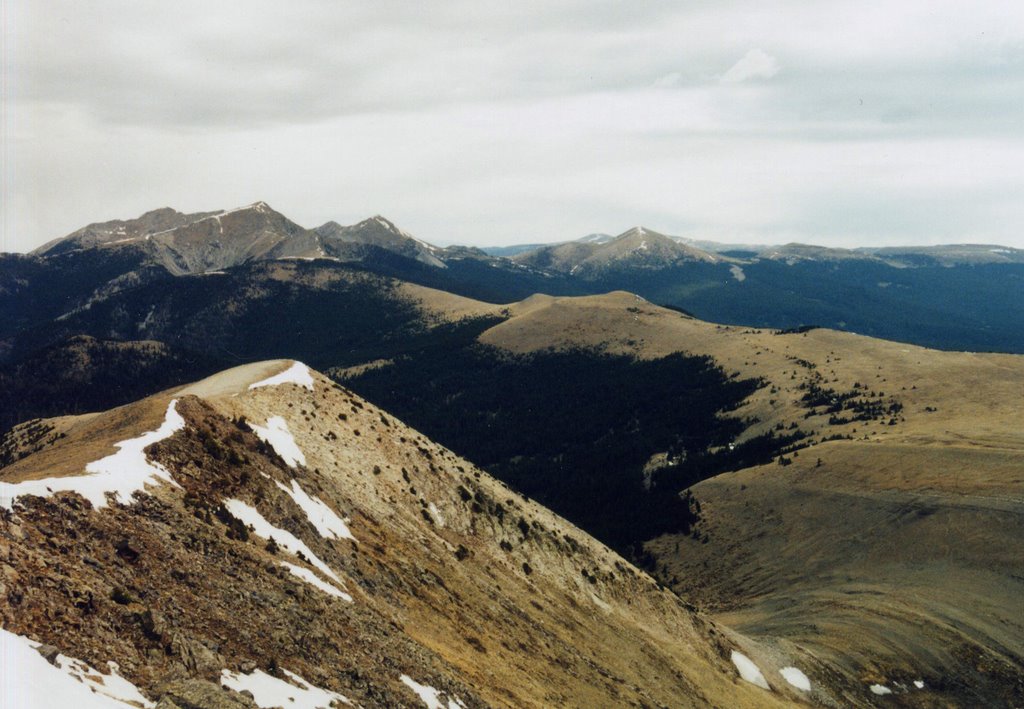
The Truchas Peaks
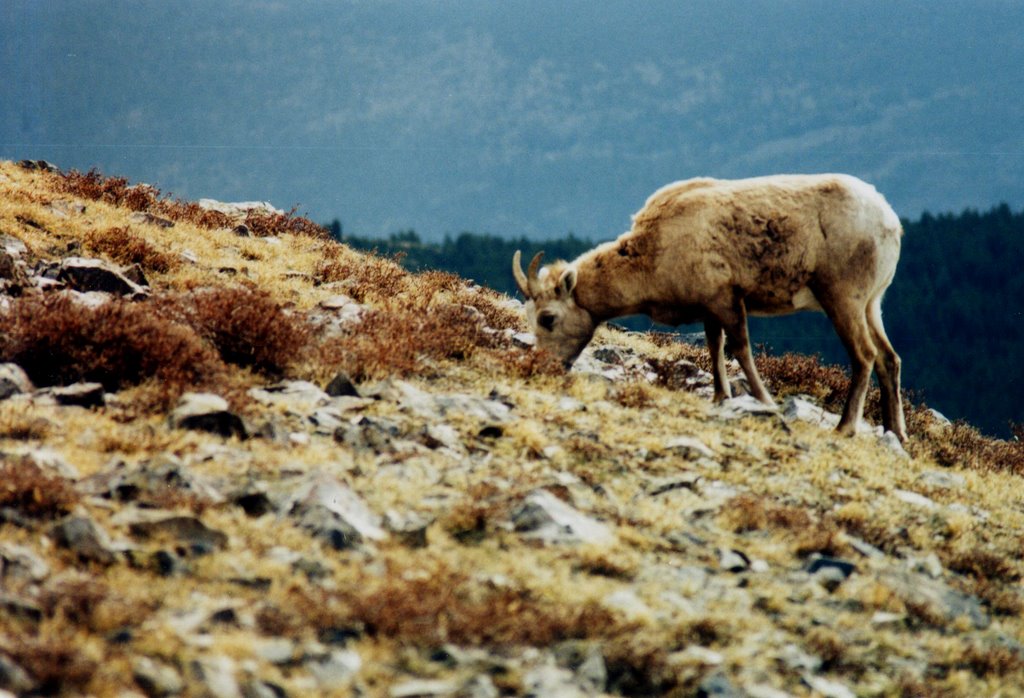
Which contained very trusting bighorns
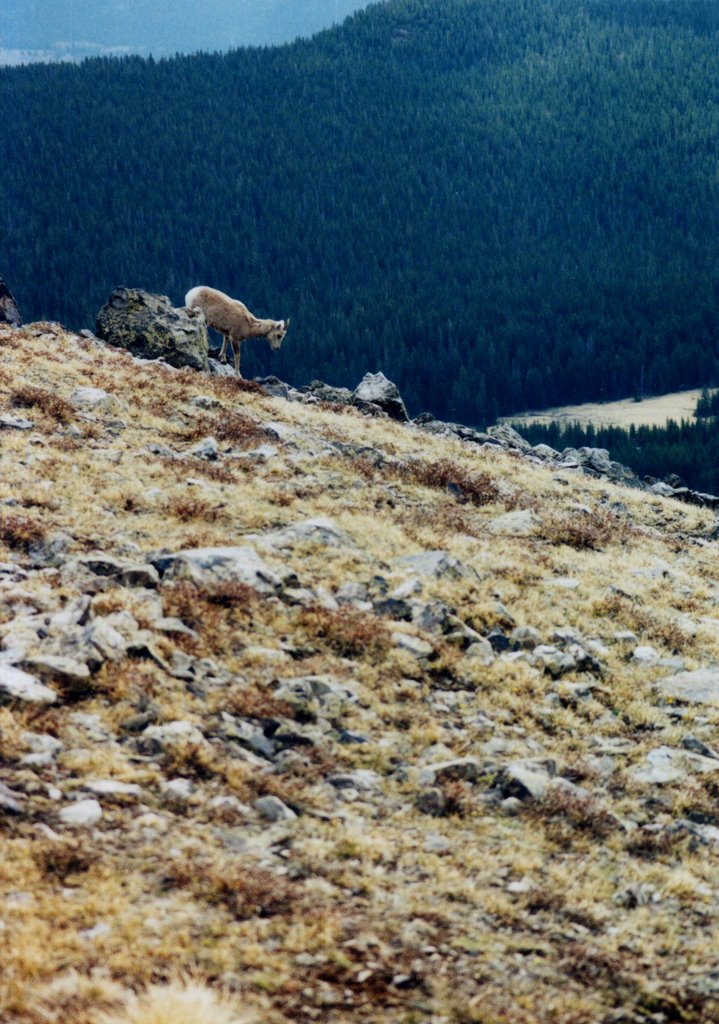
As well as baby bighorns!
DO NOT miss this collection of entries for the photo contest of the 11th International Deep-Sea Biology Symposium. (Via Deep Sea News.)
Monday, July 10, 2006
Here is allegedly the world's most dangerous road. I dunno, I've driven a few that were pretty similar. They were not, however, major conduits for inebriate Bolivian truckers; only for inebriate Oregonian loggers.
Saturday, July 08, 2006
I've been following the movement to make English the official language of the U.S. with great interest. It seems to me that both sides make an excellent case.
On the one hand, it is important for the people of a nation to share certain values. A common language is vital to this end.
On the other hand, it doesn't seem fair to make everybody speak English just because most of us do.
So I propose that a) we do, genuinely, need a National Language, and
b) there's no reason we can't pick the most logical language in the galaxy and make everybody learn that, rather than privileging certain groups.
Thus.
On the one hand, it is important for the people of a nation to share certain values. A common language is vital to this end.
On the other hand, it doesn't seem fair to make everybody speak English just because most of us do.
So I propose that a) we do, genuinely, need a National Language, and
b) there's no reason we can't pick the most logical language in the galaxy and make everybody learn that, rather than privileging certain groups.
Thus.
One major problem is that most writers on Vulcan linguistics approached Vulcan from an Earth of the 20th Century point-of-view. Also, they neglected to consider that there must be more than one major language in use on the planet Vulcan. These people acted as if their language was the only "real" version and refused to accept anyone else's work. We have had people react to us this way. Considering the hundreds of languages on Earth, it is beyond a shadow of a doubt that many languages did and still do exist on Vulcan. We all have to remember that the Vulcan languages are alien languages. They are not related to any of the languages of Earth! Trying to fit them into a human mold is most illogical. Our research has been conducted as a professional, scholarly project.UPDATE: But what do I know?
Created by a french music instructor named Jean François Sudre, Solresol remains, despite its practical disappearance, the most beautiful and perfect language ever created by one man. It consisted of just seven syllables, the notes of the scale — Do, Re, Mi, Fa, So, La, and Si (which we now call Ti) — that could be combined according to the rules of an orderly grammar to form a vocabulary of 11,732 possible words.Shiny.
Thursday, July 06, 2006
Also, for Peculiar (after the final parenthesis in his recent post), is this little excerpt:
O noble age who place their only blissThe breed is not exclusive to Santa Fe; I believe their range is expanding. The observation is not, I think, a failure of filial piety on the part of the observer, but a simple truth. I have met any number of pleasant, wise, and fair Nestors (my grandparents come to mind, among others). I wish they would, as we cannot, tell the serpents to bugger off.
In being heard until the hearer die,
Utt'ring a serpent's mind with serpent's hiss!
Then who will hear a well authorized lie
(And patience hath), let him go learn of him
What swarms of virtues did in his youth fly...
I'm reading Sir Philip Sidney's work The Old Arcadia, which can only be described as charming. Pyrocles, a young adventuring prince, has fallen in love with the image of Philoclea, a beautiful princess. In order to penetrate her father's lands (he has, after the advice of an oracle, gone into seclusion and forbidden his daughter contact with any man besides the shepherds of Arcadia), Pyrocles becomes Cleophila, an Amazon. She loves Philoclea; Philoclea's mother Gynecia divines zir true sex and loves Cleophila; Basilius, Philoclea's father, does not and also loves zir; and Philoclea herself is not indifferent to the Amazon's charms, but is rather confused by her attraction. All very Shakespeareanly gender-blent, and full of passages like:
Anyway, I mention this particularly to les autres pyrates. It's been a while since we've had a new form, having done limericks to death, resurrected them, and then buried them alive all during sophomore year. Double dactyls (higgledy-piggledies?) retain their bloom, but I, for one, am stuck on "Emily Dickinson". So I propose sapphics according to Sir Philip Sidney's rules.
(Someone else can start.)
But therewith he [a lion molesting the party] fell down, and gave Cleophila leisure to take his head to carry it for a present to her lady Philoclea, who all this while, not knowing what was done behind her, kept on her course, as Arethusa when she ran from Alpheus, her light nymphlike apparel being carried up with the wind, that much of those beauties she would at another time have willingly hidden were presented to the eye of the twice-wounded Cleophila; which made Cleophila not follow her over hastily lest she should too soon deprive herself of that pleasure.After the princess is caught and calmed, the shepherds, as is a good Arcadian shepherd's wont, pronounce eclogues. Which contest is accompanied by the following nota from Sir Philip:
The rules observed in English measured verses be these:And Sir Philip goes on to write sapphics with his newly-stated rules.
Consonant before consonant always long, except a mute and a liquid (as refrain), such indifferent.
Single consonants commonly short, but such as have a double sound (as lack, will, till) or such as the vowel before doth produce long (as hate, debate).
Vowel before vowel or diphthong before vowel always short, except such an exclamation as oh; else the diphthongs always long and the single vowels short.
Because our tongue being full of consonants and monosyllables, the vowel slides away quicklier than in Greek or Latin, which be full of vowels and long words. Yet are such vowerls long as the pronunciation makes long (as glory, lady), and such like as seem to have a diphthong sound (as show, blow, die, high.
Elisions, when one vowel meets with another, used indifferently....
Particles now long, now short (as but, or, nor, on, to).
If mine eyes can speak to do hearty errand,Not wholly successful, I think, but certainly not to be despised.
Or mine eyes' language she do hap to judge of,
So that eyes' message be of her received,
Hope, we do live yet.
Anyway, I mention this particularly to les autres pyrates. It's been a while since we've had a new form, having done limericks to death, resurrected them, and then buried them alive all during sophomore year. Double dactyls (higgledy-piggledies?) retain their bloom, but I, for one, am stuck on "Emily Dickinson". So I propose sapphics according to Sir Philip Sidney's rules.
(Someone else can start.)
The Santa fe opera season has recently opened, and we attended Carmen last night. It was something of an opportunity for me, inasmuch as I was improbably unfamiliar with either the story or the music (beyond Habañera and Toreador, of course). I was looking forward to imprinting my first impressions of a nice, classic, rip-snorting, belt-it-out warhorse of an opera, starring Anna-Sophie von Otter, live onstage.
Unfortunately, I never felt like the performance got very far off the ground. I may as well be blunt: I blame the staging. The sets and costumes were supposedly intended to portray Franco-era, fascist Spain: lots of olive uniforms, ill-fitting suits, plain dresses and aprons. All the sets were bland, urban, industrial. I have no idea how such a setting was expected to improve the opera: class struggle, tyranny, politics are not major themes in Carmen as far as I can tell. The main social tension in the libretto is between civil society, i.e. Don José's family and military career, and the freedom and exoticism of the gypsy life. But the gypsies were every bit as dreary and unappealing as everything else in the staging. The Act III smugglers' camp was a stack of intermodal shipping containers under a dingy hanging lightbulb. All the sets were claustrophobic, the only development in costuming was Escamillo's standard-issue bullfighting outfit in the final act. The only surprising moment was a capital bolt of lightning (Santa Fe's opera house is open to the air) at the exact moment the orchestra began the overature.
Less tangibly, it just didn't seem like anyone was having fun. Some momentum started to build in the Act II tavern scene, but it didn't last. All the vocalists were fine (especially Santa Fe apprentice Jennifer Black as Michaela), but they never quite let it all out. I'm well aware that there are such things as off nights, and this was only the second performance; nevertheless, I've a notion that the cast may not have found the staging any more inspiring than I did.
Carmen is often alleged to be a very sexy opera. My hopes went unfulfilled. Anne-Sophie von Otter is a rather odd choice for Carmen, and though I was more than willing to see what she might do with the role, perhaps she is indeed too cerebral a singer for all that gypsy harlot music. But again, what with the drab costuming, an inattentive and uninformed observer might never have guessed that gypsies played a role in the story. Without much to distinguish her from the many, many chorus ladies, without any exoticism, Carmen often came across as merely the bitchiest of the local strumpets.
Sorry, sorry, I didn't mean to be this negative. We did have fun. Our only really onerous irritation was overhearing a barrage of petty, lickspittle complaints from some very ill-feckit oldsters at intermission. (What's the matter with so many old folks these days? Frankly, lots of them are simply not good role models, lacking in manners, patience and generous spirit, especially in Santa Fe.) I guess I'm just perplexed why anyone would mount a miserly, austere production of a famously fun opera, for the opera house's 50th anniversery season, starring the season's headline singer. If they didn't have anything really stunning up their sleeves, cheesy gypsy costumes and castanets would have been a reliable default setting. But no doubt I'm a philistine: I came to Carmen to have fun.
Oh well. Coming soon: Die Zauberflöte, with Natalie Dessay!
Monday, July 03, 2006
Saturday, July 01, 2006
Languagehat quotes extensively from a C.S. Lewis essay on Gawin Douglas' 16th Century translation of the Aeneid into Scots. Apart from sharing my delight that so improbable a translation exists at all, I should add that Lewis, predictably, has much to teach the reader about productively approaching literature in foreign idioms.
I am glad that the question of quaintness should cross our path so early in the book; let us get it out of the way once and for all. To the boor all that is alien to his own suburb and his 'specious present' (of about five years) is quaint. Until that reaction has been corrected all study of old books is unprofitable. To allow for that general quaintness which mere distance bestows and thus to be able to distinguish between authors who were really quaint in their own day and authors who seem quaint to us solely by the accident of our position—this is the very pons asinorum of literary history...I have noted before my preference for translations with such quaintness, even awkwardness if necessary. The joy of reading such literature is in discovering scenes I would never imagine, not in populating my own stale imaginations with the names of Romans, Finns or Narts.[W]hen Douglas speaks of the Salii 'hoppand and siggand wonder merely' in their 'toppit hattis' it is easy to remember that 'top hats', in our sense, were unknown to him. But it is not so easy to see aright the real qualities of his Scots language in general. Since his time it has become a patois, redolent (for those reared in Scotland) of the nursery and the kaleyard, and (for the rest of us) recalling Burns and the dialectal parts of the Waverley novels. Hence the laughter to which some readers will be moved when Douglas calls Leucaspis a 'skippair', or Priam 'the auld gray', or Vulcan the 'gudeman' of Venus; when comes becomes 'trew marrow', and Styx, like Yarrow, has 'braes', when the Trojans 'kecklit all' (risere) at the man thrown overboard in the boat race, or, newly landed in Latium, regaled themselves with 'scones'. For we see the language that Douglas wrote 'through the wrong end of the long telescope of time'. We forget that in his day it was a courtly and a literary language...
Virgil describes Aeneas, on hearing Turnus's challenge, as laetitia exsultans; Douglas says 'he hoppit up for joy, he was so glad'. To get over the low associations of the verb 'hop' in modern English is the first adjustment. But even when this has been done, there remains something—a certain cheerful briskness—in Douglas which may seem to us very un-Virgilian. Here is another example; Virgil writes:
Quamvis increpitent socii et vi cursus in altum Vela voccet, possisque sinus implere secundos. (iii. 454)
Douglas translates:
Ya, thocht thi fallowis cry out, Hillir haill! On burd! ane fair wind blawis betwix twa schetis!
[Hillir hail - a nautical cry; On burd - "aboard"]It is admirably vivid; but it sounds very unlike the Virgil we knew at school. Let us suspend judgement and try another passage.
lumenque juventae
Purpureum et laetos oculis adflarat honores. (i. 590)Douglas says that Aenaes' mother made him 'Lyk till ane yonkeir with twa lauchand ene' [lauchand ene - "laughing eyes"]. The picture is fresh and attractive; somehow unlike the Aeneas of our imagination. But is that because Virgil has never said anything about the beauty of Aeneas, both here and in other places? On the contrary, Virgil quite clearly has told us that his hero was of godlike beauty. There has been something in our minds, but not in the mind of Douglas, which dimmed the picture; our idea of the great king and warrior and founder apparently shrinks (as Virgil's and Douglas's did not) from the delighted vision of male beauty. Douglas shocks us by being closer to Virgil than we are. Once a man's eyes have been opened to this, he will find instances everywhere. Rosea cervice refulsit: 'her nek schane like until the rois in May'. Do you prefer Dryden's "she turned and made appear Her neck refulgent"?
But refulsit cannot possibly have had for a Roman ear the 'classical' quality which 'refulgent' has for an English. It must have felt much more like 'schane'. And rosea has disappeared altogether in Dryden's version—and with it half the sensuous vitality of the image.
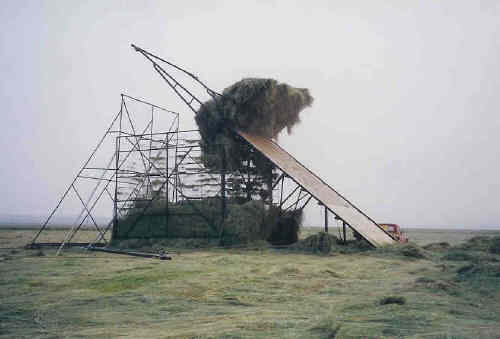
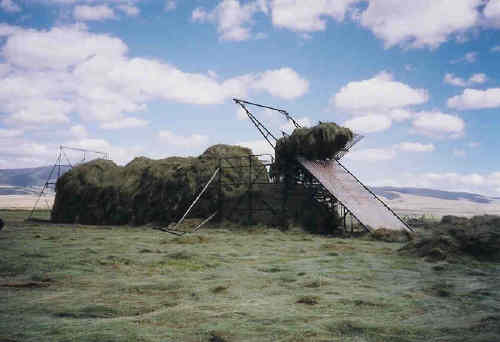
"The 'Beaverslide was invented and patented by two Big Hole Valley ranchers, Herb Armitage and Dade Stephens in 1910, under the name 'Sunny Slope Slide Stacker.' Because of the swampy ground commercial equipment has never worked very well in the Big Hole, and so locals have been creative in adapting devices to suit their needs. Use of the Beaverslide spread throughout much of the western US and Canada, but the Big Hole is now one of the few places where it is still commonly used."
From Hay in Art: the definitive website on the subject, I've no doubt, an encyclopedic treatment of a worthy topic. I've always loved driving around Wisdom, Montana, the last refuge of traditional haystacks.
Thanks to Prairie Mary.
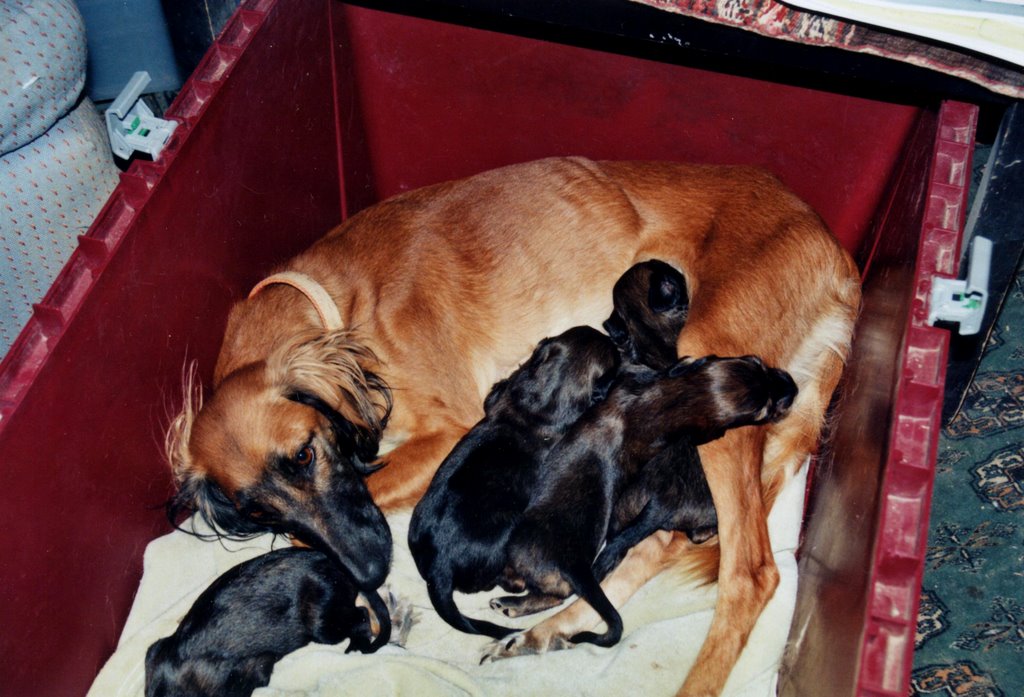
From our recent trip to visit Steve and Libby: a rather dated photo of Ataika and her puppies. At the time, they had just opened their eyes and were beginning to squirm. I don't doubt that now, two weeks later, they are considerably less sedate. Genetic gold, there! Their only fellow Asian tazis on the continent were lying in the next room with their mother Lashyn.
Tuesday, June 27, 2006
Got paid again.
It ought to go without saying, but: I am not I; thou art not he or she; they are not they. And here is not there, New Mexicans.
It ought to go without saying, but: I am not I; thou art not he or she; they are not they. And here is not there, New Mexicans.
Tuesday, June 13, 2006
This is NAIS, the National Animal Identification System. This is what they have to say about themselves:
Steve and Matt have been blogging about this (see here, here, here, here) for some time now. I haven't chimed in before because the question ("Is NAIS a good thing?") has an answer ("No") so obvious to me that I didn't want to waste time dealing with it.
But somebody out there --a not insignificant number of somebodies, I suppose-- must feel differently. And I. Don't. Get. It.
I accept that most questions will be answered differently by different people, and I try to understand why someone would come up with a different answer than I do. Are they stressing practical benefits, where I am concerned with natural rights? Is it a dispute over the data? Are we perhaps unknowingly in heated agreement? I'd rather find common ground than fill the air with bluster and sound bites. It is a great comfort to me to remember that I am not charged with convincing the world of the truth, and indeed that the chance of possessing it myself, perfectly, is vanishingly small.
But with NAIS, or similar efforts (see, e.g. Natalie Solent discussing National ID cards), there doesn't seem to me to be any possible justification. Can people really look at the last hundred years of history --of which I feel it is a remarkably small and manageable undertaking to make an acquaintance, it's not like we're asking people to study the Three Kingdoms and recite the seven impieties of Cao Cao-- and say to themselves, "I feel perfectly comfortable with increasing government surveillance and power over my private life"? And how can the same people who decry it whenever the other party is in power decide that suddenly what was a vicious abridgement of someone's rights is now an understandable requirement? Do they really think that they will never need to give up power, or that if they do, such programs will disappear with them?
And how can anyone look at history (still the last hundred years, so as not to tax anyone's waning interest) and decide that the government will never become a troubling entity against which the only option is fire, and lots of it?
Blah; rhetorical questions are a sign of a short temper. Like I said, I don't get it, and don't expect to be convinced otherwise. There are, I guess, just some people who will not be happy until they can be sure that no one is doing anything unsupervised ever. I shall call them umbridges, after the unlovely creature in Harry Potter.
The National Animal Identification System (NAIS) is a national program intended to identify animals and track them as they come into contact with, or commingle with, animals other than herdmates from their premises of origin.I quote at length because this is important.
The system is being developed for all animals that will benefit from rapid tracebacks in the event of a disease concern. Currently, working groups comprised of industry and government representatives are developing plans for cattle, swine, sheep, goats, horses, poultry, bison, deer, elk, llamas, and alpacas.
...
In April 2004, the U.S. Department of Agriculture (USDA) announced the framework for implementing the NAIS—an animal identification and tracking system that will be used in all States and that will operate under national standards. When fully operational, the system will be capable of tracing a sick animal or group of animals back to the herd or premises that is the most likely source of infection. It will also be able to trace potentially exposed animals that were moved out from that herd or premises. The sooner animal health officials can identify infected and exposed animals and premises, the sooner they can contain the disease and stop its spread.
The NAIS will enhance U.S. efforts to respond to intentionally or unintentionally introduced animal disease outbreaks more quickly and effectively. USDA’s long–term goal is to establish a system that can identify all premises and animals that have had direct contact with a foreign animal disease or a domestic disease of concern within 48 hours of discovery.
The first step in implementing the NAIS is identifying and registering premises that house animals. Such premises would include locations where livestock and poultry are managed, marketed, or exhibited. Knowing where animals are located is the key to efficient, accurate, and cost–effective epidemiologic investigations and disease–control efforts.
USDA anticipates that all States will have the capability to register premises according to the national standards by 2005. Officials with USDA’s Animal and Plant Health Inspection Service (APHIS) are currently training State officials how to use a standardized premises registration system. USDA is also evaluating alternative registration systems that States or others have developed and want to use, to ensure these systems meet the national standards. In addition, USDA is working with States and industry to educate the public about the NAIS.
As premises are registered, another component of the NAIS—animal identification—will be integrated into the system. Unique animal identification numbers (AINs) will be issued to individually identified premises. In the case of animals that move in groups through the production chain—such as swine and poultry—the group will be identified through a group/lot identification number (Group/Lot IDs).
USDA is developing the standards for collecting and reporting information, but industry will determine which type of identification method works best for each species. These methods could include radio frequency identification tags, retinal scans, DNA, or others. As long as the necessary data are sent to USDA’s information repositories in a standardized form, it will be accepted.
USDA will build upon existing identification systems and allow for a transition period from systems currently defined in the Code of Federal Regulations before requiring AINs or Group/Lot IDs. Working with States and industry, USDA will also evaluate various animal identification technologies to determine how the collection of animal movement records can best be automated.
As premises are registered and animals or groups of animals are identified based on the standard protocols, USDA will begin collecting information about animal movements from one premises to another. With an efficient, effective animal tracking system in place, USDA will be able to perform rapid tracebacks in case of an animal disease outbreak. As envisioned, only Federal, State, and Tribal animal health authorities would have direct access to the national premises and animal identification information repositories. They need this information to accomplish their job of safeguarding animal health.
USDA is investigating various options to protect the confidentiality of the information. It is important to note that the national repositories will include information only for animal and disease tracking purposes. Proprietary production data will remain in private databases.
Steve and Matt have been blogging about this (see here, here, here, here) for some time now. I haven't chimed in before because the question ("Is NAIS a good thing?") has an answer ("No") so obvious to me that I didn't want to waste time dealing with it.
But somebody out there --a not insignificant number of somebodies, I suppose-- must feel differently. And I. Don't. Get. It.
I accept that most questions will be answered differently by different people, and I try to understand why someone would come up with a different answer than I do. Are they stressing practical benefits, where I am concerned with natural rights? Is it a dispute over the data? Are we perhaps unknowingly in heated agreement? I'd rather find common ground than fill the air with bluster and sound bites. It is a great comfort to me to remember that I am not charged with convincing the world of the truth, and indeed that the chance of possessing it myself, perfectly, is vanishingly small.
But with NAIS, or similar efforts (see, e.g. Natalie Solent discussing National ID cards), there doesn't seem to me to be any possible justification. Can people really look at the last hundred years of history --of which I feel it is a remarkably small and manageable undertaking to make an acquaintance, it's not like we're asking people to study the Three Kingdoms and recite the seven impieties of Cao Cao-- and say to themselves, "I feel perfectly comfortable with increasing government surveillance and power over my private life"? And how can the same people who decry it whenever the other party is in power decide that suddenly what was a vicious abridgement of someone's rights is now an understandable requirement? Do they really think that they will never need to give up power, or that if they do, such programs will disappear with them?
And how can anyone look at history (still the last hundred years, so as not to tax anyone's waning interest) and decide that the government will never become a troubling entity against which the only option is fire, and lots of it?
Blah; rhetorical questions are a sign of a short temper. Like I said, I don't get it, and don't expect to be convinced otherwise. There are, I guess, just some people who will not be happy until they can be sure that no one is doing anything unsupervised ever. I shall call them umbridges, after the unlovely creature in Harry Potter.
Tuesday, June 06, 2006
Wargh. Just woke up from fever dreams in which I was arguing about the relevance of Nietzsche to unarmed combat with Ari. Not sure what to make of that, but I decided that my rambling, disconnected state of mind was the perfect time to post a bit. Hurrah for heat exhaustion/dehydration!
I look awful, by the by. Not just the crusty eyes and gaping mouth, but beaten up -- which is perfectly accurate, since I got jumped yesterday. I took one on the chin that's making me look like Bruce Campbell, and a shot near my eye is promising to turn into a really excellent shiner. There's another lump on my head the size of a... well, traditionally one should say "robin's egg", but it's more hummingbird sized. Thank you, hair. I'd say that you should see the other guys, but they were all girls, first off, and secondly, they're all dead. This is not my fault; they came at me with knives. In their defense, I suppose I should mention that I was breaking into their house to rearrange things a little.
Yes, clever ones, I have a beehive (Roald Dahl's English/Boxing teacher's remarks, which stood for both disciplines: "Punches slow and easily seen coming" may be relevant to this post. In my defense, I am creaky and stupid). Yesterday I gave it its two week inspection, and I'm sure that you will be ecstatic to learn that the queen, whom I did not see, is nevertheless breeding like a nun of London. From little dots at the bottom of their hexagonal homes to curling larvae to etiolate miniatures, I have small creatures in every state of development.
I feel shockingly affectionate towards them. Everything Kate has said is true, except that my French was a little ruder after they got near my swimsuit area. Thank heaven for Villon's vocabulary. And, "docile", quotha! It's easy to call them docile from twenty feet off. But they are engaging little creatures. I like them not some much individually, but as a collective. I think of the hive as a sort of companion, and it's easy to spend an afternoon just watching it guard and forage.
Pleasantly, I am not alone with my ignorance. A real beekeeper came by yesterday as well. His name is not Max, but that's what I'm calling him. He is a smart, cheerful Armenian and has kept bees for years. He was kind enough to take me down to see his hives.
The difference between what a newcomer and an experienced beekeeper can see is remarkable. He was checking for queen cups, in hopes of preventing swarming. But he walked me through the hive frame by frame. I was particularly impressed that he handled the frame with neither gloves nor smoke, and was wondering what his secret was when he said a word I do not know but am unlikely to repeat in mixed company. "Dey got me," he explained, showing me his thumb. "Now I smell like dey want to sting me. What a deal."
It was, however, not against him that their wrath fell but against me. This seemed (and seems still) rather unfair. But a little smoke sent them into their hive to gorge themselves, and we were soon peering at frame after frame again. Max could tell the young bees from the old. "Dey look bewildered," he said. I suspect him of punning.
He told me that the honey flow was starting, and that we needed to get some supers on a hive quickly. "Sometimes dey will fill up a super in one, two days. What a deal!" We shall follow his advice.
It's always a pleasure to watch someone competent and confident go about his business, so it was with renewed enthusiasm and humility that I waved good-bye to Max and started to put on my own equipage. From what followed I am tolerbaly sure that I have more to learn about how the veil works.
The stings, though, just add piquance to the endeavor. It is completely worth it, to answer Voracious Reader, for the pleasure of interacting with and working alongside such an alien earthly creature. Even if they produced neither honey nor wax I should enjoy their company. Bees have been everything to everyone from amazons to a symbol of pioneer frugality. I'm doing my best to anthropomorphise them as little and as pleasantly as possible. Reading Fabre helps. Reading Maeterlinck does not. I myself shall conclude with a selection on bees from T. H. White's Book of Beasts, as a reminder to remain credulous:
(Interesting typos in the writing of this post: "prefectly curate", "ronin's egg", "little rudder")
I look awful, by the by. Not just the crusty eyes and gaping mouth, but beaten up -- which is perfectly accurate, since I got jumped yesterday. I took one on the chin that's making me look like Bruce Campbell, and a shot near my eye is promising to turn into a really excellent shiner. There's another lump on my head the size of a... well, traditionally one should say "robin's egg", but it's more hummingbird sized. Thank you, hair. I'd say that you should see the other guys, but they were all girls, first off, and secondly, they're all dead. This is not my fault; they came at me with knives. In their defense, I suppose I should mention that I was breaking into their house to rearrange things a little.
Yes, clever ones, I have a beehive (Roald Dahl's English/Boxing teacher's remarks, which stood for both disciplines: "Punches slow and easily seen coming" may be relevant to this post. In my defense, I am creaky and stupid). Yesterday I gave it its two week inspection, and I'm sure that you will be ecstatic to learn that the queen, whom I did not see, is nevertheless breeding like a nun of London. From little dots at the bottom of their hexagonal homes to curling larvae to etiolate miniatures, I have small creatures in every state of development.
I feel shockingly affectionate towards them. Everything Kate has said is true, except that my French was a little ruder after they got near my swimsuit area. Thank heaven for Villon's vocabulary. And, "docile", quotha! It's easy to call them docile from twenty feet off. But they are engaging little creatures. I like them not some much individually, but as a collective. I think of the hive as a sort of companion, and it's easy to spend an afternoon just watching it guard and forage.
Pleasantly, I am not alone with my ignorance. A real beekeeper came by yesterday as well. His name is not Max, but that's what I'm calling him. He is a smart, cheerful Armenian and has kept bees for years. He was kind enough to take me down to see his hives.
The difference between what a newcomer and an experienced beekeeper can see is remarkable. He was checking for queen cups, in hopes of preventing swarming. But he walked me through the hive frame by frame. I was particularly impressed that he handled the frame with neither gloves nor smoke, and was wondering what his secret was when he said a word I do not know but am unlikely to repeat in mixed company. "Dey got me," he explained, showing me his thumb. "Now I smell like dey want to sting me. What a deal."
It was, however, not against him that their wrath fell but against me. This seemed (and seems still) rather unfair. But a little smoke sent them into their hive to gorge themselves, and we were soon peering at frame after frame again. Max could tell the young bees from the old. "Dey look bewildered," he said. I suspect him of punning.
He told me that the honey flow was starting, and that we needed to get some supers on a hive quickly. "Sometimes dey will fill up a super in one, two days. What a deal!" We shall follow his advice.
It's always a pleasure to watch someone competent and confident go about his business, so it was with renewed enthusiasm and humility that I waved good-bye to Max and started to put on my own equipage. From what followed I am tolerbaly sure that I have more to learn about how the veil works.
The stings, though, just add piquance to the endeavor. It is completely worth it, to answer Voracious Reader, for the pleasure of interacting with and working alongside such an alien earthly creature. Even if they produced neither honey nor wax I should enjoy their company. Bees have been everything to everyone from amazons to a symbol of pioneer frugality. I'm doing my best to anthropomorphise them as little and as pleasantly as possible. Reading Fabre helps. Reading Maeterlinck does not. I myself shall conclude with a selection on bees from T. H. White's Book of Beasts, as a reminder to remain credulous:
They are skilled in the art of making honey. They live in definite houses. They build their homes with indescribable dexterity, making them out of various flowers and filling innumerable cells with woven wax. They have kings. They have armies. They go to war.I promise that I am reading real books about beekeeping as well. They're just not as quotable.
Bees flee from smoke and are irritated with noises.
(Interesting typos in the writing of this post: "prefectly curate", "ronin's egg", "little rudder")
Saturday, June 03, 2006
I let our readers down last summer, neglecting to post the promised review of Osvaldo Golijov's new opera, Ainadamar. Well, NPR has a decent feature about it, with plenty of music to listen to, which is more than I could have offered.
Let me say, however belatedly, that I liked it. Most importantly, I liked it musically first and foremost: flamenco rhythms and melodies, Latin percussion, moorish-sounding chorus, many Sephardic touches. The occasional electronica was not overly domineering. The music has strong momentum, and the scenes flow pretty well together. Dawn Upshaw is characteristically excellent in the lead, and there is some very, very beautiful music for the low mezzo trouser role of Lorca.
As for the libretto, and the deeper meaning, well, my interest remains musical. I am not fascinating by Lorca, and Ainadamar did not engender any such interest. I think, for the record, that a lot of the libretto is paraphrased from Lorca's own poetry. As with much modern art, the meaning may or may not be present and may or may not be deep; either way, the opera doesn't motivate me to expend much effort teasing it out. I am inclined to purchase the new recording, and listen to it sans libretto.
As a post-script, let me point out that new operas are held to absurdly high standards. They are mercilessly compared (consciously or not) to the classics of the standard repetoire, which represent a tiny fraction of opera. Taking a wide historical view, I'd say that while Ainadamar might not belong in the company of the true greats, it is at least as successful as 80-85% of all operas. It's also much better than almost anything from the last 60-70 years. Finally, I quite approve of Golijov's approach of plundering ethnic musics for complex and listenable sounds. Classical music might actually have a future in such a dalliance.
Subscribe to:
Posts (Atom)