Wednesday, February 15, 2006


By the by, have I mentioned just how excellent Mrs. Peculiar is? Item: the dinner I found waiting for me Monday night was nothing other than Toad in the Hole! Item the second: for Valentine's Day, not only was she willing to listen to Tristan und Isolde with me, she suggested it!

I could say much more, but it would be wrong to excite too overwhelming a jealousy in our readers.

A fine new reference, worthy of sidebar status: Bird Families of the World! The above, if you're wondering, is a lyrebird.

And if you have time on your hands, Blugreen Pictures has fine photography of anything and everything related to the ocean.

Stop planning for the future! "It's called Apophis. It's 390m wide. And it could hit Earth in 31 years time."
"Each week, keepers were finding shark carcasses in the bottom of the tank. Week after week the three- to four-foot sharks kept vanishing. So one night someone stayed up to see who the culprit was. And, lo and behold, the learned something about this species that they never imagined..."

Video here.

Now that's a cephalopod attack!

(Hat tip: Dappled Things.)

Tuesday, February 14, 2006


Speaking of avatars, try the Mini-Mizer.

That thing on my back is a jetpack. I crocheted the scarf myself!

Sunday, February 12, 2006


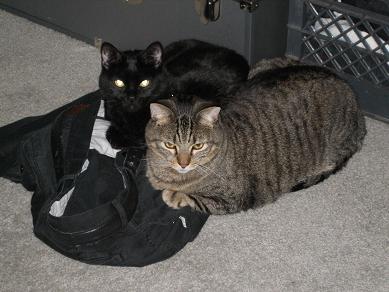
While I was outside, Vermin and Horseflesh stole my pants.
I and my wife--the Helen of the Northwest--were sitting on our balcony. Enjoying the view, the clement evening air, the twenty-pound test cobwebs.

"What a lovely night."

"Yes, we're lucky it's so nice tonight."

"Mm."

A pause, a sip of wine. "Do you think we can go back inside?"

"The smoke still looks pretty thick. I think we'd better wait a little longer."

I had been making sopapillas--and successfully, too, until the plastic slotted spoon I had been using melted, sending up enormous clouds of greasy smoke from the frying oil. After the smoke alarm went off, concerned neighbors called the fire department, who broke down the door, sprayed fire-retardant foam everywhere, and dragged us outside.

Or at least that's what would have happened, if I hadn't had the presence of mind to smash the smoke alarm with a really excellent flying front kick before it had a chance to wreak our lives. Thus, we were on the balcony, enjoying the doughy fruits of my labour and waiting for the air to clear so we could watch the Simpsons.

Sopapillas

3 cups flour
1/3 cup vegetable oil (+ approximately 2 cups for frying)
2 tbs sugar
1 tps baking powder
2 tbs salt
1 cup warm water

Mix flour, sugar, and baking powder in a large bowl. Sprinkle in 1/3 cup of oil, mixing as you go, until the mixture is grainy.

Dissolve the salt in the water and add to the flour. Mix with your hands until the texture is consistently doughy. Knead the dough for three minutes, then place on a floured surface and roll out until about 1/4 of an inch thick. Cut into 3 inch squares.

Heat the 2 cups of oil in a saucepan on high heat. When ready, drop the squares of dough in. Burn the first three or five. Melt a plastic spoon over the next couple. Fill the house with smoke. The rest should be a perfect golden brown, although it may be hard to tell with your eye watering. Sprinkle powdered sugar over the survivors. Bite off one corner, curse, and pick a cooler one. Bite off that one's corner and fill with honey. Eat outside, for the sake of the carpet and your lungs.

Lick your fingers. Shiver.

Thursday, February 09, 2006

Minutes of the Royal Society, recorded by Robert Hooke, have been found in a cupboard:
Filled with crabby italics and acerbic asides, the 520 or so yellowing and stained pages are the handwritten minutes of the Royal Society as recorded by the brilliant scientist Robert Hooke, one of the society's original fellows and curator of experiments.

The notes describe in detail some of the most astounding and outlandish scientific thinking from meetings of the society between 1661 to 1682. There is the very earliest work with microscopes, confirming the first sightings of sperm and micro-organisms. There is correspondence with Sir Isaac Newton and Sir Christopher Wren over the nature of gravity, with the latter's proposal to fire bullets into the air to see where they might drop. And there is a page that lays to rest the bitter controversy over who designed the watch that would eventually lead to the first measurements of longitude...

Minutes from December 1679 describe correspondence between Hooke and Newton proposing an experiment to confirm the rotation of the Earth. The notes include a suggestion from Sir Christopher Wren, Hooke's closest friend, to test the hypothesis by "shooting of a bullet upwards at a certaine angle from the perpendicular round every way - thereby to see whether the bullets soe shot would all fall in a perfect circle".

May we please have the complete text online? (Thank you Rachel.)
Yes! Feathered Tyrannosaur (fuzzy, anyway)! See also...
What could possibly improve a great work like Ibsen's Hedda Gabler? Recasting most of the characters as robots, of course! Heddatron!

Why, oh why, does the public not support contemporary arts?

Quote of the day, heard on Independent Native News:
"Suicide is preventable and treatable."
Do they mean necromancy?

Saturday, February 04, 2006

Heinrich Harrer: 1912-2006

(This news is almost a month old, but I missed it until recently. I suspect others might have as well.)

Heinrich Harrer, a great mountaineer, Twentieth-Century explorer, writer and geographer died on January 7th, aged 93. I have been familiar with his Tibetan travels from my youth, and Seven years in Tibet remains one of the best reads in mountaineering/Himalayan exploration literature. Harrer's account and photographs are some of the finest documents we have of Tibet as it was. He is also well know for the first ascent of the North Face of the Eiger. I was unaware until recently, however, that he also made the first ascent of Carstensz Pyramid, a 16,000' peak in New Guinea which is now generally counted as the seventh summit (representing Australasia/Oceania, since Australia's high point is, frankly, rather disappointing).

Unfortunately, much of the press attention to Harrer late in his life and after his death dwells on his fleeting and superficial connection to the Nazi party. I have no doubt that anyone who actually takes the trouble to read his books and examine his life will see his personal goodness as self-evident. His life and deeds as a whole speak much louder than a few bureaucratic documents. John Derbyshire asserts (in a podcast, not archived) that most of the Nazi muckracking which attended the film Seven Years in Tibet originated from the Communist Chinese, which makes perfect sense. The Chinese doubtless have a major interest in discrediting so excellent a documentor and defender of the kingdom they brutally invaded.

The Twentieth Century was the last, and in some ways the best, of the five centuries of great explorations. There are still innumerable oddities awaiting discovery in space and in the deep sea; there remain unclimbed peaks and walls, unentered cirques and valleys, ground where no man has stood; the intrepid can still find ample scope for personal adventure and discovery. But the world is different. Sea and space are not places we can experience without mediation. We can't get our hands dirty there, and their exploration is largely the domain of robots, not humans. Even the remotests peoples will now know who we are, as we have heard tell of all of them. And the remaining wildernesses are places we venture, but do not remain; our interaction with them is always artificial and temporary. As we lose Harrer and the last few like him, we are losing the knowledge of how it feels to enter a forbidden kingdom, discover a lost tribe, find a means of life in an empty land, venture beyond the edge of all our maps. I fear already young people are unmoved by tales of discovery because they cannot imagine how it would feel to truly discover a thing by themselves. There are many for whom a photo essay or a documentary film is a perfectly acceptable substitute for a physical journey. The wonder of beholding living creation is being replaced by the wonder of fantasy. Fantasy wonders are not bad things in themselves, but are they enough to make people step outside themselves and feel the world, their fellow men and the divine? Explorers' writings need to be read, and hard paths need to be traveled. Otherwise, life is only a game with nothing at stake.

From Cronaca I learned of this cancer killing Tasmanian devils.
A BIZARRE infectious cancer seems to be the cause of the fatal facial tumours that are wiping out Tasmanian devils, the world's largest surviving carnivorous marsupial. The disease, which has killed at least a third of the wild population since the mid-1990s, had now infected devils across more than half the island.

Early analysis of the tumours suggested that the animals may be passing on cancerous cells during fights (New Scientist, 6 July 2005). Now a team led by Anne-Maree Pearse of Tasmania's department of primary industries has performed a genetic analysis of tumour cells from 37 animals.

Results from the first 11 animals reveal that all the tumours contain cells with 13 grossly abnormal chromosomes, instead of the usual 14 healthy ones (Nature, DOI:10.1038/439549a). They were genetically identical whatever their stage of development, suggesting they did not arise in the animals' own tissue. "The cancerous cell line is leading a sort of independent existence," Pearse says.
The idea of this cancer leading an existence as a parasitic but nevertheless somehow separate entity reminds me of HeLa cells.
HeLa cells have proven difficult to control. They sometimes contaminate other cell cultures growing in the same laboratory, interfering with biological research. The degree of contamination is unknown, because few researchers test the identity or purity of already-established cell lines. It has been claimed that a substantial fraction of in vitro cell lines are actually HeLa, their original cells having been overwhelmed by a rapidly growing population derived from HeLa contaminant cells. Walter Nelson-Rees was the first to publish on the contamination of cell lines by HeLa. It has been estimated that the total mass of HeLa cells today far exceeds that of the rest of Henrietta Lacks' body.
Life is stranger than we think.
A Greek shipwreck photographed.
Sometime in the fourth century B.C., a Greek merchant ship sank off Chios and the Oinoussai islands in the eastern Aegean Sea. The wooden vessel may have succumbed to a storm or a fire, or maybe rough weather caused the cargo of 400 ceramic jars filled with wine and olive oil to shift without warning. The ship went down in 60 meters (about 200 feet) of water, where it remained unnoticed for centuries.

The classical-era ship might never have divulged to archaeologists its clues to ancient Greek culture, except for a research team from MIT, the Woods Hole Oceanographic Institute (WHOI), the Greek Ministry of Culture and the Hellenic Centre for Marine Research (HCMR). They used a novel autonomous underwater vehicle (AUV) to make a high-precision photometric survey of the site last July. Using techniques perfected by MIT and WHOI researchers over the past eight years, the robot accomplished in two days what would have taken divers years of effort.
Sadly, the robot did not answer the most important question: was the wine still any good?
It's a thin line between priceless and worthless (original article was a .pdf, which I hate, so here's a Google-cached html).
Ecosystems services to humans can somtimes be simply assessed, as in the case of fish harvested from the sea, but in other instances may be indirectly enjoyed in ways that can be complex and difficult to determine. Management based on ecosystem services requires a full understanding of the complex ways in which these services benefit humans. The valuation of ecosystem services is also necessary for the accurate assessment of the trade-offs involved in different management options. Valuation can be expressed in economic terms in many instances, using an expanding set of practical valuation techniques. These valuations should reflect the significance or importance of the ecological service categories, and ideally the valuations of unit changes in the levels of those services across management options. When unit valuations based on ratio or interval scales are not feasible, practical methods of scoring, ranking, or rating can be used in combination with assessments of the changes in service flows.
By refusing to apply standards of economic value to the services nature provides, we end up not avoiding all comparisons based on economic considerations, but rather assuming that the natural system has value only as raw resources. Making explicit those values helps us make rational decisions.
"The situation in New Orleans is classic," said Farber, who was on the National Academy of Sciences panel that reviewed Louisiana's coastal restoration plan, both before and after the disaster. "Before Katrina, everyone was saying that there were not enough wetlands to protect the city. A crude 'rule of thumb' is that three miles of wetlands will reduce storm surges by one foot, and that an acre of wetlands provides roughly $20,000 worth of services. But that same acre would sell for only $500. The gap between market value and social value is huge…if everything in the grocery store was free, we'd walk out with it all. Markets, then, cannot be relied upon to preserve resources of great social value, such as wetlands."
I'm not entirely sure that Farber's conclusion that "markets...cannot be relied upon to preserve resources of great social value" is complete. It is true, I think, but it is also true that government projects can destroy the very areas they were created to protect. It's an issue where neither the privitisation nor the centralized control of an asset is always correct, but rather one in which the only right action is the action that is right for this particular instance. No general rules, no easy answers.

Via Eurekalert.
Speaking of things Danish: leg godt.

And if you need something that involves plastic bricks and giant robots....
Rant: Irritating Technology

We're going to pick up Mrs. Peculiar's car today, which hasn't started in two weeks. What was wrong with it, concerned readers may ask? The damn thing was convinced that it's 30 degrees below zero, and helpfully compensated by instantly flooding the engine. Fortunately for us, it proved to be a problem with the thermometer, a relatively minor ailment. Had it been a computer issue, we would have been in deep.

On top of that, we just got our Logick Engine back from a computer whisperer. (Let me add he did a great job, aged about 50 and lives with his mom, but he's cool, fixed us up for $30, whereas the goons at Best Buy wanted $150 just to get started.) It took a sudden notion that our CD/CD-ROM/DVD hardware had ceased to exist.

Why on earth does everyone regard computers as a stable, reliable technology? They're more hypochondriac than Mr. Woodhouse, and their maladies seem generally of an occult nature, caused by imbalances in their Logickal Humours and the malevolences of bodiless assailants.

As the readers has probably gathered by now, my relationship with computers operates very much in the spirit of a cargo cult: I wish to offer a moderately credible icon of propitiation and thereby receive wondrous bounty; I am inclined to attribute any irregularities to Daemonic influence. I understand intellectually that this is not a tenable position. But my point stands that the Number-Sorcerors are not as trustworthy as their acolytes would have us belive. Things go wrong with them all the time, and there exists an enormous industry dedicating to palliating the hassles they create. And yet we are asked increasingly to predicate all other aspects of our life on them, our transportation, our utilities, our kitchens, our health, our art. The problem is very clear with automobiles. I know a person who drove his new car over a stick, threw a sensor out of whack; no one in his or adjoining counties could even begin to look at it, and after a tow to the city it cost $500 just to begin repairs. This for a car with a 100% functional engine: it's absurd. Why is this touted as progress? For my next car, I think I may shop for a 50s vintage Ford truck, devote myself to home repair, and get to have the bitchen wrap-around windshield.

(Similarly, capacity, convenience and reliability of data storage media are one of the reasons I have decided to eschew digital a while longer in my search for some decent photography gear. I may post more on this in future.)

Sigh. I can't bring myself to be a total Luddite, though, appealing as it is. Sometimes technology does help people. For instance, Virgin Mobile will now make fake emergency calls to subscribers, to aid and abet their weaseling out of awkward social situations. Oh brave new world, that has such people in it!

Better yet, they're making cell phones that incorporate breathalyzers (scroll down to "Sports car-design phone"). Will these assist bitter, jilted drunks in their efforts not to violate yet another restraining order by calling their ex-s in the wee hours? But I'd want one with a Herodotus Persian debate option (scroll to 1:133): a setting that wouldn't let you talk sober.

Friday, February 03, 2006

Have you bought your Danish cheese yet? I got a chunk of Denmark's Finest Havarti yesterday, and I'm quite glad I did. Support free speech and Western civilization by eating cheese: if only all moral acts were this much fun! Rosenborg Blue is another option you should have no trouble finding at the average supermarket.

This article, on MSN of all places, contains a link which allows to see the scandalous affront to the Religion of Peace. They display it too small to make out details or read most of the text, but it hardly seems on the level of say, a Alcoran in a jar of urine. Gosh, maybe violence is the answer.

Also, it's nonsense that images of the Prophet are categorically taboo in Islam (link via Cronaca). Mohammad showed up in art from Islam's much-vaunted Golden Age; things have fallen far in recent centuries.

He often appears with veiled face, as in this Turkish painting:

There are many pictures of him riding the Buraq:

And here he is full-faced:

The Birth of the Prophet Muhammad, Iran (Tabriz), c. AD 1314-15/AH 714

Excellent advice from the late Sir John Cowperthwaite, Financial Secretary of Hong Kong in the 1960s:
Asked what is the key thing poor countries should do, Cowperthwaite once remarked: "They should abolish the Office of National Statistics". In Hong Kong, he refused to collect all but the most superficial statistics, believing that statistics were dangerous: they would led the state to to fiddle about remedying perceived ills, simultaneously hindering the ability of the market economy to work. This caused consternation in Whitehall: a delegation of civil servants were sent to Hong Kong to find out why employment statistics were not being collected; Cowperthwaite literally sent them home on the next plane back.
(Via Natalie Solent.)
Augustine Volcano has been continuously erupting for many days now, tossing ash towards Anchorage, Kenai and Kodiak. These things happen in Alaska. As I was on my way out of Kodiak a little over a year ago, the island was being similarly menaced by an ash plume from Mt. Veniaminof (named after St. Innocent Veniaminov, horologist, inventor of native alphabets, bishop of Alaska and Kamchatka, circumnavigator of the globe, sea kayaker extraordinaire, and of course saint) on the Alaska Peninsula.

To the uninformed, an ash fall may sound like an annoyance at worst. But consider this eyewitness account of the 1912 event in Kodiak:

About three o'clock in the afternoon, as we emerged from the forest, we saw, for the first time, a huge, fan-shaped cloud directly west of the village. It was the blackest and densest cloud that I have ever seen. Lightning frequently flashed through. This lightning did alarm us, for electrical storms just do not happen in Alaska...

It grew dark. This was very strange, for in June in Kodiak, the daylight is almost continuous... By eight o'clock that night it was pitch dark. The ash was failing so heavily that our greatest anxiety was whether we should be able to get another breath. The gases were nauseating and to add to our terror, earthquake shocks became almost continuous. The terrible bombardment grew louder and louder; the ash sifted through cracks around the windows and doors causing such a haze in the room that, had we not known who the other occupants were, we should not have been able to recognize them...

[After receiving word to make for a ship at anchor in the harbour:] I can't describe the walk of about three blocks down to the dock, but one may have some idea of the ordeal when I say I think that was the longest walk I ever took. We tied dampened cheesecloth over our faces, but the ash penetrated several thicknesses of the material. We followed fences and ditches and somehow reached our destination. The officers of the "Manning" turned on the searchlight, but the ash was so dense that even its powerful light gave no aid. The ship's crew were more than busy, shoveling ash from the decks to keep the ship from sinking at the dock...

We didn't know which volcano it was until the following Wednesday when we learned that it was doubtless Mount Katmai, on the mainland. One woman who had been particularly brave, said, "Well, if I've got to go, I'd like to know what dirty old volcano killed me!" ...

The men who had shoveled ash from the decks were worn out and their eyes were in a pitiful condition; the ash had penetrated the bandages they wore over their eyes and had painfully cut their eyeballs...

After forty-eight hours of that awful blackness, that desolate town certainly did look good to us, ash-covered though it was. The ash was eighteen inches deep on the level, but the numerous slides that came down the cliffs were many, many feet deep... One house at the base of a hill was completely wrecked by the ash. Many roofs collapsed from the great weight and the water mains were so choked that new mains had to be laid... During the fall of ash, a log building of twenty rooms burned to the ground and people two hundred feet away were unaware of the blaze. That will probably explain to some extent the terrible density of the ash...

One of the most disastrous results was the fact that when the ash filled the streams, it made it impossible to tell where the streams had been and the dampened ash became quicksand. One man sank in the sand to his armpits before rescuers found him. It took only half an hour for him to sink so deep, but it took two and one-half hours to dig him out. His body was blue from the pressure and he later died from the effects of the ordeal...

All over Kodiak you can still see the sandy gray and yellow layer of ash wherever there's a break in the moss. I therefore found Mt. Veniminof's rumblings more than a little unnerving, particularly as the eruptions also bring the risk of tsunami.

Alaska's quite a place.

Memory Eternal

Tessa Horan died last Wednesday from a shark attack while working in the Peace Corps on the Island of Vava'u in Tonga. I was not a close friend, but she was one of my favourite co-workers at the Santa Fe ski area, always friendly and kind, a person who made people's days better. Her death was much too early, but it was in a good place engaged in good works. We can only hope people will one day say as much of us. I will miss our acquaintance.

Wednesday, February 01, 2006

Happy St. Brigid's Day!
I should like a great lake of ale
For the King of Kings;
I should like the family of Heaven
To be drinking it through time eternal.

I should like the viands
Of belief and pure piety;
I should like the flails
Of penance at my house.

I should like the men of Heaven
In my own house;
I should like the kieves
Of peace to be at their disposal.

I should like vessels
Of charity for distribution;
I should like caves
Of mercy for their company.

I should like cheerfulness
To be in their drinking;
I should like Jesus,
Too, to be here (among them).

I should like the three
Marys of illustrious renown;
I should like the people
Of Heaven there from all parts.

--Attributed to St. Brigid of Ireland
Raise a glass and rejoice!

Sunday, January 29, 2006

Saturday, January 28, 2006

An article on Mozart by Terry Teachout is well worth your time. He makes one of those points which is so frustratingly obvious in retrospect:
To my mind, no one has done a better job of concisely explaining what makes Mozart Mozart than Donald Tovey, whose essay on the G Minor Symphony, K. 550, the greatest of the minor-key works, is a convenient starting point. Tovey offers a seeming paradox that will startle many readers: “We can only belittle and vulgarize our ideas of Mozart by trying to construe him as a tragic artist.” What could he possibly mean, especially with reference to the G Minor Symphony, still widely regarded as the locus classicus of tragedy in music? The answer, Tovey replies, is that Mozart was up to something altogether different: “Mozart’s whole musical language is, and remains throughout, the language of comic opera.”

This bald-faced assertion, so surprising at first glance, turns out on closer inspection to be all but self-evident. From the rush and bustle of the outer movements of the G Minor Symphony (whose compositional language Tovey likens to Rossini’s Overture to The Barber of Seville) to the wittily “theatrical” exchanges between soloist and orchestra in the later piano concertos, one finds in Mozart’s mature instrumental works an abundance of proof that he thought of all his music in dramatic terms—and that the kind of “drama” he had in mind was 18th-century opera buffa, abstracted at times to the point of sublimity but still essentially comic.

For the Romantic of deepest hue, such a claim must necessarily have the effect of trivializing Mozart’s minor-key music. But Mozart himself, lest we forget, was not a Romantic—indeed, Romanticism per se did not exist in his lifetime—and thus was not afflicted by the paralyzing idea that comedy is unserious.
This octopus attack is doubtless making the rounds, but how can one not link to such a thing?

Tuesday, January 24, 2006

Natalie Solent is picking fights again. This time she's arguing with Prof. A. C. Grayling about the size of religious versus scientific contributions to human welfare. I'm failing to see the conflict, myself, but both sides seem to feel that there is one.

I don't, for one, understand the criteria Prof. Grayling is using to divvy up the shares. Religious motives are not incompatible with the scientific method. Nicholas Steno was no less a scientist than he was a bishop.

Moreover, Prof. Grayling wants to have it both ways:
The express implication of my original formulation was of course that there are precious few ways in which religion does not do serious disservice to mankind, and many ways in which the benefits of science outweigh the disservice it can be used to do. The defenders of religion like to point to the ceiling of the Sistine Chapel and Bach's sacred cantatas (etc), together with the solace afforded the old, ill and lonely (etc again), as a kind of equivalence to the payoff of science's positive fruits against Zyklon B (to use your own & well-chosen example).

But the enthymematic point I was making is precisely that even if religious art (invariably a product of devotion? or of the fact that the church had the money to commission it?) and the deceiving solaces are counted into the equation, the massive burden of conflict, psychological no less than in the way of wars, inquisitions, crusades, burnings of heretics and the rest - egregious among them the Holocaust - for which religion is directly and indirectly responsible, makes for a massive weight of harm to humanity which dwarfs these benefits.
That religion has inspired men to do wrong is not a datum I would dispute. What I fail to see is how this criterion of inspiration may ever be met by "science". If we are to judge debits and credits purely by the source of motivation, I do not understand how a method can provide this. And turning about, I fail to see how science, even Prof. Grayling's post-1600 definition of it, has been absent from tragedy. We are tool-using animals, and we have put tools to a number of nasty uses. By one standard almost all crimes can be placed at religion's door; by the other, all falls under science's broad lintel.

It is odd that Prof. Grayling places the start of science at Bacon and Descartes, ignoring the great works of the medieval logicians. The state parallels our own times rather uncomfortably. There seem to be a number of outstanding scientists (Richard Dawkins, I'm looking at you) who wouldn't know a logical fallacy if it licked their face. But empirical evidence requires this foundation of logical thought.

A postscript: I hate--detest--abominate these "science v. religion" arguments. I've tried to express what I feel is the fundamental flaw in this one. I have never felt that my belief in empirical truth was ever threatened by my faith in the Divine, and I don't see how any sensible person could find them conflicting. If you think that the world is six thousand years old, well, congratulations: you're wrong. But to use that belief as a stand-in for all religious thought is just stuffing another straw man.

Sunday, January 22, 2006

Overheard at a Santa Fe restaurant:
Customer: So what's the altitude here?

Waiter: Oh, about 7,000 feet or so.

Customer: Huh.... is that year-round?

Waiters are an immensely underappreciated lot*. In an ideal world, everyone would be required to work customer service before gaining the right to receive any. In this world, everyone should at least have to read a few months' entries on Waiter Rant in order to be admitted to a restaurant. It's truly appalling how wretchedly restaurant patrons can treat their servers. It's not rare either, a lot of people do it. People speak and act to waiters in ways they would never dare to strangers on the street. If the Christian ethic/categorical imperative/golden rule/common human decency are insufficient motivation for you to treat your server politely, consider the ample opportunities they have for vengeance (and how!). It behooves you to be at least a teeny bit nice to the person carrying your food.

Also, tip! Waiters make their money through tips and nowhere else. An inadequate tip is stealing, just as much as if you take your spare key and drive your car away from the mechanic without paying for your new transmission. Guidelines: 10% is nasty, insulting, only for palpably bad service. 15% is adequate, but hardly generous. 20% and up says, "Thank you." And if you have special requests, difficult children, &c., tip more! Remember, poor people are very often the most generous tippers. If you can afford to eat out, you can afford to tip.

Keep in mind, waiters take it from all sides: from customers, who want their hearts' desire, and seldom appreciate any good thing they didn't think of beforehand; from cooks, who somehow resent being asked for enchiladas without cheese or tortillas; and from management, who are the reason the last customer's placemat gets turned upside down for you (sometimes twice) instead of being replaced with a new one. Do you want, on your romantic evening out, to venture into a steamy kitchen full of sweaty, surly, Spanish monoglot chefs bearing prison tattoos and knives and tell them that your steak is just a hair underdone? Or would you rather complain to the coked-up dilletant and his trophy wife, who secretly want the restaurant to fail to escape the shadow of a famous restaurantuere mother, not to mention tax purposes? I thought not. That's what your waiter does: keep it in mind. And remember just how spoiled and incredibly lucky you are to live in the only age in history where you can receive such service and food without being born of noble blood. Noblesse oblige.

*Full disclosure: I have never worked as a waiter. I'm not that good. If I were a waiter, I wouldn't be complaining to you, the customer, because waiters don't do that. They're that good! But I am married to one, and count many among my friends. And I have worked several customer service jobs, I have worked for tips. When I was a river guide, I saved people's lives without getting tipped for it.

Also, I can't think of a time when I've ever had a bad experience in a non-fast-food restaurant. (As far as fast food goes, I'll only point out that the world's worst geographic location for acute gastrointestinal distress is the salt flat east of Wendover, Nevada.) When I go out, I'm willing to be surprised with food that a professional chef thinks is good. I'm not in a hurry. I'll trust the judgement of the people who deal with the food every day. I want to place an uncomplicated order and receive a tasty meal with a minimum of trouble. If I want my special favourite idée fixée, done just so, I cook it myself.

But you, as a reader of this blog, are surely nice to your servers, a generous tipper, gentlemanly in all things. What then can you do? Educate! Tell your family, friends and anyone who will listen how to be decent customers. And secondly, ridicule! If you're at a restaurant and the next table over is berating their waitress for forgetting their request that the house salad look like the flag of Ireland, speak up! Tell them what ludicrous swine they are. Invite them to speak that way to someone who doesn't depend on their putative generosity for a living. Offer them lurid visions of what will happen if the cooks catch them outside the restaurant doors. Let's make these people too ashamed and afraid to show their faces in polite society!
Friday, January 20, 2006

There are a few first principles in bee-keeping which ought to be as familiar to the Apiarian as the letters of his alphabet :

1st. Bees gorged with honey never volunteer an attack.

2nd. Bees may always be made peaceable by inducing them to accept liquid sweets.

3rd. Bees, when frightened by smoke or by drumming on their hives, fill themselves with honey and lose all disposition to sting, unless they are hurt.

4th. Bees dislike any quick movements about their hives, especially any motion which jars their combs.

5th. Bees dislike the offensive odor of sweaty animals, and will not endure impure air from human lungs.

6th. The bee-keeper will ordinarily derive all his profits from stocks, strong and healthy, in early Spring.

7th. In districts where forage is abundant only for a short period, the largest yield of honey will be secured by a very moderate increase of stocks.

8th. A moderate increase of colonies in any one season, will, in the long run, prove to be the easiest, safest, and cheapest mode of managing bees.

9th. Queenless colonies, unless supplied with a queen, will inevitably dwindle away, or be destroyed by the bee-moth, or by robber-bees.

10th. The formation of new colonies should ordinarily be confined to the season when bees are accumulating honey ; and if this, or any other operation must be performed, when forage is scarce, the greatest precautions should be used to prevent robbing.

The essence of all profitable bee-keeping is contained in Oettl’s Golden Rule : KEEP YOUR STOCKS STRONG. If you cannot succeed in doing this, the more money you invest in bees, the heavier your losses ; while, if your stocks are strong, you will show that you are a bee-master, as well as a bee-keeper, and may safely calculate on generous returns from your industrious subjects.
Rev. Langstroth's Axioms of Bee-Keeping.

Saturday, January 14, 2006

Another translation of the new-found Sappho.
Pursue the violet-laden Muses' handsome gifts,
my children, and the loud-voiced lyre so dear to song;
But me--my skin which once was soft is withered now
by age, my hair has turned to white which once was black,
my heart has been weighed down, my knees give no support
which once were nimble in the dance like little fawns.
How often I lament these things. But what to do?
No being that is human can escape old age.
For people used to think that Dawn with rosy arms
amd loving murmurs took Tithonus fine and young
to reach the edges of the earth; yet still grey age
in time did seize him, though his consort cannot die.

Friday, January 13, 2006

From the Ulaanbaatar Post:
Th Moscow Circus has not performed in Mongolia for over 25 years... However, that will soon change when the troupe form Moscow hits Ulaanbaatar to produce a week-long series of twice-daily shows between January 15 and 21 at Mongolia's State Circus...

Whilst the Russian performers who are on their way to Mongolia will not have too much problem with the winter temperatures, the elephants originate in India and are not used to the cold in Ulaanbaatar. To keep them warm Zorigt revealed that they are being given two liters of vodka per day.

Is that all? The Russian performers must be drinking them under the table.

Wednesday, January 11, 2006

More photos:

Take a look at some fascinating photos from the shipbreaking yards at Chittagong, Bangladesh. They're all worthwhile, and a couple (Cable Gang, Dust, Boy Worker) are really stunning. Chittagong is pretty much the only place on earth where they take ocean-going ships apart. It's also not the kind of place that loves photographers, so these images are pretty unique.

Also take a look at these pictures from China. A few are wonderful photographic imitations of classical Chinese landscape painting. Very fine! The parent website, The Luminous Landscape, has tons of other good stuff.

(I'd post some on the blog, but I don't want to step on copyrighted toes. Give the photographers their due, and visit the site.)

Tuesday, January 10, 2006

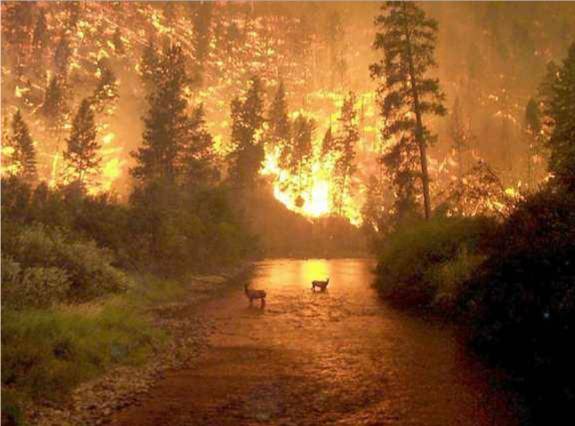
I recently stumbled across the above photograph, an image I remember well (not exactly fondly) from five-and-a-half years ago. It's a picture of the 2000 fires in the Bitterroot Valley, specifically the East Fork of the Bitterroot outside Conner, Montana. I was quite nearby at the time, in Salmon, Idaho, about an hour's drive south. It was the first time I was in the vicinity of major forest fires. I remember the smoke clouds to the west being so thick that we could look directly at the sun, sometimes seeing sunspots with our naked eyes through the perfect brown filter.

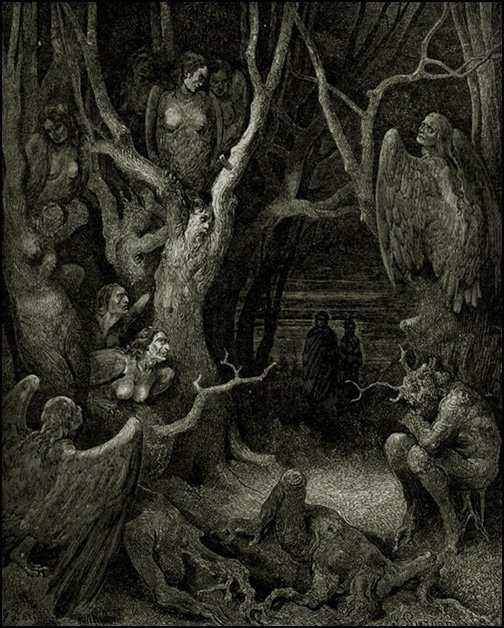
I've since floated and driven through several other small to medium fires. Though I was never in a scene as hellish as that photo, active blazes do put one in mind of scenes a few circles down in Inferno. The light is veiled and ruddy, the air unwholesome. Blackened silhouettes of trunks and stumps stand naked, carved into Rococo shapes by burning, some smoking like chimneys. Smoke pours from holes in the earth and stones tumble down the loosened slopes. Flames ripple up brushy hillsides or crackle into crowns of trees. I floated through one such on the Main Salmon in 2003 without incident. It seemed that we had come through after the worst was over, as the fire was calming down. But the next morning we awoke to strong winds, and looked back upstream to see an immense column of yellow-orange erupting into the sky above the canyon.

Whenever I have seen such fires in action, I have assumed the worst about what would be left when the flames were gone. But every time I have been pleasantly surprised. Where there's smoke there's fire, but there's usually vastly more smoke. The areas you see marked as burned in newspaper maps are very far from wastelands. Some patches are indeed devastated, but most areas are only mildly singed. Undergrowth soon flourishes happily, and wildflowers are profuse in the following years. Wildlife doesn't seem to mind burned zones particularly. I even spent time in the Kalmiopsis Wilderness in the years immediately following the Biscuit Fire, possibly the nastiest burn in living memory. Even there, there are still living trees, limpid water, bears, salmon, carnivorous plants. The most dramatic aftereffects (in Idaho, at least) are landslides. The rivers have run clear much more seldom than they did before the fire years, as any reasonably focused downpour induces the loosened mountainsides to cast themselves down in a wall of mud, logs and stones, often giving the rivers some wonderful new rapids in the process.

Cramer Creek Rapid (a.k.a. De-Rig) formed overnight from a debris flow in August 2003, shortly after the Cramer Fire, creating some of the biggest whitewater on the Salmon.

My point in all this is that forest fires most definitely do not destroy an area's value as wilderness. Nature's change and growth is often not a gentle process; there is violence and destruction in it. That is where much of the awe and majesty of wilderness is to be found, and it is what sets true wilderness apart from gentlemen's estates. The notion implicit in salvage logging of burned forests is that the area is ruined, so why not pull what resources we can from it? I don't mind the resource extraction per se. What I greatly mind is the attendant road-building in roadless areas, excused on the grounds of this alleged ruination, which is believable only to those who have no serious knowledge of the areas. Wilderness should be managed as wilderness, through fires, floods and everything else. I say again, these areas are far from ruined, even on the scale of a few years. Seeing them change, through slow growth or sudden shock, in ways one would never guess, is one of the great delights and privileges of knowing the wilderness.

This is sadly likely to be an issue in my neck of the woods in the coming year. New Mexico has had no significant snowfall this season; our 12,000-foot mountains show no white at all. There have already been fires in Colorado: it's freakin' January! For all I've said above, please don't think I enjoy seeing forests burn. I definitely don't want to see the entire Pecos Wilderness burn in a week. If we don't get some precipitation soon, things will be very grim. But they'll still be better than an infestation of new roads.

Here (courtesy of Chas) is a soldier in Iraq blogging on Iraqi birds. And not birds alone: he also mentions eels and Tigris salmon (Barbus esocinus), among much else. His general natural history blog, Homerange, is definitely worh a visit as well.

It's good to see that we have some soldier-scholars out there!

I ain't afeared of a man with a beard. From our lovely mid-continent correspondent comes a brief history of priestly facial hair.
In the West hermits and monastics also had long hair and beards, like St Martin of Tours. However, the parish clergy came to a kind of compromise. Although in order to avoid seeming effeminate, Western Orthodox clergy did not shave, they nevertheless trimmed their beards quite closely. This is clear from icons of St Leo the Great or St Gregory the Great. Unfortunately, this tradition of trimmed beards was lost with the tyranny of Charlemagne at the end of the eighth century. With his massive 'barbarian' inferiority complex, it was his desire in all things to imitate pagan classical Rome. It was therefore under him that Western clergy were ordered to shave regularly. For example at the Council of Aachen (816), it was stipulated that priests and monks were to shave every two weeks.
The opening quip is from my grandfather, after someone called him the cat in the hat. He (my grandfather) was never slow off the mark.

Monday, January 09, 2006

Blessings on thy warty head

Loyal readers are doubtless aware of Odious' and my fondness for bad poetry, often favouring it over good. Since Billy Collins and Were the Gracchi worth the hassle don't don't quite compete in this category, let me offer up the following:

At ease he sits upon the pool
And, void of fuss or trouble,
Makes vesper music fit for kings
From out an empty bubble:

A long-drawn-out and tolling cry,
That drifts above the chorus
Of shriller voices from the marsh
That April nights send o'er us;
A tender monotone of song
With vernal longings blending
The rises from the ponds and pools,
And seems at times unending;

A linked chain of bubbling notes,
When birds have ceased their calling,
That lulls the ear with soothing sound
Like voice of water falling.
It is the knell of winter dead;
Good-by his icy fetter.
Blessings on thy warty head:
No bird could do it better.

--John Burroughs, The Song of the Toad
Update: Rats! (So to speak.) Not true, and therefore not well-deserved. Billy Collins is still good though!

Swift, harsh and well-deserved poetic justice in New Mexico. It rather reminds me of my favourite Billy Collins poem to date:

I wondered about you
when you told me never to leave
a box of wooden, strike-anywhere matches
lying around the house because the mice

might get into them and start a fire.
But your face was absolutely straight
when you twisted the lid down on the round tin
where the matches, you said, are always stowed.

Who could sleep that night?
Who could whisk away the thought
of the one unlikely mouse
padding along a cold water pipe

behind the floral wallpaper
gripping a single wooden match
between the needles of his teeth?
Who could not see him rounding a corner,

the blue tip scratching against a rough-hewn beam,
the sudden flare, and the creature
for one bright, shining moment
suddenly thrust ahead of his time—

now a fire-starter, now a torch-bearer
in a forgotten ritual, little brown druid
illuminating some ancient night.
Who could fail to notice,

lit up in the blazing insulation,
the tiny looks of wonderment on the faces
of his fellow mice, one-time inhabitants
of what once was your house in the country?

—Billy Collins, The Country, from Nine Horses
Speaking of Peculiar, he has excellent taste in literature, as evidenced by his gift to me of Kepler's Somnium. It's the tale of Duracotus, the son of the Icelandic witch Fiolxhilde. She summons a spirit, which can only travel through shadows, but thus at a great pace, to tell him of the Moon.

The story is a thin disguise of Kepler's objective, which is a brief description of what men would see from the surface of the Moon. It's altogether lovely, and I recommend it to anyone. If what I've told you doesn't intrigue you enough to read it, perhaps his nasty little epigram regarding the anti-Copernicans will:
They were able to castrate
The bard lest he fornicate;
He survived without any testicles.
Alas, O Pythagoras,
Whose thinking wore out iron chains;
They spare you your life,
But first they get rid of your brains.
--Note 7, Kepler's Somnium, trans. Edward Rosen

He also, accurately enough, refers to central Kansas as "an anus of the universe".
Peculiar and Proclus and I have a history of--well, of a number of things, but the one I'm thinking about right now is going up on the mountain and slinging rocks at trees. Given our skill, it is remarkable that we have six eyes between us still. But I don't believe we ever considered inscribing our stones:
Many sling bullets survive from antiquity, some with inscriptions scratched on them. The Greek for one of these leaden projectiles is molybdis, and in Latin they are called glandes plumbeae (literally leaden acorns). Here are a couple of inscriptions, from Corpus Inscriptionum Latinarum, I:

650: Feri Pomp(eium) = Strike Pompey.

682: Pet(e) culum Octavia[ni] = Attack Octavian's arsehole.
(The implication is that Octavianus (the future Augustus) would have turned tail in flight.)
Is anyone surprised?
Town hall bureaucrats are to be given sweeping new powers to investigate homes for identity card evasion and to impose heavy fines on occupants found without one.

The revelation, in an obscure Whitehall consultation paper, calls into serious doubt the Government's repeated promises that planned ID cards, already hugely controversial, will be voluntary and that no one will be forced to carry one.

It will stiffen resolve at Westminster to oppose the Identity Cards Bill, which is due before the Lords again next week.
I should damn well hope so. From Samizdata.