If a customer never says “Please” or “thank you” during the course of the meal you’re getting 15% or less.
If the customer says “You’re the best waiter I’ve ever had” – your tip is sure to be shit.
A customer who smells the cork is an amateur.
Serve Decaf – to everybody.
Never shortchange the bus people when you tip out.
Coke head waiters work their entire shift. The Potheads always want to leave early. The Crackheads bolt as soon as they get their first cash tip.
Sunday, August 28, 2005
Damn straight:

Monday, August 22, 2005
Nature is always stranger than you think:
The snapping shrimp (Alpheus heterochaelis) produces a loud snapping sound by an extremely rapid closure of its snapper claw. It was commonly believed that the sound is generated when the two claw surfaces hit each other. We show that the sound, in fact, originates from the collapse of a cavitation bubble. During the rapid snapper claw closure a high-velocity water jet is emitted from the claw with a speed exceeding cavitation conditions. Hydrophone measurements in conjunction with time-controlled high-speed imaging of claw closure demonstrate that the sound is emitted at the cavitation bubble collapse. A model for the bubble dynamics based on a Rayleigh-Plesset type equation quantitatively accounts for the time dependence of the bubble radius and for the emitted sound."Shrimpoluminescence"?
We now also report that a short, intense flash of light is emitted as the bubble collapses, indicating that extreme pressures and temperatures of at least 5,000 K must exist inside the bubble at the point of collapse. We have dubbed this phenomenon 'shrimpoluminescence' — the first observation, to our knowledge, of this mode of light production in any animal — because of its apparent similarity to sonoluminescence, the light emission from a bubble periodically driven by ultrasound.
Do you want to behold the strange and lurid art of a culture bizarre almost beyond imagination? Take a look at James Lileks' Bureau of Corporate Allegory: engravings from old stock certificates!
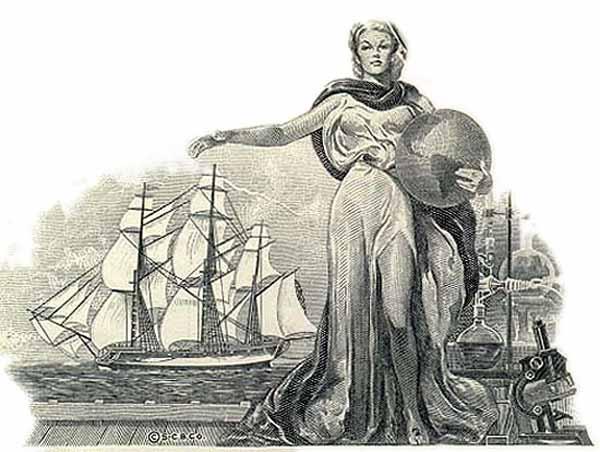 Note the stigmatum on her left foot. Whatever will future archaeologists conclude?
Sunday, August 21, 2005
Iconoclast terrorists. Those who can't build, tear down.
Via Cronaca.
The Colosseum in Rome is to be cordoned off to the public behind metal barriers as Italy moves to protect its cultural heritage from the threat of terrorism.I wish the Italians luck in defending their heritage and their lives. Italy seems to me to be a likely target for the next bombing. I'm glad this conclusion has not escaped the people who can do something to prevent it.
Heightened security at the 2,000-year-old amphitheatre is among a number of preventive measures being implemented across the country after last month's terror attacks in London.
Via Cronaca.
Saturday, August 20, 2005
Also, here are some fun toys for fellow geomorphology and orometry enthusiasts:
Virtual Earth allows you to zoom in on a map of the U.S. until the map turns to aerial photos. You can zoom in to an impressive level of detail, enough to distinguish individual trees. You can even, if your curiosity inclines this way, see photos of Nevada's Area 51.
If you happen to have some old 3-D glasses lying around, take a look at the USGS' 3D-formatted photos of Lodore Canyon, including many shots from Powell's 1871 expedition. The parent site has 3-D images of many other national parks.
And if you're really obsessive about this kind of stuff, you might enjoy these writings on prominence theory and the mathematics of orometry. Prominence, if you're wondering, is a method of measuring a mountain's size and regional importance independent of its absolute elevation. Imagine it thus: picture sea level beginning to rise around your favorite mountain. At some point, the water would cut off your mountain's land connection to any higher peaks. It would then be the highest peak on its own island, and its height above that imaginary sea level is its prominence. Enjoy!
Headline of the day: "Lava sledding is one tough sport."
You bet your ass it is!
Someone once told me that the many vertical gouges one sees adorning the fall-lines on the blasted shale mounds on the Navajo reservation north of Flagstaff are the result of similar recreation. I hope it's true. It would certainly be an excellent way not to grow up a whiner, taking high-speed, face-first diggers into the Chinle Formation, picking shards of petrified mud out of eyes and teeth, and cheerfully sprinting back for more.

Sledding anyone?
Rightly thinking that it was the sort of thing which would intrigue me, Peculiar sent me this:
My brain kept me up at night worrying at it. I keep wanting to make little bits of it make sense, but without getting at least a stanza, I can't get any sense of what's going on. Cerdis zerom: Sur dix héroes? One commentator at languagehat suggests "Ceux d'Izere on diront tous lapins y est".
It doesn't help that the mathematical portion of my mind keeping telling me to analyse it according to the occurence of phonemes.
POEME EN LANGUE INCONNUE.From languagehat.
Cerdis zerom deronty toulpinye,
Purois harlins linor orifieux,
Tictic falo mien estolieux,
Eulfiditons lafar relonglotye.
Gerefeluz tourdom redassinye;
Ervidion tecar doludrieux,
Gesdoliou nerset bacincieux,
Arlas destol osart lurafirie.
Tast derurly tast qu'ent derontrian,
Tast deportulast fal min adian,
Tast tast causus renula dulpissoitre,
Ladimirail reledra survioux,
C'est mon secret ma Mignonne aux yeux doux,
Qu'autre que toy ne sauroit reconnoistre.
—Marc Papillon, seigneur de Lasphrise (1597)
My brain kept me up at night worrying at it. I keep wanting to make little bits of it make sense, but without getting at least a stanza, I can't get any sense of what's going on. Cerdis zerom: Sur dix héroes? One commentator at languagehat suggests "Ceux d'Izere on diront tous lapins y est".
It doesn't help that the mathematical portion of my mind keeping telling me to analyse it according to the occurence of phonemes.
Friday, August 19, 2005
Lacking anything spectacular of my own, I can't resist sharing some amazing shots of the Four Girls Mountains (Siguniang) Nature Preserve in Sichuan. The photographer is Kenzo Okawa. Bravo!



Harry Potter and the Half-Blood Poet.
JUNE is the cruellest month, breedingVia Eve Tushnet.
Voldemort out of the dead land, mixing
Crucio and Imperius, stirring
Harry to behave like a prat.
What's that term? Oh yeah: heh.
Honesty is not a quality often found in debates regarding conservation. Any number of "facts" have been published by both sides, and it takes a bit of searching to determine which are absurd. If everyone would just stop lying, we could get a lot more done. But the short-term gains from mendacity apparently overshadow the long-term gains of reputation.
I like wind power. It's as close to free as one gets, and if it's not horribly noisy or "kill[ing] birds in an avian frappe", I'm all for it. While I don't believe that it will ever serve as a primary source of energy, that doesn't mean that it can't help out where appropriate. Apparently for some people, "appropriate" means "in someone else's yard".
I am also perfectly happy to trade houses with Sen. Kennedy.
Honesty is not a quality often found in debates regarding conservation. Any number of "facts" have been published by both sides, and it takes a bit of searching to determine which are absurd. If everyone would just stop lying, we could get a lot more done. But the short-term gains from mendacity apparently overshadow the long-term gains of reputation.
I like wind power. It's as close to free as one gets, and if it's not horribly noisy or "kill[ing] birds in an avian frappe", I'm all for it. While I don't believe that it will ever serve as a primary source of energy, that doesn't mean that it can't help out where appropriate. Apparently for some people, "appropriate" means "in someone else's yard".
I am also perfectly happy to trade houses with Sen. Kennedy.
Parallels between terrorism and piracy.
What is needed now is a framework for an international crime of terrorism. The framework should be incorporated into the U.N. Convention on Terrorism and should call for including the crime in domestic criminal law and perhaps the jurisdiction of the International Criminal Court. This framework must recognize the unique threat that terrorists pose to nation-states, yet not grant them the legitimacy accorded to belligerent states. It must provide the foundation for a law that criminalizes not only terrorist acts but membership in a terrorist organization. It must define methods of punishment.It's always nice to have a new model to consider when dealing with a problem as intractable as terrorism. The "war" paradigm is simplistic and easily criticized, that of "law enforcement" toothless. I think the author neglects the special motivations of terrorists, but dealing with them as pirates were dealt with has a certain charm:
Coming up with such a framework would perhaps seem impossible, except that one already exists. Dusty and anachronistic, perhaps, but viable all the same. More than 2,000 years ago, Marcus Tullius Cicero defined pirates in Roman law as hostis humani generis, "enemies of the human race." From that day until now, pirates have held a unique status in the law as international criminals subject to universal jurisdiction—meaning that they may be captured wherever they are found, by any person who finds them. The ongoing war against pirates is the only known example of state vs. nonstate conflict until the advent of the war on terror, and its history is long and notable. More important, there are enormous potential benefits of applying this legal definition to contemporary terrorism.
The gallows was a simple structure of two wooden uprights joined at the top by a crossbeam. A ladder was leaned against the gallows, and the rope with the hangman's noose was suspended from the beam. The pirate was helped up the ladder by the executioner, the noose was placed around his neck, and when the Marshal gave the signal, the executioner pushed him off into space.--Under the Black Flag, David Cordingly
Thursday, August 18, 2005
So you wanna build a rocket?
Take that warning about "horribly simplistic" equations seriously. A brief bounce about the site tells me that you're not going to want to plan your trip to Alpha Centauri without a little more research. Not to disparage the site, which is excellent. Or Alpha Centauri, which I hear is nice.
Take that warning about "horribly simplistic" equations seriously. A brief bounce about the site tells me that you're not going to want to plan your trip to Alpha Centauri without a little more research. Not to disparage the site, which is excellent. Or Alpha Centauri, which I hear is nice.
Wednesday, August 17, 2005
Actually, I am a dualist. I just don't discount matter because it isn't form. Gnosticism is the place to shop for that particular error.
This is all tangential to the original post, which is much more interesting.
I don't know (I do, really; it's is just an idiom) how the "ghost in the machine" type of dualism achieved such prominence. It's easily refuted, silly, and egregiously wrong. But I, at least, am a dualist, so far as I understand the stance. I believe in matter, and form.
This belief makes my life easier in lots of ways. For example, I can say that a waterfall, or a river, or a person, is always the same waterfall or river or person, without having to worry about them changing, or even whether they possess any of the same bits of matter as they did when I last dealt with them. I assume that they each possess substance, to which various accidents happen, and that that substance has an eternal form. And while I believe that the form continues even after the matter passes away, I don't believe that the soul is complete without a body. Heaven is not populated with ghosts, and the angels are not airy beings, whatever Milton may have thought.
On a very slightly related point, I've seen E Prime suggested as a cure for semantic confusion. To me, the cure seems worse than the disease. While it's nice, every now and then, to be reminded that existence is not a predicate, simply removing the verb "to be" does not advance the argument. Some things are, even in the limited sense the gentleman argues against: they are permanent, unchanging, and always true. Two plus two is four; God is love; the Twins are the greatest team to root for in the history of baseball. Two a priori synthetics and one a posteriori.
Also, and I apologize if this is too flippant, since I do find iconoclasm an abhorrent heresy:
The ICONOCLASTS go smashing
With hammer, pick, and iron bar,
The genitals that bronze is flashing,
Heedless of what art they mar.
This is all tangential to the original post, which is much more interesting.
I don't know (I do, really; it's is just an idiom) how the "ghost in the machine" type of dualism achieved such prominence. It's easily refuted, silly, and egregiously wrong. But I, at least, am a dualist, so far as I understand the stance. I believe in matter, and form.
This belief makes my life easier in lots of ways. For example, I can say that a waterfall, or a river, or a person, is always the same waterfall or river or person, without having to worry about them changing, or even whether they possess any of the same bits of matter as they did when I last dealt with them. I assume that they each possess substance, to which various accidents happen, and that that substance has an eternal form. And while I believe that the form continues even after the matter passes away, I don't believe that the soul is complete without a body. Heaven is not populated with ghosts, and the angels are not airy beings, whatever Milton may have thought.
On a very slightly related point, I've seen E Prime suggested as a cure for semantic confusion. To me, the cure seems worse than the disease. While it's nice, every now and then, to be reminded that existence is not a predicate, simply removing the verb "to be" does not advance the argument. Some things are, even in the limited sense the gentleman argues against: they are permanent, unchanging, and always true. Two plus two is four; God is love; the Twins are the greatest team to root for in the history of baseball. Two a priori synthetics and one a posteriori.
Also, and I apologize if this is too flippant, since I do find iconoclasm an abhorrent heresy:
The ICONOCLASTS go smashing
With hammer, pick, and iron bar,
The genitals that bronze is flashing,
Heedless of what art they mar.
Trojan gold?
Archeologists working a dig in central Bulgaria have unearthed some 15,000 miniature rings and other gold ornaments that date to the end of the third millennium BC - a find they say matches the famous treasure of Troy, scholars announced Wednesday.
"Documents and photographs leaked to ITV News also confirmed that Mr de Menezes did not run from the police, as had been reported, had used his Tube pass to enter the station, rather than vault the barrier, and had taken a seat on the train before being grabbed by an officer."
I don't understand how this happened. Were the officers jumpy due to the other bombings? If so, why shoot him once he was restrained? At first I felt that this killing was a tragic mistake, but that if you're going to run from the police, jump the barrier, &c., you take your chances. But now I can think of no explanation except the irrational.
UPDATE: I realize that "irrational" seems a little bland. But to me it means that the policemen responsible were not people. Racism, should that prove to be their motive, is irrational; being overcome by fear, for oneself or others, makes one irrational. And irrational beings must be controlled by others. That is to say, that these officers should go to jail for a long, long time, should these latest findings prove correct.
That this behavior should appear in the ranks of those chosen to protect the people is distressing. That it should cost Mr de Menezes his life is tragic.
I don't understand how this happened. Were the officers jumpy due to the other bombings? If so, why shoot him once he was restrained? At first I felt that this killing was a tragic mistake, but that if you're going to run from the police, jump the barrier, &c., you take your chances. But now I can think of no explanation except the irrational.
UPDATE: I realize that "irrational" seems a little bland. But to me it means that the policemen responsible were not people. Racism, should that prove to be their motive, is irrational; being overcome by fear, for oneself or others, makes one irrational. And irrational beings must be controlled by others. That is to say, that these officers should go to jail for a long, long time, should these latest findings prove correct.
That this behavior should appear in the ranks of those chosen to protect the people is distressing. That it should cost Mr de Menezes his life is tragic.
Wednesday, August 10, 2005
We're not dualists:
I posted the following as a comment to Chas Clifton's post on Early Christians' attacks on Pagan art:
Dear Chas,
Just a note on the Abrahamic religions' hostility to art: its worth noting that traditional Christianity stands out as the one member of this group in which such a priori hostility is emphatically not present. It took a seventh Ecumenical Council and well over a century of nasty conflict with the Iconoclast heretics to decide the subject. Eastern Orthodox teaching maintains that to deny the possibility of representing spiritual truth in material symbols is to miss out on the full import of Christ's Incarnation. God took on a material body so that we who are also formed of matter may know Him and be united with Him. Renowned Iconodule St. John of Damascus wrote: "I do not worship matter but I worship the creator of matter, who for my sake became material and deigned to dwell in matter... I will not cease from worshipping the matter through which my salvation has been effected." That's why Orthodox churches are full to the gills of paintings, and it's why we use material things-- bread, wine, oil, water, wedding rings, crowns-- in our sacraments. They're not just symbols, but rather matter deified through the Creator's presence within His creation.
It's a joyous and celebratory theology which the Western churches have unfortunately been missing out on for quite a while now; many sects took it a very sad extreme, e.g. the Calvinist iconoclasts destroying Christian art in Scotland. Archbishop Kallistos Ware explains it thus:
"[The Iconoclasts] fell, as so many puritans have done, into a kind of dualism. regarding matter as a defilement, they wanted a religion freed from all contact with what is material; for they thought that what is spiritual must be non-material. But that is to betray the Incarnation, by allowing no place to Christ's humanity, to His body; it is to forget that our body as well as our soul must be saved and transfigured."We're not dualists, however much most Christians have neglected and forgotten the point. C.S. Lewis remembered, though. I love his blunt and to the point remark: "God likes matter. He made quite a lot of it."
Update: It's an interesting side note that the Roman Catholic church held on to sculpture as a religious art form, while the Orthodox almost completely abandoned it. What might be at stake here theologically, I have no idea. But Catholic art since the Renaissance (much of which, let me hasten to add, I love) definitely embraced a more Pagan aesthetic, while Orthodox icons maintained their otherworldly and non-representational style.
Sunday, August 07, 2005
Ways to Avoid Vomiting on the Way to Work.
1) Limit intake of ipecacuanha.
2) Do not consider the "but I'm a priestess sworn to chastity" scene in Troy.
3) Do not get distracted by a discussion of zombie invasion surival tactics while drinking petite syrah to overcome flu-like symptoms (feed a fever, drown the 'flu), look at the clock, indulge in profanity, note that to reach work on time one must achieve a personal best for the three mile run that one set in a previous millenium, meditate on the nature of this Kierkegaardian either/or (stupid red wine), and decide to go for it rather than taking the obvious step of calling ahead to let them know one will be ten--better make it fifteen--minutes late.
1) Limit intake of ipecacuanha.
2) Do not consider the "but I'm a priestess sworn to chastity" scene in Troy.
3) Do not get distracted by a discussion of zombie invasion surival tactics while drinking petite syrah to overcome flu-like symptoms (feed a fever, drown the 'flu), look at the clock, indulge in profanity, note that to reach work on time one must achieve a personal best for the three mile run that one set in a previous millenium, meditate on the nature of this Kierkegaardian either/or (stupid red wine), and decide to go for it rather than taking the obvious step of calling ahead to let them know one will be ten--better make it fifteen--minutes late.
Category: Time, Wasting of; Wastrels; Waste; Killing of. The Tree of Life website, which I stumbled across rather by accident but am sure is better known to the reading public, will suck away your afternoon.
Each page contains information about a particular group of organisms (e.g., echinoderms, tyrannosaurs, phlox flowers, cephalopods, club fungi, or the salamanderfish of Western Australia). ToL pages are linked one to another hierarchically, in the form of the evolutionary tree of life. Starting with the root of all Life on Earth and moving out along diverging branches to individual species, the structure of the ToL project thus illustrates the genetic connections between all living things.That line about the "root of all Life on Earth" had me worried that they were rather overconfident; fortunately, the complexity of that question is honored:
The rooting of the Tree of Life, and the relationships of the major lineages, are controversial. The monophyly of Archaea is uncertain, and recent evidence for ancient lateral transfers of genes indicates that a highly complex model is needed to adequately represent the phylogenetic relationships among the major lineages of Life.Cool.
When you eliminate all but material concerns from a society, health becomes the only morality. Even when you have other motives.
Sunday morning. I am not hungover, and anyway not nearly as badly as you are, you dirty dog. But I am sick, which has much the same feeling to it, only without having had any fun, first. I thought I would make a list, inspired by the Corner, of movies which I consider excellent hangover recovery vehicles.
10. Every Which Way But Loose. I loathe this movie. Its only redeeming feature is that the camera work is relatively steady, excepting the fight scenes, which keeps one's equilibrium in whack. It is also commonly shown between noon and 2:00 pm, which means that just as one has recovered basic motor skills, one can reassure oneself that at least one is not co-starring with an orang-utan.
9. Ghostbusters. This would be higher on my list, but I really like it. Which means that I try to pay attention when it's on, which is not a good quality for a hangover movie to possess. Distraction from wretchedness, yes. But said wretchedness only increases with the realization that one can only focus on objects for thirty seconds before everything starts blurring and wobbling.
8. Diggstown. Classic hangover fare. The fights are fun, the acting bad, and the premise absurd. For me, this takes the place of Road House, since Patrick Swayze is not someone I like to watch even when I'm sober.
7. Big Trouble in Little China. Kurt Russell, whence camest thou? From the darkest days of Disney's frantic fare, now to star in this, our campy genre-less film. Escapist is good.
6. True Grit. Another genuinely enjoyable movie, with Oscars for various movie-related things. Rooster Cogburn will make you think last night's indulgences were a drop in his ocean. And by the time he says, "Fill your hands, you son-of-a-bitch!", you're feeling a heckuva a lot better.
5. Fistful of Dollars. Clint Eastwood looks like you probably feel. But he gets to shoot people. I'd have put Yojimbo here, but like you're really going to read subtitles. You're a disgrace, you know that?
4. The Man From Snowy River. Horses. Australia. A love interest that couldn't act her way out of a paper bag if the instructions were on the heel. And the greatest riding scene in any movie, ever.
3. The Last Starfighter. The 80's were a fertile time for hangover movies. The Last Starfighter is classic teenage wish fulfillment sci-fi. Good for it. You'll wish you had a spaceship, or at least a Thumb.
2. Top Gun. Loud, which is bad. But fast jets, which is good! But Goose dies (sorry!), which is bad. But Maverick gets to be a pilot, which is good! This movie requires no thought to enjoy, which is good, good, good.
1. Omega Man! Oh, the joy of Omega Man. Just when you're wishing that all human life had been wiped out, along comes this movie and IT'S LIKE THEY READ YOUR MIND. Sorry. Didn't mean to shout. But Charleton Heston running around a post-Apocalyptic urban wasteland, killing off mutants and trying to stay sane: that's what you need right now. ALong with salt. And water. And protein. And less movement.
Comments are open; suggestions appreciated.
10. Every Which Way But Loose. I loathe this movie. Its only redeeming feature is that the camera work is relatively steady, excepting the fight scenes, which keeps one's equilibrium in whack. It is also commonly shown between noon and 2:00 pm, which means that just as one has recovered basic motor skills, one can reassure oneself that at least one is not co-starring with an orang-utan.
9. Ghostbusters. This would be higher on my list, but I really like it. Which means that I try to pay attention when it's on, which is not a good quality for a hangover movie to possess. Distraction from wretchedness, yes. But said wretchedness only increases with the realization that one can only focus on objects for thirty seconds before everything starts blurring and wobbling.
8. Diggstown. Classic hangover fare. The fights are fun, the acting bad, and the premise absurd. For me, this takes the place of Road House, since Patrick Swayze is not someone I like to watch even when I'm sober.
7. Big Trouble in Little China. Kurt Russell, whence camest thou? From the darkest days of Disney's frantic fare, now to star in this, our campy genre-less film. Escapist is good.
6. True Grit. Another genuinely enjoyable movie, with Oscars for various movie-related things. Rooster Cogburn will make you think last night's indulgences were a drop in his ocean. And by the time he says, "Fill your hands, you son-of-a-bitch!", you're feeling a heckuva a lot better.
5. Fistful of Dollars. Clint Eastwood looks like you probably feel. But he gets to shoot people. I'd have put Yojimbo here, but like you're really going to read subtitles. You're a disgrace, you know that?
4. The Man From Snowy River. Horses. Australia. A love interest that couldn't act her way out of a paper bag if the instructions were on the heel. And the greatest riding scene in any movie, ever.
3. The Last Starfighter. The 80's were a fertile time for hangover movies. The Last Starfighter is classic teenage wish fulfillment sci-fi. Good for it. You'll wish you had a spaceship, or at least a Thumb.
2. Top Gun. Loud, which is bad. But fast jets, which is good! But Goose dies (sorry!), which is bad. But Maverick gets to be a pilot, which is good! This movie requires no thought to enjoy, which is good, good, good.
1. Omega Man! Oh, the joy of Omega Man. Just when you're wishing that all human life had been wiped out, along comes this movie and IT'S LIKE THEY READ YOUR MIND. Sorry. Didn't mean to shout. But Charleton Heston running around a post-Apocalyptic urban wasteland, killing off mutants and trying to stay sane: that's what you need right now. ALong with salt. And water. And protein. And less movement.
Comments are open; suggestions appreciated.
Xenophon's Symposium, cont.
Earlier attempts:
Part 2
Part 1
Those more remote dined in silence, as though ordered to do so by a superior.A short bit this time, since I'm a little lazier than usual. Phillipos will be sketched out a bit more in later paragraphs. The word I've translated as "fool" is literally "laugh-maker", and I considered "jester" or "comedian". But "jester" makes me imagine him in a floppy hat with bells, and "comedian" connects him with Greek comedies, which is inappropriate. His entrance here is typical of him. We'll see in a bit how Socrates deals with a fellow like Phillipos.
Phillipos the fool knocked on the door, and he told the doorman to announce who he was and that as for food he had all sorts--of an appetite for someone else's, and that his slave, he continued, was bent over with his burden--an empty stomach, and no breakfast, either.
Kallias, hearing this, said, "At any rate, gentlemen, to refuse him a roof would be shameful; so let him in." And he gazed at Autolycos, clearly to see what he thought of this pleasantry.
Earlier attempts:
Part 2
Part 1
Friday, August 05, 2005
Thursday, August 04, 2005
Anecdote disguised as thoughts on martial arts training. I was once told that the pecking order of a schoolyard is set by the fourth grade. My own experience confirms this. With allowance for jostling once puberty, with its burden of muscle and hormones, hits, no one really "fought" after age eleven or so. The school I attended was K-12, and so such sovereignty as was to be gained had already been distributed by the time we could have done serious damage. We knew who was tougher than whom, and managed things accordingly.
This happy--or at least pacific--state was not true of the summer camp I disappeared to for three weeks every year. At age thirteen, some of us were starting to put on serious muscle mass, while others remained undersized. I don't believe I need to tell you which group I belonged to. But because of my experience on the school yard as a small(er) fry, I tended to uncomprehendingly offend. My image of myself was one of a fellow who could deal with anyone who wanted to step up, and although I never went out of my way to cause trouble, I didn't avoid it, either. I was at least six inches taller and thirty pounds heavier in my head than outside it.
One night, when the counselors were off smoking (what, I cannot tell), we the campers were rough housing in the cabin. I played rough, another fellow played rough, words were exchanged, and we ended up facing off, before an audience of our peers.
My opponent had gotten his growth spurt, and was well over my height and weight. I had no formal training, and my basic tactics until tonight (in the rare occasions that things went beyond harsh words) had been to close, grab the other fellow, and squeeze him until he peed his pants. Hey, it worked great when I was nine; and in recent years I've found myself viewing it as more and more viable. But it was clearly not going to work on my friend across the room.
While I was considering what I'd gotten myself into, he opened the dance with a haymaker which took me in the side of the head. I honestly don't know if he hit with his fist or an open hand, but the room started spinning and my vision was full of phosphenes and narrowed almost to non-existence. I'm told I just shook my head and grunted, which everyone thought was a sign that I wasn't hurt. In fact it was visceral shock at being hit, coupled with a strange lack of belief in that punch's reality (pain came the next morning, along with a pretty good shiner). Whichever it was, it came off as toughness, and made my opponent reconsider his plan to attack at range. He charged.
People charge poorly, especially untrained thirteen year old boys. If I'd had my wits about me I'd have crushed his nose with an uppercut when he came at me (as an untrained tactic. My response these days would be a little different). Instead he hit me hard in the chest with his shoulder and ended up with his head under my right arm, trying to football tackle me.
At the time I held two competing beliefs about fighting. First, that it was important to fight fairly, which mean no kicking, biting, &c. Second, that I really ought to win. It was the second impulse that led me to drive my knee into his stomach while I kept his head in my guillotine (backwards headlock, for those who hate lingo). The first knee was accompanied by a reply of "Whuff," from my assailant and a sudden limpness; after the fifth I let him fall down and throw up on the floor. When he seemed to have finished, I gave him a hand up (the belief in fighting fairly winning out once the actual fight was done).
"That was a cheap way to win a fight," he said, trying to salvage some dignity.
"I've got plenty more," I said, which was facile, as well as untrue, but came off as sufficiently menacing to forestall further trouble. Which it did, and I avoided physical confrontation for the rest of my stay.
I bring this up not to demonstrate just how badass I was as a thirteen year old (the picture of me with my face covered in chocolate pudding in the yearbook will forever prevent that dream from being realized), but because, if you are a martial artist, and you have in you repertoire some version of a front kick, at some point you will overextend the kick and tweak your knee. My style doesn't have a "snap" kick and a "thrust" kick (our "thrust" kick as much more like a Muay Thai thrust kick--for jamming an opponent or getting some room), but for those of you who do, the "snap" kick is the one that'll get you most of the time, especially if, like me, you practice kicks in the air most of the time.
I hate not practicing a kick when it needs it. Which brings us back to the knee strike. It's--at least for me--a perfect prepare for a front kick, which lets me practice that aspect. It is a devastating technique in its own right, especially if one has overcome a reluctance to attack the groin.
The striking surface is the end of the femur, not the kneecap. I like to practice them from forward stance, fighting stance, and then from a deep horse stance, which reminds me to do my squats every morning. The last is not terribly practical, but is excellent exercise. It's also satisfying to bring down one's hands as the knee rises as though you were smashing your opponent's face, and enjoy the slapping of palms against knee. Think about possible targets--groin, stomach, face, inner thigh. I add roundhouse knees, coming in parallel to the ground to strike the floating ribs. If you've got a heavy bag, use it carefully. The bottom of the bag is the hardest part, and it's easy to hurt yourself against it. But a heavy bag can be excellent for working on using knees in a clinch.
A knee strike with the leading leg can be a nasty surprise for someone trying to close, but tends not to have the power of a rear leg knee. Flying and jumping knees are pleasantly dramatic, and I have been reassured that they are even (occasionally) useful. I'm fond of a skipping knee strike, where I bring my rear foot up to meet my front foot while striking with the front knee. I find I get a good deal more power from this manuever, as well as closing ground unexpectedly.
This happy--or at least pacific--state was not true of the summer camp I disappeared to for three weeks every year. At age thirteen, some of us were starting to put on serious muscle mass, while others remained undersized. I don't believe I need to tell you which group I belonged to. But because of my experience on the school yard as a small(er) fry, I tended to uncomprehendingly offend. My image of myself was one of a fellow who could deal with anyone who wanted to step up, and although I never went out of my way to cause trouble, I didn't avoid it, either. I was at least six inches taller and thirty pounds heavier in my head than outside it.
One night, when the counselors were off smoking (what, I cannot tell), we the campers were rough housing in the cabin. I played rough, another fellow played rough, words were exchanged, and we ended up facing off, before an audience of our peers.
My opponent had gotten his growth spurt, and was well over my height and weight. I had no formal training, and my basic tactics until tonight (in the rare occasions that things went beyond harsh words) had been to close, grab the other fellow, and squeeze him until he peed his pants. Hey, it worked great when I was nine; and in recent years I've found myself viewing it as more and more viable. But it was clearly not going to work on my friend across the room.
While I was considering what I'd gotten myself into, he opened the dance with a haymaker which took me in the side of the head. I honestly don't know if he hit with his fist or an open hand, but the room started spinning and my vision was full of phosphenes and narrowed almost to non-existence. I'm told I just shook my head and grunted, which everyone thought was a sign that I wasn't hurt. In fact it was visceral shock at being hit, coupled with a strange lack of belief in that punch's reality (pain came the next morning, along with a pretty good shiner). Whichever it was, it came off as toughness, and made my opponent reconsider his plan to attack at range. He charged.
People charge poorly, especially untrained thirteen year old boys. If I'd had my wits about me I'd have crushed his nose with an uppercut when he came at me (as an untrained tactic. My response these days would be a little different). Instead he hit me hard in the chest with his shoulder and ended up with his head under my right arm, trying to football tackle me.
At the time I held two competing beliefs about fighting. First, that it was important to fight fairly, which mean no kicking, biting, &c. Second, that I really ought to win. It was the second impulse that led me to drive my knee into his stomach while I kept his head in my guillotine (backwards headlock, for those who hate lingo). The first knee was accompanied by a reply of "Whuff," from my assailant and a sudden limpness; after the fifth I let him fall down and throw up on the floor. When he seemed to have finished, I gave him a hand up (the belief in fighting fairly winning out once the actual fight was done).
"That was a cheap way to win a fight," he said, trying to salvage some dignity.
"I've got plenty more," I said, which was facile, as well as untrue, but came off as sufficiently menacing to forestall further trouble. Which it did, and I avoided physical confrontation for the rest of my stay.
I bring this up not to demonstrate just how badass I was as a thirteen year old (the picture of me with my face covered in chocolate pudding in the yearbook will forever prevent that dream from being realized), but because, if you are a martial artist, and you have in you repertoire some version of a front kick, at some point you will overextend the kick and tweak your knee. My style doesn't have a "snap" kick and a "thrust" kick (our "thrust" kick as much more like a Muay Thai thrust kick--for jamming an opponent or getting some room), but for those of you who do, the "snap" kick is the one that'll get you most of the time, especially if, like me, you practice kicks in the air most of the time.
I hate not practicing a kick when it needs it. Which brings us back to the knee strike. It's--at least for me--a perfect prepare for a front kick, which lets me practice that aspect. It is a devastating technique in its own right, especially if one has overcome a reluctance to attack the groin.
The striking surface is the end of the femur, not the kneecap. I like to practice them from forward stance, fighting stance, and then from a deep horse stance, which reminds me to do my squats every morning. The last is not terribly practical, but is excellent exercise. It's also satisfying to bring down one's hands as the knee rises as though you were smashing your opponent's face, and enjoy the slapping of palms against knee. Think about possible targets--groin, stomach, face, inner thigh. I add roundhouse knees, coming in parallel to the ground to strike the floating ribs. If you've got a heavy bag, use it carefully. The bottom of the bag is the hardest part, and it's easy to hurt yourself against it. But a heavy bag can be excellent for working on using knees in a clinch.
A knee strike with the leading leg can be a nasty surprise for someone trying to close, but tends not to have the power of a rear leg knee. Flying and jumping knees are pleasantly dramatic, and I have been reassured that they are even (occasionally) useful. I'm fond of a skipping knee strike, where I bring my rear foot up to meet my front foot while striking with the front knee. I find I get a good deal more power from this manuever, as well as closing ground unexpectedly.
Wednesday, August 03, 2005
A very improbable segue: Sushi and Lucio Silla
It's definitely worth your while to check out this series of posts about sushi, though not if you're at all hungry. Noriko Takiguchi told me quite a bit I didn't know. I never had an inkling, for instance, that sushi as we know it began as a sort of fast food:
Soy sauce became available in large quantities only in the Edo era, and people found how delicious it was to eat sashimi with soy sauce. Wasabi also began to be grown around the region in Edo era. And fish was abundant in Tokyo Bay. Yohei put all these elements together to make one-bite snack which was served at a stand. It became quickly popular and many more sushi stands were seen along many streets in Edo.I'd also never heard that it's considered ideal to dip the fish side in the soy sauce, not the rice. Can't wait to try!
I had rather suspected that rolls are largely an American contribution, even the ones which fall well short of the absurdity of Santa Fe rolls with green chile. That tendency to add more and more ingredients to a dish, in ever stranger combinations, strikes me as very American, seeking always novelty before perfection. We've done it with pizza as well.
These things certainly don't always fall from high to lowbrow, though, in Japan or America. Takiguchi comments on the phenomenon:
However, low or popular culture can creep up to become high culture. Think of kabuki, a traditional Japanese all-male theater which also started in Edo era (17–mid 19 century). The name kabuki comes from a word "kabuku" which describes a state not standing straight up but leaning. People called it so, because kabuki actors were regarded as transients and outside of a normal way of life. It was no high culture. When people went to see a kabuki play, they would eat their box meal during the play, talk with a friend about which actor has what mistress, etc., and yell at the stage if they liked or did not like the acting or the story. So, it was a very noisy atmosphere.As in kabuki, so in opera. Now many opera snobs will probably tell you that the whole art form has fallen to pitiful depths in our time, with space-barbarian costumes and worse things infesting stages, catering to tastes better suited to the Vegas strip. On the surface, maybe they're right. But if we look a little deeper into opera history, we will find that expectations for the genre have come up and up and up over the last couple centuries, and are now almost impossibly high. Lack of understanding of this development largely accounts, I think, for majority of the audience being disappointingly underwhelmed by Lucio Silla last Friday.But now, going to see a kabuki play is a formal thing to do in Japanese cultural life. If you are sitting closer to the stage, you would wear something nice, and all the people have to be quiet and appreciate what is going on on the stage.
The same "trading up" applies to sushi, which, after almost two hundred years of time passing, has gained much respect.
Lucio Silla was not written to be highbrow, capital A Art. It was written to make money by entertaining crowds of aristocracy, who could mostly be trusted to be vapid, musically simple and far more fascinated by the intrigues and amours in the seats than by those on the stage. Mozart's Mitridate was first performed in a hall with an adjoining casino. For most of the audience, attending an opera was probably more like going to a football game or playing The Big Lebowski in the background at a party. It was a chance to be social, flirt, yell at lousy tenors, cheer the hottie sopranos. Composers mostly wrote works to accomodate these conditions, attention-grabbing, flashy, easy to grasp in the short term, not requiring close attention in the long term. Singers played the game too, sopranos twittering, male sopranos twittering back, tossing in higher notes or harder runs, even substituting whole arias to draw more attention. Really, it's a marvel that so many great works ever got written in such circumstances.
(If you want to get a good idea what it was like, read Berlioz' Evenings with the Orchestra and hear him lament the philistinism of audiences, the claques dedicated to bolstering some careers while ruining others, the fact that poor tortured romantics were never at peace to enrapture themselves fully. Or watch Farinelli, if you can ignore the filthy-minded plot, and see the excellent reproductions of Baroque performance styles and stage machinery.)
Things really began to change in the 19th Century. Berlioz' writings offered pleas for audiences to take works seriously and open themselves to the transcendence of art. But it was good old Richard Wagner, music's greatest villian, who really started raising standards. Turning off the lights so audiences have nothing to watch but the stage is a Wagnerian innovation. As much as the world demonizes old Richard, everyone now subscribes to his view that high Art is to be viewed in rapt silence, with utmost concentration, the goal being to open one's soul completely to unmediated manipulation and mystical experience.
So I really can't blame the Santa Fe audience. People don't go to operas now for the reasons they once went to Lucio Silla. Three acts of bravura coloratura and surreal stage antics were just not what they thought they signed up for.
At any rate, they better not have been walking out after Act II because of the singers. The cast was awesome! I myself had come with some trepidation, since three acts of coloratura performed by singers unequal to the task would make for a very long evening indeed. But my fears were quite needless. Michael Maniaci, the male soprano (yes, full soprano, right to the top, goatee and all), was bold, confident, delightful to listen to. Susan Graham and Celena Shafer were unceasingly excellent; and Gregory Kunde, the tenor and the lowest voice in the cast, sang with real vigour and focus even through 16-year-old Mozart's nastier passages. The least experienced cast member, Anna Christy, held her own as well, not one bad note, only needing a fuller sense of engagement with her music.
The staging was odd, to be sure, but I don't think I'd have anything better to suggest for such an opera. The costumes were outrageous and quite entertaining, sort of perversions of 18th Century French dress, hoops skirts about seven feet wide on the x-axis for the ladies. The male characters' hoop skirts probably didn't exceed a yard. There were four male dancers, really excellent, with perfect control of their bodies, whose job was to make things surreal, symbolic, and often a little scary with their pantomimes. Some pretty far out props made contributions as well. Though there were some definite misses, there was plenty that worked. Silla (Kunde) stabbed an upholstered chair in his pissed-off aria, which had the good grace to spurt blood in acknowledgement of an emperor's wrath. The empty-headed Celia (Christy) sang a long aria about the impending delights of marriage, as the silent Giunia (Shafer), whose impending marriage was not so delightful, was crushed to the floor by long-stemmed roses plucked from the stage and heaped upon her by the dancers. And Giunia sang her ten-minute show stopper while being forcibly and unpleasantly dressed for involuntary matrimony in the hideous hoop skirt.
Anyway, don't misunderstand me: I'm very glad we've embraced some high standards for our experience of performance art. I quite like sinking into operas and movies in the dark, without excitable boys throwing things at the stage or fighting duels in the back. But it's a delight that sushi can be a fun, casual meal in America, and it's a delight to see an opera where I can hear flashy singing, raise an eyebrow at the spectacle, kiss my sweetheart and neglect the plot. I have nothing to complain about.
Next up: Osvaldo Golijov's Ainadamar.
Update: Thanks to Charles T. Downey for a good, fair review, with pictures!
 Left to right: Giunia, Silla, Celia.
Saturday, July 30, 2005
Wednesday, July 27, 2005
So long as I'm at it. Michael Bérubé discusses theory, which is dull. But in the midst of it he gives us this:
I don't really get short poems. I need structure and length in order to engage aesthetically. I like Gawain, I like Paradise Lost, I like Homer and Spencer and Chaucer. I am completely at sea with any poem under fourteen lines in length. I can't tell if it's good, bad, or ugly; a parody or a heartfelt cry; high art or haiku. When William Carlos Williams tells me he's eaten the plums in the icebox, I want to reply, "That's all right, they would have gone bad anyway. Did you have a nice fry-up, too?" I am reliably informed that that is a great poem: it is so far over my head that intergalactic geese need to dodge it. I also cannot bring myself to believe that so much depends on a red wagon.
I can, I think, judge certain pieces of art with reasonable accuracy. I can tell a good novel from a bad novel, and a great one from either. Ditto opera. But given a piano concerto, all I can do is grunt and nod. Some art is simply opaque to me, when those around me are moved to tears by it.
With these short, formless poems, I fall back on the obvious features. I like Basho's
This is probably my own inadequate study showing. But certain works of art are instantly powerful; and I can't think of a modern poem that achieves that. Some art is great, and will always be great, even in translation, even out of its own time and compass. I have no theory behind this statement, nor any evidence I can present beyond my own experience.
UPDATE: At least in English poetry, I'm sure that my inability to appreciate certain poems has much to do with the difficult of scanning them. My ear hears feet, and is pleased by their regularity as well as deviance from that regularity. When someone tries something subtle, I lose the thread.
UPDATE 2: I like this.
UPDATE 3: I thought I would pull Mr. Mullenix's recommendation out from the comments. I like the poem very well, but I keep looking for structure that isn't there. To me, it reads like an incomplete sestina--which is oddly charming, but I want two more stanzas and tighter key words. This reflects more on me than on the poem, which is lovely.
UPDATE 4: "I do not like this country's women."
Unbelted occupantsConfession: even after it is revealed to be from a 2003 VW Passat manual, I still kind of like it.
Are not able to resist
The tremendous forces of impact by holding tight
Or bracing themselves. Their impact
With the vehicle interior
Has all the energy they had
Just before the collision.
I don't really get short poems. I need structure and length in order to engage aesthetically. I like Gawain, I like Paradise Lost, I like Homer and Spencer and Chaucer. I am completely at sea with any poem under fourteen lines in length. I can't tell if it's good, bad, or ugly; a parody or a heartfelt cry; high art or haiku. When William Carlos Williams tells me he's eaten the plums in the icebox, I want to reply, "That's all right, they would have gone bad anyway. Did you have a nice fry-up, too?" I am reliably informed that that is a great poem: it is so far over my head that intergalactic geese need to dodge it. I also cannot bring myself to believe that so much depends on a red wagon.
I can, I think, judge certain pieces of art with reasonable accuracy. I can tell a good novel from a bad novel, and a great one from either. Ditto opera. But given a piano concerto, all I can do is grunt and nod. Some art is simply opaque to me, when those around me are moved to tears by it.
With these short, formless poems, I fall back on the obvious features. I like Basho's
Winter downpour-because I picture a sad, wet monkey in a trenchcoat & fedora. Is it art? Beats me. I like the Passat poem, too; even the faux-analysis that follows it makes as much sense to me as any other examination of like poetry I've heard.
Even the monkey
Needs a raincoat
This is probably my own inadequate study showing. But certain works of art are instantly powerful; and I can't think of a modern poem that achieves that. Some art is great, and will always be great, even in translation, even out of its own time and compass. I have no theory behind this statement, nor any evidence I can present beyond my own experience.
UPDATE: At least in English poetry, I'm sure that my inability to appreciate certain poems has much to do with the difficult of scanning them. My ear hears feet, and is pleased by their regularity as well as deviance from that regularity. When someone tries something subtle, I lose the thread.
UPDATE 2: I like this.
UPDATE 3: I thought I would pull Mr. Mullenix's recommendation out from the comments. I like the poem very well, but I keep looking for structure that isn't there. To me, it reads like an incomplete sestina--which is oddly charming, but I want two more stanzas and tighter key words. This reflects more on me than on the poem, which is lovely.
UPDATE 4: "I do not like this country's women."
Thursday, July 21, 2005
And, so long as we're at Eurekalert, the question everyone's asking is, "Where's my monosword?"
A team of British and Russian scientists led by Professor Geim have discovered a whole family of previously unknown materials, which are one atom thick and exhibit properties which scientists had never thought possible.
Not only are they ultra-thin, but depending on circumstances they can also be ultra-strong, highly-insulating or highly-conductive, offering a wide range of unique properties for space-age engineers and designers to choose from.
Sandia National Labs' study on depleted uranium.
Original link via Eurekalert.
Marshall’s study concluded that the reports of serious health risks from DU exposure are not supported by veteran medical statistics nor supported by his analysis. Only a few U.S. veterans in vehicles accidentally struck by DU munitions are predicted to have inhaled sufficient quantities of DU particulate to incur any significant health risk. For these individuals, DU-related risks include the possibility of temporary kidney damage and about a 1 percent chance of fatal cancer.DU is a heavy metal. Don't eat it. But it's not the unholy mother-of-all-carcinogens it's been made out to be. It is used as a radiation shield (under "APPLICATIONS OF DEPLETED URANIUM"). It is not going to transform the areas in which it's used into Mad Max Land. Unpleasant? Certainly. But rather low amongst potential health problems in Iraq right now.
Original link via Eurekalert.
Well, if we're going to discuss that. Online comics, eh? I've a particularly fondness for dinosaur comic, which not only has spoken of phlogiston, but knows the etymology of niggardly, which is more than a lot of people can claim.
A charming vista. Via Homo Ludens I find Google Moon. I am not at leisure to plan a lunar stroll, but I shall do so at the first opportunity.
I am still not really here. But I'm getting closer. For those of you longing to reach us by phone, it's the same bat-everything.
The lovely Pamela Dean, whose only fault is that she has not written enough books over which I can drool, links to TV Bookshelf and an interview she gave. If you've 38.7 MB to spare I heartily recommend it. Also note the other interviewees: Lois Bujold, Tim Powers, Terry Pratchett, Caroline Stevermer, Pat Wrede. I can't speak for the quality of each interview (I am not really here), but it's an excellent selection.
The lovely Pamela Dean, whose only fault is that she has not written enough books over which I can drool, links to TV Bookshelf and an interview she gave. If you've 38.7 MB to spare I heartily recommend it. Also note the other interviewees: Lois Bujold, Tim Powers, Terry Pratchett, Caroline Stevermer, Pat Wrede. I can't speak for the quality of each interview (I am not really here), but it's an excellent selection.
Wednesday, July 20, 2005
Give me women, wine, and snuff. Further research into why wine goes bad. New fungi examined; fluorescence; histamines. Components of corked wine, their life histories, turn-ons and -offs, Wagnerian impulses of, &c.
Cork is a stupid sort of stopper, fit only for use in Portugal, and even there not on the good stuff. Screwtops must overcome prejudice and rise as the superior choice. Give way! How many eyes are senselessly lost, how many ears pierced each hour in corkscrew accidents. It is the silent genocide of our time. I myself managed to embed the blade on my winekey rather deeply into the flesh between thumb and forefinger the first time I opened a bottle at a table.
"There seems to be something wrong with this cork," I said, trying to bleed discreetly behind my back. "I'll be right back." I ran to the service bar, where another waiter laughed callously at me, threw bar sanitizer on the wound, and sent me back out on the floor.
"The bartender took care of it," I told the table in a voice rather higher than usual. "Here you are!"
So one can see the perils of cork. I have not even mentioned the heartbreak of mistaking musty flatulence for terroir.
Cork is a stupid sort of stopper, fit only for use in Portugal, and even there not on the good stuff. Screwtops must overcome prejudice and rise as the superior choice. Give way! How many eyes are senselessly lost, how many ears pierced each hour in corkscrew accidents. It is the silent genocide of our time. I myself managed to embed the blade on my winekey rather deeply into the flesh between thumb and forefinger the first time I opened a bottle at a table.
"There seems to be something wrong with this cork," I said, trying to bleed discreetly behind my back. "I'll be right back." I ran to the service bar, where another waiter laughed callously at me, threw bar sanitizer on the wound, and sent me back out on the floor.
"The bartender took care of it," I told the table in a voice rather higher than usual. "Here you are!"
So one can see the perils of cork. I have not even mentioned the heartbreak of mistaking musty flatulence for terroir.
I am not really here. Since we're still getting moved in, I am not in fact online. But so long as I have a reasonable facsimile of it, I shall take advantage.
Oft in times past we have posted on various aspects of self-defense. Sticks, canes, crochet-hooks, knives: for each weapon there is a defense. For each defense there exists a counter. But when a defense cannot be overcome, that is called perfection:
Oft in times past we have posted on various aspects of self-defense. Sticks, canes, crochet-hooks, knives: for each weapon there is a defense. For each defense there exists a counter. But when a defense cannot be overcome, that is called perfection:
Mugger: (Waving it under his nose) You know what this is?Even the Greeks' relentless search for excellence in all things could lead them no further down the martial path than eironeia.
Hugh: Yes. I do actually. Sweet of you to try and help me
out, but I do actually know what it is.
Mugger: Right. Wallet.
Hugh: Wall ... oh for heaven's sake you're mugging me.
Mugger: That's right.
Hugh: Oh, now you've ... oh. Of all the people here...you've picked on little old me. I don't know what to say. I think I'm going to cry.
Tuesday, July 19, 2005
Wild and Unjustified Harry Potter Speculations
V guvax gung Qhzoyrqber jnf n Ubepehk. Ur unq fbzrubj nofbeorq gur sentzrag bs fbhy sebz gur evat vagb uvzfrys. Nf ur qenax gur cbgvba, gung sentzrag fybjyl tnvarq nfpraqrapr. Bayl Fancr jbhyq xvyy uvz--naq vg jnf Fancr jub nvqrq Qhzoyrqber jura Qhzoyrqber jnf svefg vawherq ol gur evat--naq qvq fb.
V guvax gung Qhzoyrqber jnf n Ubepehk. Ur unq fbzrubj nofbeorq gur sentzrag bs fbhy sebz gur evat vagb uvzfrys. Nf ur qenax gur cbgvba, gung sentzrag fybjyl tnvarq nfpraqrapr. Bayl Fancr jbhyq xvyy uvz--naq vg jnf Fancr jub nvqrq Qhzoyrqber jura Qhzoyrqber jnf svefg vawherq ol gur evat--naq qvq fb.
Saturday, July 16, 2005
Life is good here in Santa Fe: lots of mild days, Miltonian clouds, Ragnarok sunsets, and cool nights with live operas. In the absence of Odious, it falls upon me to maintain coverage of this summer's opera season.
Last week we saw Barber of Seville, and I haven't got too much to say about it, except that I liked it but am not tempted to go see it again. People say the Barber is one of the masterpieces of comic opera, but I remain unconvinced (even within the composer’s oeuvre, I prefer L‘Italiana in Algieri). I've always struggled a bit with Rossini; even at the acme of my indulgence for twittery sopranos and bathodrama, I had a hard time making it through a whole Rossini recording, comic or tragic. Every ten-measure passage he writes is excellent, but his entire arias and acts and operas are too sprawling for me. They always feel like enormous and very wrong dinosaurs, assembled from each and every wonderful bone in the fossil bed, not a single treasure omitted, third head or fifth backbone though it be. That said, however, Barber came across much better on stage for me than it has on recording, and all the cheap slapstick really helped. Figaro was very fun, exophthalmic and vocally fine, though rather leering and sniggering. The harpsichordist for the recitatives was placed on the edge of the stage, and idle characters would sometimes go to him for commiseration or, in one case, kisses. Continuo musicians need love too!
The soul has a faculty with which it mediates experience, filters it, judges it, contemplates it at a distance, prevents it from gaining unimpeded access to our inner hearts. Thank God we have it; but if ever we want it to turn off, it's at a live opera performance. This faculty only turned off once for me during Barber of Seville: during Don Basilio's aria La Calunnia, Slander! The bass had good power and presence, the stage went dark, half a dozen creepy Don Basilio clones emerged from holes in the scenery and skulked about, the singer piled on sadistic Machiavellian delight in causing a man's unjust downfall, right up to the cannon-shot climax. If I could have played any role that night, it would have been Don Basilio.
Barber was all very well, but Turandot last night was awesome! It helped that we arrived in leisurely and luxuriant fashion, enjoying a tailgate meal of rice and squid and ginger beer beneath the aforementioned Miltonian atmosphere. Jack wore her lovely chinoiserie gown, with green and purple eye makeup that made her look like a sorceress in a Kung-Fu movie, or possibly a cuttlefish (I find both attractive): an apt outfit for an odd, out-of-control opera production. Most newspapers who have reviewed this Turandot have done nothing but complain and whine about the lurid staging, but they just don't want to have fun. One does not go to Turandot for subtle, understated realism; lurid is the whole essence of both plot and music.
The first act staging must have been a real joy for the props guys: there were six or seven severed heads on stakes around the stage, each with individual facial features and clearly in several stages of decomposition. The costumes were pretty far out, in eye-watering colors, a sort of Manchurian tyranny cum space barbarian aesthetic. It all made me think of John Derbyshire's description of a Brittany Spears concert: "The sort of entertainment provided by the gaudier kind of Oriental despot for the enjoyment of the coarser kind of barbarian conqueror."
Hallucinatory though it was, the production did achieve a real creepiness, an undeniable and horrifying sense of just how twisted Peking had become through Turandot's murderous virginity. Timur, Calaf and Liu seemed very isolated and far from home in their subtler, more elegant costumes: unnerved strangers speaking sense (well, Timur and Liu anyway) amidst a hideous culture obsessed with ritual torture. "We'll embroider your skin with our knives."
The Chinese aren't all bad, of course. Ping, Pang and Pong were really excellent, singing with vim and wearing hats with long feathers that I will covet for the rest of my life. Their numbers added genuine comic relief while adding a measure of creepiness at the same time: "Well, let's go enjoy another torture." Their nostalgia for pre-Turandot China was serendipitously present in the vocally lethargic Emperor, who came across as though he very much wished he were emperor of absolutely anywhere else. I couldn't help but imagine him thinking, "Beheading my daughter's suitors sounded like a corking idea when she brought it up, and the first eight or ten were sure a lot of fun, but they keep coming, the heads are taking over the palace, they sing in the night... Whatever's to be done?!"
It was a loony production, but Jack and I loved it, and Odious would have too. The two leads were excellent singers, really belting out the Wagnerian bits; Liu's voice was tender and lovely and sympathetic and really made Calaf look like an ass; Timur was perfect. My only gripe was the somewhat ponderous choreography, which often required Calaf to belt out his money notes facing 180 degrees away from the character he was addressing. But overall, well, the opera's wonderfully bonkers to begin with, and I am not at all disappointed to have seen an equally bonkers production.
Mozart's Lucio Silla in two weeks!
Thursday, July 14, 2005
Everything You Wanted To Know About Explosive Decompression
"Some degree of consciousness will probably be retained for 9 to 11 seconds (see chapter 2 under Hypoxia). In rapid sequence thereafter, paralysis will be followed by generalized convulsions and paralysis once again. During this time, water vapor will form rapidly in the soft tissues and somewhat less rapidly in the venous blood. This evolution of water vapor will cause marked swelling of the body to perhaps twice its normal volume unless it is restrained by a pressure suit. (It has been demonstrated that a properly fitted elastic garment can entirely prevent ebullism at pressures as low as 15 mm Hg absolute [Webb, 1969, 1970].) Heart rate may rise initially, but will fall rapidly thereafter. Arterial blood pressure will also fall over a period of 30 to 60 seconds, while venous pressure rises due to distention of the venous system by gas and vapor. Venous pressure will meet or exceed arterial pressure within one minute. There will be virtually no effective circulation of blood. After an initial rush of gas from the lungs during decompression, gas and water vapor will continue to flow outward through the airways. This continual evaporation of water will cool the mouth and nose to near-freezing temperatures; the remainder of the body will also become cooled, but more slowly.Intrigued?
I've been thinking about anger lately.
I try not to be angry. Anger, I am reliably informed, comes from a feeling of victimhood. It's better than fear, but not as good as reason. It indicates a wild striking out at real or imagined oppressors, which may be effective, but does not have the same chances as a rational response. Better than passivity or paralysis in the face of an attack. But no substitute for a calm, clear-seeing mind.
In any case, leaving aside the effectiveness of anger, what cause do I have to be angry? If I am doing the best I can to deal with the situation, I won't even need to control my anger: I won't feel it in the first place. From an active point of view, the situation is the situation, and the only question is how I plan to deal with it. Anger emerges when I look at things as happening to me. Fear leads to anger, anger leads to hatred, &c., it all ends up with skin problems and no arms. Anger is something always to be avoided, both for its own qualities and because of what it indicates about my mindset. It's a very modern view, although often passivity and fear are disguised as a desire for understanding. Some people want to empathize themselves to death.
But I'm reconsidering this point of view. Aristotle's Ethics has this to say on the subject:
Aristotle says that anger, like other emotions, has a time and place in which it is correct to suffer it. Anger is not in itself wrong, but instead stirs us to action when, like Hamlet, reason might delay us unreasonably. I don't mean to endorse rash, thoughtless behavior. The conclusion I'm reaching is that anger is not inherently evil, nor does it disqualify one from making a rational response. We are meant to be angry with some things. I don't have the book with me right now (stupid moving boxes), but in Perelandra there's a scene where Ransom finds that his anger with the devil is perfectly acceptable. Like a child with an axe who finds a tree, I believe is how Lewis describes it. I don't mean to imply that anger with people is justified, but that anger in response to actions is both human and virtuous.
I try not to be angry. Anger, I am reliably informed, comes from a feeling of victimhood. It's better than fear, but not as good as reason. It indicates a wild striking out at real or imagined oppressors, which may be effective, but does not have the same chances as a rational response. Better than passivity or paralysis in the face of an attack. But no substitute for a calm, clear-seeing mind.
In any case, leaving aside the effectiveness of anger, what cause do I have to be angry? If I am doing the best I can to deal with the situation, I won't even need to control my anger: I won't feel it in the first place. From an active point of view, the situation is the situation, and the only question is how I plan to deal with it. Anger emerges when I look at things as happening to me. Fear leads to anger, anger leads to hatred, &c., it all ends up with skin problems and no arms. Anger is something always to be avoided, both for its own qualities and because of what it indicates about my mindset. It's a very modern view, although often passivity and fear are disguised as a desire for understanding. Some people want to empathize themselves to death.
But I'm reconsidering this point of view. Aristotle's Ethics has this to say on the subject:
Now, a man is praised for being angry under the right circumstances and with the right people, and also in the right manner, at the right time, and for the right length of time. He may be [termed] gentle, since gentleness is used as a term of praise. For being gentle means to be unruffled and not to be driven be emotion, but to be angry only under such circumstances and for as long a time as reason may bid. But he seems to be more prone to going wrong in the direction of deficiency: a gentle person is forgiving rather than vindictive.I'm deliberately avoiding political commentary with regard to this quote. For one thing, any side might seize upon it, and, with a few examples, make a case against their opponent. I intend it as an internally directed criticism.
The deficiency, whether it is a kind of apathy or whatever else it may be, receives blame. For those who do not show anger at things that ought to arouse anger are regarded as fools; so, too, if they do not show anger in the right way, at the right time, or at the right person. Such people seem to have no feelings, not even for pain; they do not seem to rise to their own defense, since they do not show anger; but to let one's own character be smeared and to put up with insults to those near and dear to him is slavish.
Aristotle says that anger, like other emotions, has a time and place in which it is correct to suffer it. Anger is not in itself wrong, but instead stirs us to action when, like Hamlet, reason might delay us unreasonably. I don't mean to endorse rash, thoughtless behavior. The conclusion I'm reaching is that anger is not inherently evil, nor does it disqualify one from making a rational response. We are meant to be angry with some things. I don't have the book with me right now (stupid moving boxes), but in Perelandra there's a scene where Ransom finds that his anger with the devil is perfectly acceptable. Like a child with an axe who finds a tree, I believe is how Lewis describes it. I don't mean to imply that anger with people is justified, but that anger in response to actions is both human and virtuous.
Subscribe to:
Posts (Atom)