Emmer wheat is mentioned in ancient rabbinic literature (as one of the five grains forbidden to Jews during Passover). It is often incorrectly translated as spelt in English translations of the rabbinic literature but spelt did not grow in ancient Israel and emmer was a significant crop until the end of the Iron Age. Likewise, references to emmer in Greek and Latin texts are traditionally translated as "spelt," even though spelt was not common in the Classical world until very late in its history.Take that, Ezekiel 4:9.
Sunday, March 11, 2007
From Wikipedia:
Thursday, March 08, 2007
Everything you've been dying to learn about soft-shelled turtles, including a testudine Lady of the Lake.

Monday, March 05, 2007
Endless entertainment: the Archive of Turkish Oral Narrative (thanks Languagehat!). Excellent stuff, particularly if you enjoy folk tales containing lines such as:
Upon this the fox asked the farmer, "Will you give me one of your testicles to eat if I save you from the bear?"There's lots of music, too! What is it with Turks, foxes and testicles, anyway?
An exchange with the estimable Chas inspired me to elaborate on the previous post. I would certainly not have our readers cherish an image of me as clicking my tongue at a daredevil going to needless risk for the sake of cheap thrills. Frankly, I approve of most people who do that. It's the publicity that makes me sceptical, and the fact that he's doing his under-dressed climb on Everest, a mountain inextricable from publicity. If he were climbing Khan Tengri naked, I'd be behind him 100% as an excellent specimen worthy of much indulgence. (In fairness, high altitude mountaineering is ungodly expensive, even unclad, and many admirable loonies have to submit to some publicity to procure funding for their follies.)
No indeed, I'm all for pursuing dangerous stunts that leave the world's dreary naysayers tsking and shuffling. Take for instance the story of Spence Campbell, who swam from Orofino, Idaho to the Pacific Ocean in 1962 (hat tip: the GOAT). Capital work, capital! Or take Bill Beer and John Daggett, who got drunk one night, boasted that they were going to swim the Grand Canyon, and made good on their boast shortly thereafter (1952, if memory serves). Their publicity was pretty much involuntary and negative, and when they hiked out from Phantom Ranch to inform their familes of their life and well-being, they argued their way out of arrest thus: "We've made it this far, we're all over the papers, and if you stop us every daredevil in America will be jumping in the Colorado next week!" Fortunately, the presiding ranger saw the wisdom of the argument. That's how it's done! Raise a glass!

Thursday, March 01, 2007
I was recently expounding to Mrs. Peculiar regarding why cutting-edge mountaineers are not interested in Everest. "You'd have to climb the damn thing naked to make any splash these days!" said I.
It turns out I am not the only one to have this thought.
Wednesday, February 28, 2007
Tuesday, February 27, 2007
Monday, February 26, 2007
 Going straight to the sidebar: Strange Maps, which is a blog entirely unconflicted about its mission. Thanks to Dr. Hypercube.
Ever wonder what Saturday morning cartoons are like if you're a North Korean? Wonder no more. And there's more where that came from, including highly militarized propoganda films. Courtesy of (who else?) Lileks.

Saturday, February 24, 2007
I had the good fortune to stumble across Roger Scruton's Gentle Regrets. It has the unusual virtue of being the sort of book I might recommend to anyone: either it will be usefully vexing, or it will give one such a shock of recognition that one will be kicked out of the sitting room for reading too many passages aloud. My response was the latter, as you may have guessed.
"The works of our culture were not mysterious to us, but merely deep, in the way that the face of a mother is deep to the eyes of her child." Or, "I suppose that underlying that sense of loss is the permanent belief that what has been lost can also be recaptured -- not necessarily as it was when it first slipped from our grasp, but as it will be when consciously regained and remodelled, to reward us for the toil of separation through which we are condemned by our original transgression. That belief is the romantic core of conservatism, as you find it -- very differently expressed -- in Burke and Hegel, in Coleridge, Ruskin, Dostoevsky, and T. S. Eliot."
I might add that that sense of loss is the reason I adore Epictetus and consider Marcus Aurelius not worth re-reading. And there were other moments of amazed discovery. For example, he and I favored the same reagents for our exothermic experimentation: "I was an accomplished fouler of the nest, and used my knowledge of chemistry to blow up small but significant parts of the school facilities with chlorate bombs and nitrogen tri-iodide."
I never inflicted any damage on my school, desire it as I did, and the only time we were ever truly evacuated was due to some picric acid someone had let dry. But a certain number of blasts and bangs could be heard in the forest behind my house, c. 1989-1997.
These chemical effusions children are so given to form their characters inimitably. A steady hand, a cool eye, grace under pressure, the ability to move quickly, and the stoicism to dig out the shrapnel and treat the burns oneself: these qualities are what make the boys and girls of today into the men and women of tomorrow. And should we lose a few -- well, nobody needs a clumsy chemist. Dealing with nitrogen tri-iodide alone taught me a great deal more about useful safety precautions than any lab class since.
Post script:
Hey kids. Don't blow yourselves up. Because that's not cool.
UPDATE: I forgot the best part! He also has sensible things to say about opera!
"The works of our culture were not mysterious to us, but merely deep, in the way that the face of a mother is deep to the eyes of her child." Or, "I suppose that underlying that sense of loss is the permanent belief that what has been lost can also be recaptured -- not necessarily as it was when it first slipped from our grasp, but as it will be when consciously regained and remodelled, to reward us for the toil of separation through which we are condemned by our original transgression. That belief is the romantic core of conservatism, as you find it -- very differently expressed -- in Burke and Hegel, in Coleridge, Ruskin, Dostoevsky, and T. S. Eliot."
I might add that that sense of loss is the reason I adore Epictetus and consider Marcus Aurelius not worth re-reading. And there were other moments of amazed discovery. For example, he and I favored the same reagents for our exothermic experimentation: "I was an accomplished fouler of the nest, and used my knowledge of chemistry to blow up small but significant parts of the school facilities with chlorate bombs and nitrogen tri-iodide."
I never inflicted any damage on my school, desire it as I did, and the only time we were ever truly evacuated was due to some picric acid someone had let dry. But a certain number of blasts and bangs could be heard in the forest behind my house, c. 1989-1997.
These chemical effusions children are so given to form their characters inimitably. A steady hand, a cool eye, grace under pressure, the ability to move quickly, and the stoicism to dig out the shrapnel and treat the burns oneself: these qualities are what make the boys and girls of today into the men and women of tomorrow. And should we lose a few -- well, nobody needs a clumsy chemist. Dealing with nitrogen tri-iodide alone taught me a great deal more about useful safety precautions than any lab class since.
Post script:
Hey kids. Don't blow yourselves up. Because that's not cool.
UPDATE: I forgot the best part! He also has sensible things to say about opera!
For the chances are that what you will see on stage will have nothing to do with what you hear from the pit. The habit has grown of ignoring not merely the stage directions given by the composer, but also the spirit of the music, the sense of the words, and even the nature of the drama. A nineteenth-century opera may be set in Hitler's Germany, so that the producer can reveal that he is, contrary to rumour, sound on the Nazi question. Or it may be transported, like Wagner's Ring, to the world of industrial capitalism, so that the producer can show that he too has read Feuerbach, Marx and Bernard Shaw. [Or, more likely these corrupt times, wants to pretend so. --O.]It shows great restraint on my part that I stop here and do not quote his remarks on Pelleas et Melisande. Go read it yourself, anyhoo.
--
There are special reasons, of course, for the mutilation of Wagner. For Wagner's dramas concern sacred things, and sacred things are intolerable to those who no longer believe in them: an urge to desecrate replaces the desire to worship and -- just as in periods of religious iconoclasm, such as that which destroyed the interiors of our English churches -- the finest and most beautiful symbols are torn down and trampled on, lest they retain their power over the human soul. That is why Siegfried is wearing schoolboy shorts and carrying a satchel; it is why Wotan is encumbered with a suitcase, a bicycle, a teddy bear or a mobile telephone. These are moralizing gestures on the producer's part, warnings against corruption and deliberate gestures of mockery towards gods that have died. Moreover, it was Wagner who made the greatest claim for opera as the equivalent for the modern world of the Greek tragic stage: a festival experience in which the spirit of religion lives as it can no longer live (according to Wagner) except in art.
Thursday, February 22, 2007
And a very good opera anecdote from Jay Nordlinger, "a reminiscence by Manuel Rosenthal, the late composer-conductor who was a student of Ravel:
One day he was speaking to me in glowing terms about Puccini. And being the silly, impertinent young man I was, I started to sneer. At that Ravel flew into a towering rage, locked us both into his little studio at Monfort l’Amaury and sat down at the piano. He then played me the whole of Tosca from memory, stopping about 50 times on the way to ask: “Have you anything to complain of about that passage? Look how good the harmony is, how he respects the form, what a clever, original, and interesting modulation there is in that tune.” Finally he took down the score to show me how perfect the orchestration is. He said, “This is exactly what I did with Le tombeau de Couperin: this economy of means by which two solo instruments in Puccini’s orchestra produce such an impact — that is the mark of a great artist.”Nordlinger adds, quite correctly, "I have long observed that there are two groups of people who love Puccini: common folk and true musicians (e.g., other composers). The only people who are anti-Puccini are middlebrows, idiot middlebrows, who have been told by someone, somewhere, that Puccini is sappy, sentimental, and insubstantial. They think they are expressing a sophistication by running down this remarkable composer."
I must confess that I have myself formerly deprecated Puccini in a similar vein. His composition was so wholly oriented towards stage drama, and he was so expert at composing to that end, that it is easy to overlook the mastery behind his musics thunderbolt immediacy. Some composers, Mozart for instance (who is also often criticized by the middlebrow for being "childish" and "predictable"), make sure you are well aware of a piece's virtuosity, never letting you forget all the craft and artistry on display from both composer and performer. Puccini's craft doesn't dazzle, it goes right for the gut. It matches the drama so perfectly, you can easily forget it's there at all. Many people are made uncomfortable by the fact that music grips them so directly but they can't explain how; it can be easier to dismiss stunningly emotive music as "sentimental." Puccini didn't write to amuse philosophers, but avanti a lui tremava tutta Roma.

Islamic decoration and quasicrystal patterns: a very interesting piece on NPR tonight related how Islamic decorative patterns from the 14th C. and earlier hit upon modern mathematical concepts called quasicrystal patterns (see also aperiodic tiling), which I don't pretend to understand. Here is an article with much more on the mathematical and artistic aspects. Here is how to produce such patterns with lasers.

Calamari rings the size of tractor tires
Is this the year for squid or what? Right on the heels of the stunningly excellent bioluminescent cephalopod attack (about which my blogging has been most tardiloquent: apologies), we now have the largest squid ever caught, a Mesonychoteuthis hamiltoni, i.e. colossal squid. (Architeuthis, the giant squid, is longer, which Mesonychoteuthis is heavier.) Half a ton and 33 feet long! Obviously, this has made my day!
While you're looking at Deep Sea News, check out the video of the giant isopods.
Tuesday, February 20, 2007
Stupid, stupid, toys.
Shield with sword blade, gauntlet, sword catchers, and lantern from the Kunsthistorisches Museum, Vienna. This unusual Italian creation seeks to combine many offensive and defensive capabilities into one package. It dates to the first half of the 16th century and combine a shield with multiple blades and an armoured gauntlet.
Saturday, February 17, 2007
More photoblogging
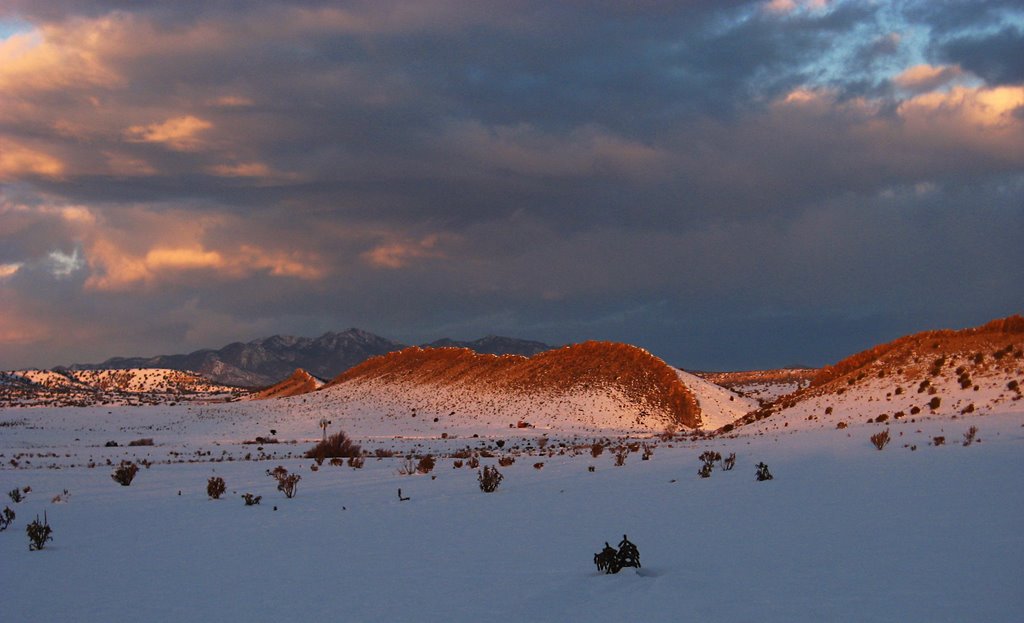
Some shots from last night in our local mountains, the southern end of the Sangre de Cristo range:


This is one of New Mexico's largest aspen groves, if not the largest. A number of people have pointed out articles such as this, about spreading malaise among the aspen groves of the west. No one knows quite what's going on, but drought and fire supression seem the most reasonable explanations to me. In any case, the southern and central Rockies remain full of spectacular groves, and the prospect of an aspen holocaust is not making me lose any sleep at night.


Thursday, February 15, 2007
Friday, February 09, 2007
Here, via Languagehat, is a wonderful series of four posts (1, 2, 3, 4) regarding the Ob-Ugrian languages, that is Mansi and Khanty. Some of the purely linguistic talk is dense even for me, who have studied a Finno-Ugrian language, but there remains much to be enjoyed: bear taboos, the Ob-Ugrian's lack of polite terms for body parts, river-related vocabulary ("Further, n?luw, meaning ‘in the direction of (down to) the river/downriver’ can also mean ‘towards the fire’, which is in the centre of the hut."), a chilling poem about the forced conversion of the Mansi, and a splendid folk story about a mouse, which concludes thus:
the mouse is offered food by children in the village, but refuses the perch because the bones will stick in his throat. At the third village he is offered roe broth, the favourite dish of his father and grandfather. The mouse eats and drinks so much his stomach bursts. The children sew it back up with a needle and some roots. The mouse gets in the boat and rows off. He meets a reindeer, and they play hide and seek in the forest. The reindeer accidentally swallows the mouse. The reindeer suggests that the mouse come out through his eyes, but his eyes are full of sleep. The mouse cannot come out through the reindeer’s mouth, because it is too sputum-y. And the reindeer’s ears are full of wax. So the mouse goes into the stomach, gets out his little knife, and cuts a hole in the reindeer’s belly. The reindeer dies, and the mouse strips the meat and fur, runs home and summons his wife and their daughters and sons. The mouse family collect the reindeer flesh and meat, and take it home, where they ate and lived well for a long time. And they all lived happily ever after.Happily ever after is rendered in Ugrian idiom as They are still alive, if they did not die. The end.
Some previous Finno-Ugrian posts: Finnish Kanteletar, Khanty Bear Feast Song.
Quote of the day:
More convincing would be an argument that religious ideas are somehow uniquely impervious to reason. Is this true? From the fact that I almost never change anyone's mind (and nor does any other pundit I can identify) on any contentious issue, I infer that almost all beliefs are impervious to reason, religious or not.
Tuesday, February 06, 2007
Lastly for tonight, here's by far the best online resource I've seen for Scots language: bilingual in Scots or English, with numerous sound files of speech and song, and extensive discussion of the several regional dialects of Scots. When you hear the singer in Old Blind Dogs pronouncing wh as f, know that it is characteristic of "the Doric o Scotland's Nor-Aist".
New Mexico is once again shooting for the bottom of the national rankings with the worst designs for a state quarter you've ever seen. Pathetic. I'd rather have a North Dakota quarter! Surely a state with 400 years of recorded history, thousands of years of archaeology, 13,000-foot mountains, a wide selection of blasted wastelands and numerous races sharing an uneasy coexistance can come up with something vaguely interesting? Well, someone did. Here's my favorite of the proposed designs:

New Mexico, exporting useful products since 1945! It'll never be accepted, though; we'll be stuck with yet another wretched Zia symbol to remind us that a state governed by a presidential aspirant is not allowed to be interesting.
Remarkably, the comment thread to the New Mexican article has some pretty decent examples of New Mexican wit: "I was leaning towards it saying 'Land of Flea - Home of the Plague'" "I thought it was supposed to be two dimes and a nickle taped together."
Hat tip to Jack, who is generally too harried for blogging.
Sunday, February 04, 2007
Saturday, February 03, 2007
John Derbyshire has a word puzzle that's right up my alley: matching the names of western writers with their Pinyin transliteration. I shall take the liberty of reproducing it in full:
OK, here are 30 Western writers:I think I made a pretty respectable showing on my first attempt, getting over two-thirds in the initial five minutes. Of course, I was at work, and therefore not at liberty to keep trackof my results other than mentally.
(1) Camus. (2) D.H. Lawrence. (3) Bunyan. (4) Trollope. (5) Pushkin. (6) Edgar Allen Poe. (7) Donne. (8) Rousseau. (9) Yeats. (10) Cervantes. (11) George Bernard Shaw. (12) Wells. (13) Dante. (14) Chaucer. (15) Dostoyevsky. (16) Kipling. (17) Goethe. (18) Kafka. (19) Dos Passos. (20) James. (21) Fitzgerald. (22) Keats. (23) Aristophanes. (24) Gogol. (25) Hardy. (26) Charlotte Brontë. (27) Johnson. (28) Thackeray. (29) Flaubert. (30) Shelley.
Now here, in a different order, are the pinyin transcriptions of their Chinese names.
(a) Guogeli. (b) Xiaobona. (c) Alisituofen. (d) Saiwantisi. (e) Zhanmeisi. (f) Gede. (g) Danding. (h) Yuehansheng. (i) Puxijin. (j) Qiaosou. (k) Duosi-Pasuosi. (l) Jiamiao. (m) Tangen. (n) Tuosituoyefusiji. (o) Yezhi. (p) Fuloubai. (q) Feicijielade. (r) Xialuoti-Bolangte. (s) Jici. (t) Kafuka. (u) Sakelei. (v) Jibulin. (w) Ailun-Po. (x) Xuelai. (y) Teluoluopu. (z) Hadai. (aa) Lusuo. (bb) Banyang. (cc) Weiersi. (dd) Laolunsi.
Your task is to match off the second list with the first. You have five minutes to do this, starting… now.
Sunday, January 28, 2007
Schlangestag!
Today was, in the Orthodox church, the feast of St. Isaac the Syrian. St. Isaac is often best remembered for his description of the Merciful Heart:
What is a merciful heart? It is a heart on fire for the whole of creation, for humanity, for the birds, for the animals, for demons, and for all that exists... For this reason, such a person offers up tearful prayer continually even for irrational beasts, for the enemies of the truth, and for those who harm her or him, that they be protected and receive mercy. And in like manner such a person prays for the family of reptiles because of the great compassion that burns with without measure in a heart that is in the likeness of God.Emphasis mine. Yes, gentle readers, you are today exhorted to entertain tender thoughts even for the reptiles. In the German fashion, Schlangestag seems a good appelation for such a holiday. Do something generous for a reptile you know! Reptile may here be understood to include amphibians, cephalopods, echinoderms, crustaceans, xenarthrans and underappreciated taxa generally. If you're very charitable and qualified, you might even adopt a reptile.
"Scientists operating with the best of intentions, using the best tools at their disposal, have taught us to look at food in a way that has diminished our pleasure in eating it while doing little or nothing to improve our health."
A fine piece of writing by Michael Pollan (from the N.Y. Times, but available to us unregistered paeons as of this post) on "nutritionism", dietary fads, dubious science and the generally problematic nature of the way our culture approaches food. To summarize his advice:
1) Don’t eat anything your great-great-grandmother wouldn’t recognize as food.Seems like good advice to me. Personally, however, I'm holding out for a study that says seldom descending below 9,000 feet will impart Confucian sagacity together with stevedore virility. I may have to conduct my own experiments, though.2) Avoid even those food products that come bearing health claims.
3) Especially avoid food products containing ingredients that are a) unfamiliar, b) unpronounceable c) more than five in number — or that contain high-fructose corn syrup.
4) Get out of the supermarket whenever possible.
5) Pay more, eat less. [Much elaborated upon.]
6) Eat mostly plants, especially leaves.
7) Eat more like the French. Or the Japanese. Or the Italians. Or the Greeks.
8) Cook.
9) Eat like an omnivore.
One more fact of interest from the article: "The American Heart Association charges food makers for their endorsement." Think about that during your next CPR class.
Wednesday, January 24, 2007
Miscellanea
For anyone skilled at sewing, there exists a pattern for a stuffed kiwa hirsuta toy, better known as the Yeti Crab.
For anyone with a serious interest in photography, here is probably the best photography blog I've run across, by a gentleman in Alberta. He discusses the whole nine yards: technical matters, composition, inspiration, practicalities, selling work. Makes me want to shoot more.
For anyone interested in Iranian mountaineering, here's a good trip report describing what it's like. Interestingly, the author's guide was an Iranian Jew who left and later returned because he missed Iran's mountains (which if you don't already know, are bigger than anything in the lower 48). Of course, anyone interested in these things at all had better see Grass, the 1925 documentary by Merian C. Cooper (King Kong), following the migration of a tribe of 50,000 Bakhtiari nomads across flooding rivers and over a 12,000-foot pass. Detractors claimed he staged it all in the San Joaquin valley; I don't think so. God, I'd like to go to that country! Preferably without joining the Marine Corps.
Finally, here's a landscape looking west from the Sangre de Cristos during a brief break in storms last weekend. The mountains breaking through the clouds in the distance are the Jemez Range, and the cloud carpet looks to be at about 8,000 feet. This winter's been a thrill in new Mexico; should have bought snowshoes this fall!

Sunday, January 21, 2007
Byzantine Musical Notation...
is a serious contender for the title of Most Complicated Thing Ever. Don't believe me? Take a look. If you're intrigued, have a look at the 106 Rules for interpreting such music. We didn't get the adjective byzantine from nowhere! You know you're in for a ride when Rule #2 begins "Exceptions to rule #1: a) A petastē is used instead of a psēfistón if..."
Friday, January 19, 2007
R.I.P Brad Washburn, mountaineer, cartographer, genuine explorer. Dr. Hypercube beat me to it, and said most of what I would want to say. For my thoughts on the passing of the last generation of true explorers (pace Deep Sea News, who do indeed explore some truly wonderful places), please revisit last years post commemorating the death of Heinrich Harrer.
And while we're on the subject, please raise a glass to my father, who fell in the Tetons 16 years ago today. Some day a post on him will come, but not until I can scan the photo of him collecting a bounty on rats from the Chi-Coms.
Tuesday, January 16, 2007
Late, late, late. If I had a large gold pocketwatch, I would be nervously checking it right now. I meant to link to and comment on Darren Naish's post on dinosauroids at, y'know, a reasonably short remove from its posting. Apparently time will not form my inner intuition appropriately for that. It is, of course, worth reading for its own lights.
If I had my books I would quote a relevant passage. If I had my books. Indeed, I'm only getting to post this now because of the lovely weather out here, so I suppose I should count my blessings.
No, post-Cretaceous maniraptorans wouldn’t end up looking like scaly tridactyl plantigrade humanoids with erect tailless bodies. They would be decked out with feathers and brightly coloured skin ornaments; have nice normal horizontal bodies and digitigrade feet; long, hard, powerful jaws; stride around on the savannah kicking the shit out of little mammals; and in the evenings they would stand together in the trees, booming out a duet of du du du-du, a deep noise that would reverberate for miles around.All I wanted to add was a nod towards John McLoughlin's Toolmaker Koan, which is, as one might guess from the title, an attempt to figure out why an intelligent species might blow the hell out of itself, and how to stop it (us). But the humans in it encounter a charming dinosauroid race, the wheelin, which are divided into racial castes. The caste our humans most encounter is a sort of diplomat/hunter type, whose group hunts are as intricately choreographed as any ballet, and correspond most closely, perhaps, to human poetry. They're appropriately shaped, they come off as realistically alien yet evolutionarily reasonable, mentally, and although certain portions of the books have been Overtaken by Events, I can recommend it without reservation.
If I had my books I would quote a relevant passage. If I had my books. Indeed, I'm only getting to post this now because of the lovely weather out here, so I suppose I should count my blessings.
An inordinate fondness for beetles. Spinning enzymes got me thinking about J. B. S. Haldane, the source of the title of this post. A long time back I had a dim recollection of a pleasant essay of his about the sizes of creatures; well, Internet, consider yourself temporarily redeemed, since you did produce it.
Let us take the most obvious of possible cases, and consider a giant man sixty feet high - about the height of Giant Pope and Giant Pagan in the illustrated Pilgrim's progress of my childhood. These monsters were not only ten times as high as Christian, but ten times as wide and ten times as thick, so that their total weight was a thousand times his, or about eighty to ninety tons. Unfortunately the cross sections of their bones were only a hundred times those of Christian, so that every square inch of giant bone had to support ten times the weight borne by a square inch of human bone. As the human thigh-bone breaks under about ten times the human weight, Pope and Pagan would have broken their thighs every time they took a step. This was doubtless why they were sitting down in the picture I remember. But it lessens ones respect for Christian and Jack the Giant Killer.Be so good as to ignore the "About the Author" bit at the end, would you? Who writes these things?
Monday, January 15, 2007
That's edutainment.
The RCSB PDB provides a variety of tools and resources for studying the structures of biological macromolecules and their relationships to sequence, function, and disease.I for one spent far too long spinning enzymes, on my employer's unwitting dollar.
The RCSB is a member of the wwPDB whose mission is to ensure that the PDB archive remains an international resource with uniform data.
This site offers tools for browsing, searching, and reporting that utilize the data resulting from ongoing efforts to create a more consistent and comprehensive archive.
Friday, January 12, 2007
Thursday, January 11, 2007
From Siris comes an Illustrated History of Chinese Siege Warfare, as well as the best summation of the Mohists I've come across: "advocating the value of universal benevolence and catapults." If I had my books I would be able to bring up a piece that were left out of the guide, the name of which escapes me at the moment, but which spat fire, lead, and poison (which always seemed like overkill (rimshot) to me) at the unfortunate target.
Monday, January 08, 2007
Speaking of, 'hem, art, those so inclined may enjoy this televised performance of John Cage's 4'33". We are treated to nothing less than the full orchestral arrangement, the BBC Symphony Orchestra at the Barbican; and if the credits are to be, er, credited, there is even a piano soloist. Gavin Bryars conducting. The piece of course has widely varying effects depending on the performance venue, and as the earnest and genial announcer points out, the possibility of experiencing the work at home opens up whole new realms of interpretation, a wonderful example of serendipitous synergy between technological progress and classical performance. My personal take is that the home venue enormously augments the humoresque character of the piece, an aspect of 4'33" that I had not heretofore appreciated in quite this fashion. This effect is, however, largely dependent upon the studio audience's general obliviousness (or affectation thereof) to precisely the aforementioned humoresque facet of the piece.
I hope I may one day experience a true dream performance of the work, which I believe might involve the non-orchestral participation of renowned critics-as-artists Tom Servo and Crow.
(Thanks to Languagehat.)
Saturday, January 06, 2007
Are any modern artists not complete bastards? The buffoonish chappy Italian/Dane in the link wants to dye the summit of Mont Blanc red to protest pollution in the Alps. If he really cares about the environmental issue, surely there are any number of productive activities he might pursue; these would likely not, however, generate the same publicity as a massive eyesore. I'm sorry, this is not Andy Goldsworthy, it is plain egotism. if you were wondering, the "artist's" curriculum vitae includes defacing an iceberg, and, oh yes, he's the complete bastard that put live goldfish in a blender and claimed it was art. Shouldn't a real artist be able to actually produce art, not just graffiti and damage? Why can't he just mock Mahomet like the good Danes? If French mountaineers attack him with piolets and crampons, is it art?
Wednesday, January 03, 2007
"When it comes to Chinese composers, I prefer Puccini."
Jay Nordlinger has a review of Tan Dun's new opera The First Emperor, currently at the Met with Domingo. John Derbyshire has related thoughts, and I too wonder why sinofascism is currently considered cool. All things considered, it sounds like one to miss, though it does sound a cut above Madame Mao.
Subscribe to:
Posts (Atom)